
Tableau Pricing: Is It Worth It In 2026? [Reviewed]
In this guide, I'll work through what each Tableau plan costs in 2026, what the license types actually do, and what a working deployment bills once you count the people who only read dashboards.
➡️ I'll close on a Tableau alternative, Dot, that bills for analysis performed and puts no ceiling on how many people can use it.
TL;DR
- Tableau prices on two axes at once: the edition you buy, and the license type held by each user, with capacity-based licensing on Cloud and compute-based licensing on Server offered as alternatives to per-seat.
- There's no free tier for team use, though Tableau Desktop Free Edition gives one person full authoring on local files with no publishing and no sharing.
- Cloud and Server both start at $15/user/month, Enterprise editions start at $35/user/month, and Tableau Next starts at $40/user/month, all billed annually, while Cloud+, Server+, and the Tableau+ Bundle are quoted by sales.
- Dot offers the best alternative to Tableau, since it performs the analysis itself in Slack or Microsoft Teams, produces its own scheduled reports, and bills credits for that work with no per-user charge attached.
How Does Tableau Calculate Its Pricing?
Tableau runs a two-axis pricing model, and both axes move independently.
The first axis is your deployment and edition and the second is the license type you assign each person.
Taking each in turn:
- Deployment: Tableau Cloud is hosted by Salesforce, Tableau Server is hosted by you on-premises or in your own cloud, and Tableau Next is the agentic layer built on the Agentforce 360 Platform for Salesforce customers.
- Edition: Standard is the base, Enterprise adds Advanced Management and Data Management, and the premium tiers (Cloud+, Server+) add Tableau Agent coverage, Premier Success, and more sites.
- License type: Cloud and Server both use Creator, Explorer, and Viewer. Tableau Next uses Creator and Consumer.
- Purchasing model on Cloud: role-based licensing counts individual Creator, Explorer, and Viewer seats, while capacity-based licensing covers Creators and Explorers by seat and then opens read access through Capacity-based Viewer Blocks sized to your deployment. Capacity-based is offered on all three Cloud editions and priced by sales.
- Compute-based licensing (Server only): you buy the Creator licenses you need, then license processing power in 8-core units to cover Explorer and Viewer access. Priced by sales.
Two rules apply across every product line:
- Every deployment needs at least one Creator license.
- There is no monthly billing anywhere in the portfolio, since Tableau requires an annual contract billed annually.
Support tiers ride along with the edition you pick:
- Standard Success comes with every plan, Enterprise adds eLearning, and Cloud+, Server+, and the Tableau+ Bundle include Premier Success with 24/7 expedited support.
- Premier Success and Signature Success can also be bought as upgrades on any plan.
➡️ If I were sizing this, I'd count license types before shopping editions. The edition sets your rate multiplier, but the ratio of readers to authors is what decides the total.
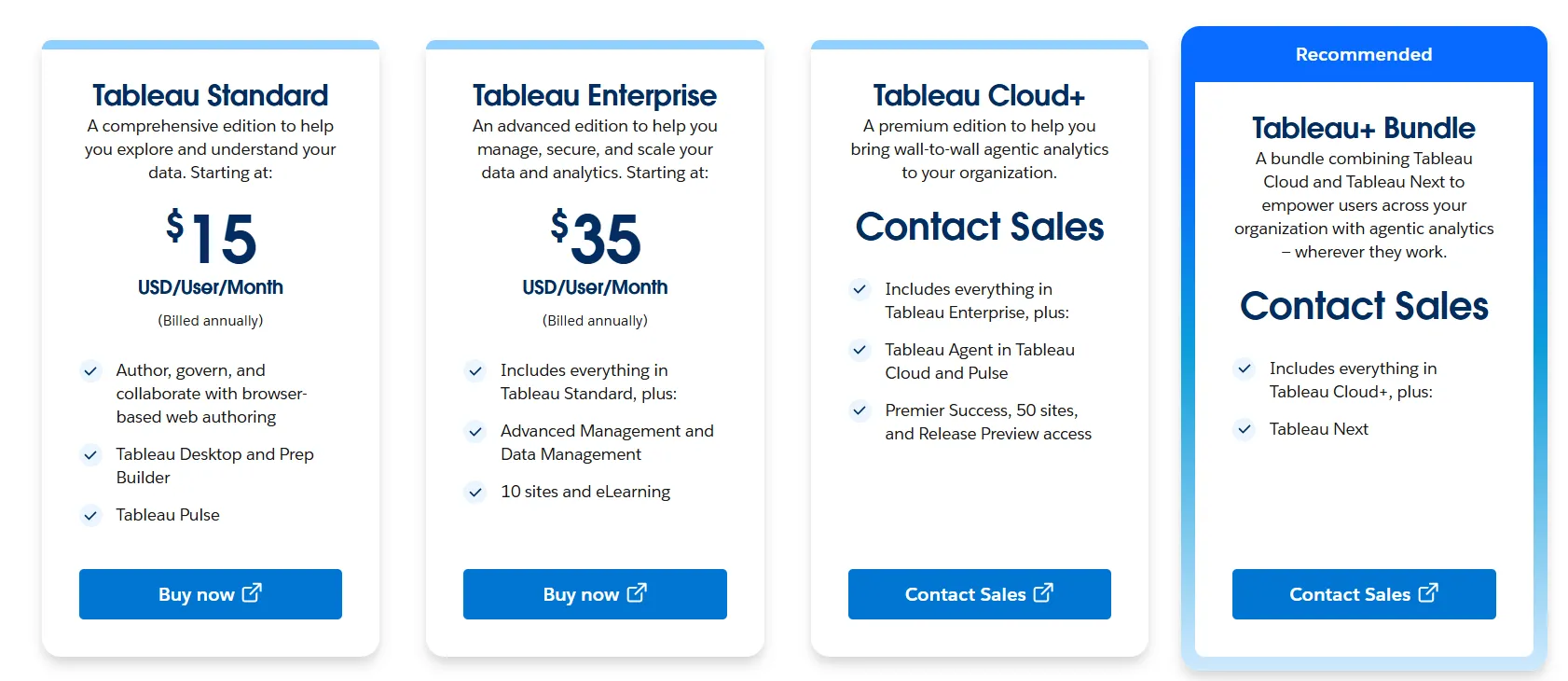
Source:Tableau's pricing page and product selector.
Does Tableau Have a Free Plan or Free Trial?
There's no free tier for team or shared use.
Tableau does give away two separate desktop products with no expiry date on either, and they solve opposite problems.
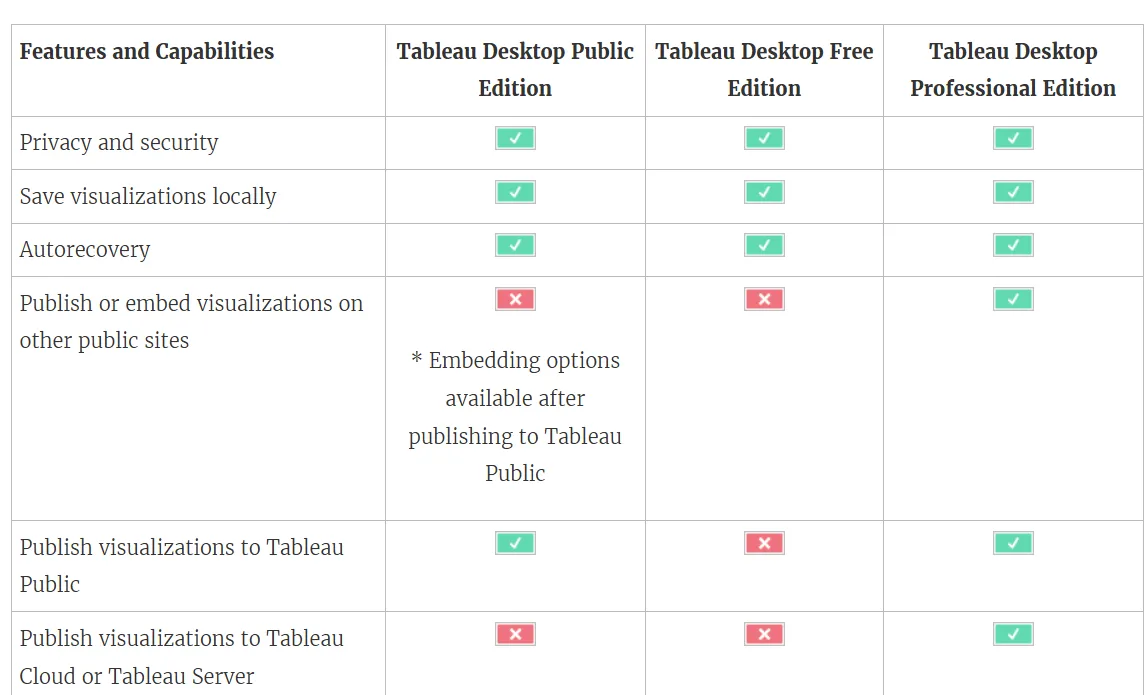
Tableau Desktop Public Edition
Public Edition is built for learning Tableau and for telling stories with public data.
Its capabilities:
- Handles datasets up to 15 million rows.
- Publishes to Tableau Public, with 10GB of storage there and embedding available once your work is published.
- Connects to a fixed list of sources: text and statistical files, spatial files, PDFs, JSON, OData, Google Drive, and Excel from 2007 onward.
- Refreshes live data from Google Drive alone, automatically once every 24 hours.
⚠️ One restriction rules Public Edition out for most people reading a pricing guide: it isn't licensed for commercial use.
Tableau Desktop Free Edition
Free Edition is the one businesses are permitted to use, and it lifts the technical limits that constrain Public Edition.
Here’s what it unlocks:
- Removes the row cap, so data source size is unlimited.
- Refreshes live data with no source restriction.
- Connects to sources Tableau Public won't accept, which makes proprietary and internal data workable.
Sharing is the one thing it can't do. Free Edition can't publish to Tableau Public, can't publish to Tableau Cloud or Tableau Server, can't read published data sources from either, and can't hand a packaged workbook to a colleague.
Everything stays on local storage, with no cloud storage attached.
The two free routes divide cleanly:
- Public Edition shares your work publicly at limited scale, with commercial use prohibited.
- Free Edition handles commercial data at any scale and keeps it on one machine.
Either way, the second person who needs access is the moment you start paying.
Tableau's License Types And What They Cost
This table is the part of Tableau pricing worth memorizing, because the license mix drives almost all of the variance in a quote.
License | Standard | Enterprise | What the user can do |
Creator | $75/user/month | $115/user/month | Builds workbooks and data flows, curates and shares data sources, exports data, monitors flow performance, and uses Tableau Agent for AI-assisted preparation and visualization. On Cloud, Creators also define Pulse metrics and schedule Pulse digests. |
Explorer | $42/user/month | $70/user/month | Edits existing workbooks and visualizations, downloads full data, manages users and content, and uses Tableau Agent in web authoring to read and write calculations. Receives Pulse metrics and digests. |
Viewer | $15/user/month | $35/user/month | Views and interacts with published dashboards and Pulse metrics, downloads data, creates custom views, comments, and receives subscriptions and data-driven alerts. |
All rates are billed annually, and every figure above is published by Tableau in the FAQ on itsTableau Cloud pricing page.
Notice the step-up between columns. Moving from Standard to Enterprise costs about 1.53x on a Creator seat and 2.33x on a Viewer seat.
So the governance upgrade lands hardest on the people who only read.
💡 On Cloud, Viewers can be licensed individually or absorbed into Capacity-based Viewer Blocks, which is Tableau's own answer to the arithmetic above.
Tableau Cloud Pricing
Tableau Cloud comes in three editions, with a fourth option that bundles the top edition together with Tableau Next.
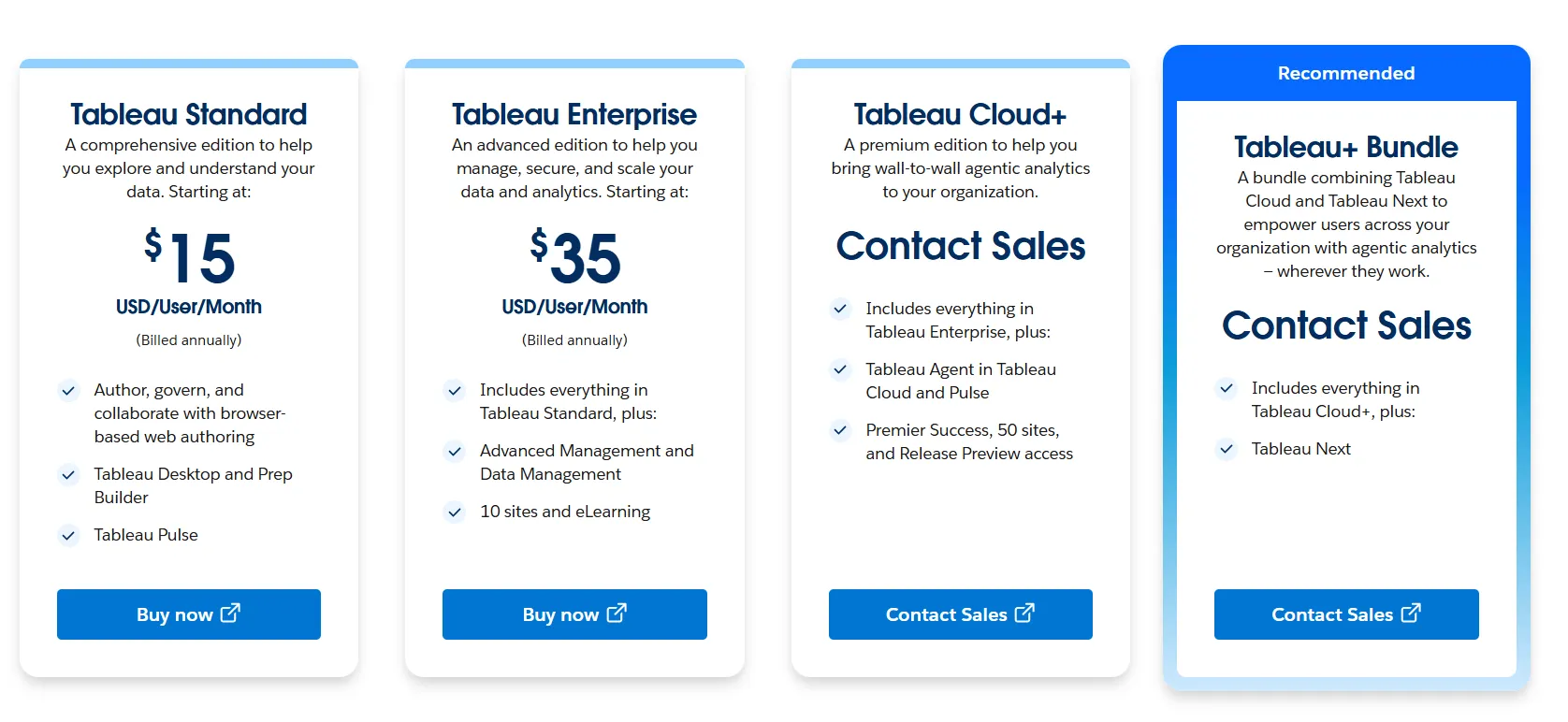
Tableau Standard
Standard starts at $15/user/month billed annually, which is the Viewer rate.
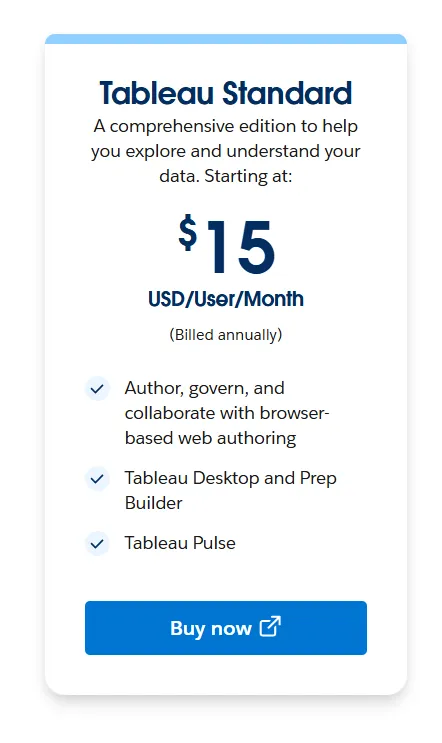
It covers browser-based web authoring with governance built in, plus Tableau Desktop, Prep Builder, Tableau Pulse, and Tableau MCP. Tableau Cloud Manager is capped at 3 sites.
This is the tier for a team that wants Tableau's authoring and dashboarding without the governance add-ons.
Tableau Enterprise
The Enterprise edition moves that entry rate to $35/user/month on annual billing, again measured at the Viewer license.
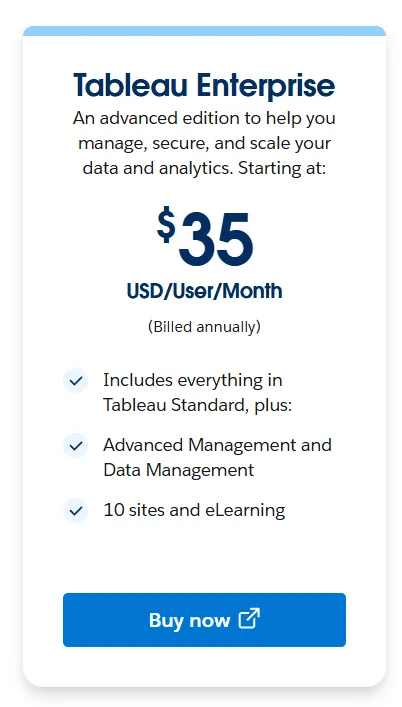
You keep the whole Standard feature set and gain Advanced Management and Data Management for governance at scale, 10 sites, and eLearning.
Most mid-sized and larger deployments land here, since the governance features tend to become procurement requirements once analytics spreads past a single team.
Tableau Cloud+
Cloud+ carries no published price, so it's a sales conversation.
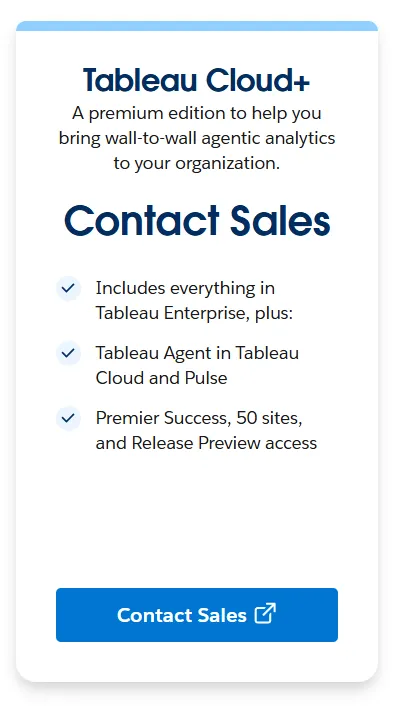
Everything in Enterprise carries over.
On top of that, Tableau Agent turns on across five surfaces: Prep, Authoring, Catalog, dashboards, and Tableau Pulse.
You also get Premier Success support, a 50-site ceiling, Release Preview sites, and access to Data 360 and Tableau Semantics through Salesforce Foundations.
At Cloud+, the agentic features stop being an authoring convenience and start reaching people who never build content.
Tableau+ Bundle
The Tableau+ Bundle is quoted the same way.
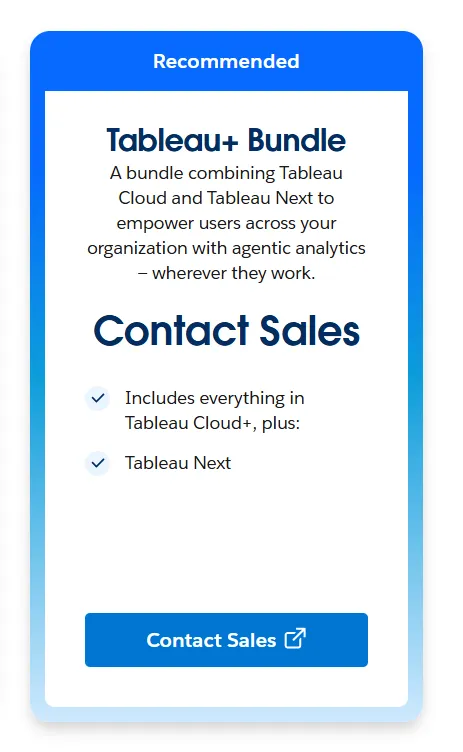
It combines everything in Cloud+ with the Tableau Next platform, Tableau Next in Slack, and Data 360, and it carries 250,000 credits.
Those credits are the one consumption-based element in Tableau's model, drawn on by select AI features working with the Audit Trail capability in Data 360.
Tableau Server Pricing
Server is the self-managed route, for organizations with data residency or compliance requirements they can't hand to a vendor.
The per-license rates match Cloud exactly on both editions, so the table above applies here without adjustment.
What changes is the infrastructure underneath, which Cloud absorbs and Server hands to you.
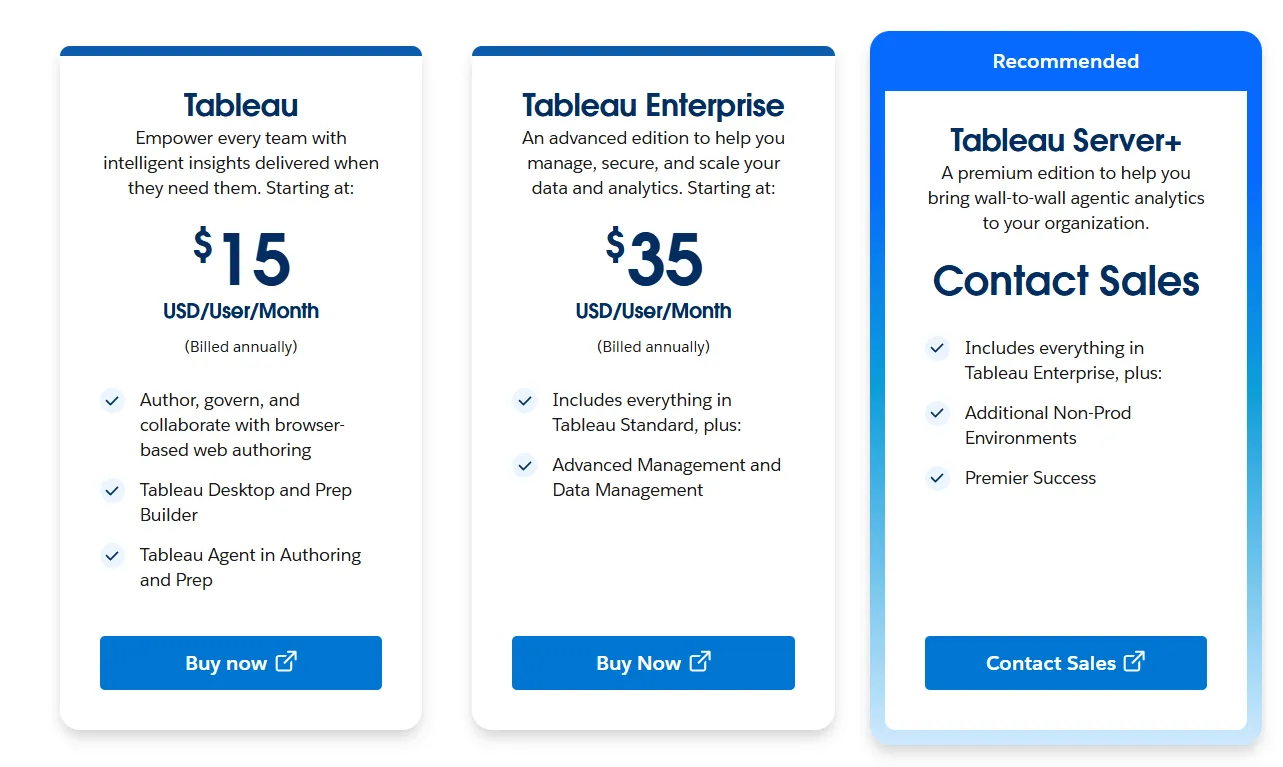
Tableau Standard
Server's base tier opens at $15/user/month, billed annually.
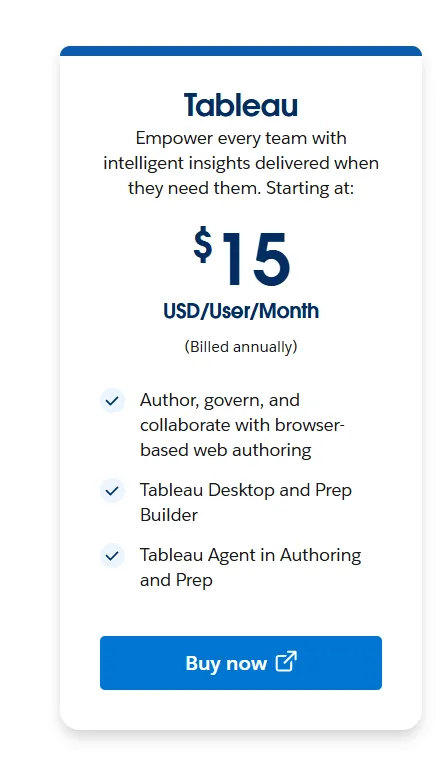
You get browser-based web authoring with governance, Tableau Desktop, Prep Builder, Tableau MCP, and up to 2 non-production environments.
Tableau Agent in Authoring and Prep is included at this tier, whereas Cloud reserves the equivalent for Cloud+.
⚠️ That parity comes with a condition. Tableau Server customers have to supply their own LLM to use any Tableau Agent capability, so the agentic features arrive as a model bill you pay separately.
Tableau Pulse doesn't appear in the Server editions at all, which is the clearest functional gap between the two deployments.
Tableau Enterprise
Enterprise on Server runs from $35/user/month annually.
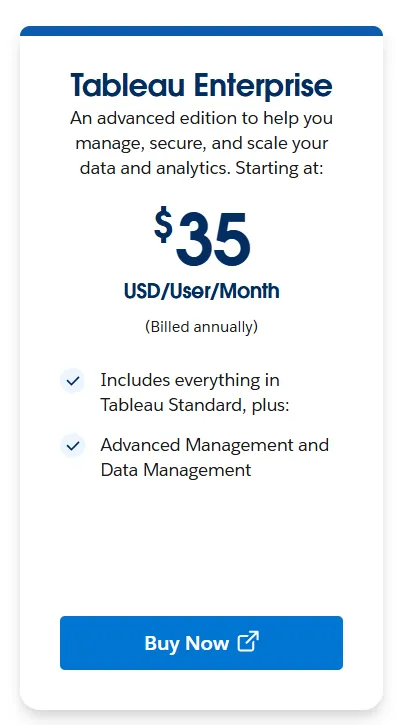
It adds Advanced Management and Data Management on top of the base tier, along with eLearning. The non-production allowance stays at 2.
Tableau Server+
Server+ needs a quote. It layers Premier Success for Tableau Server onto Enterprise and raises the non-production allowance from 2 environments to 6.
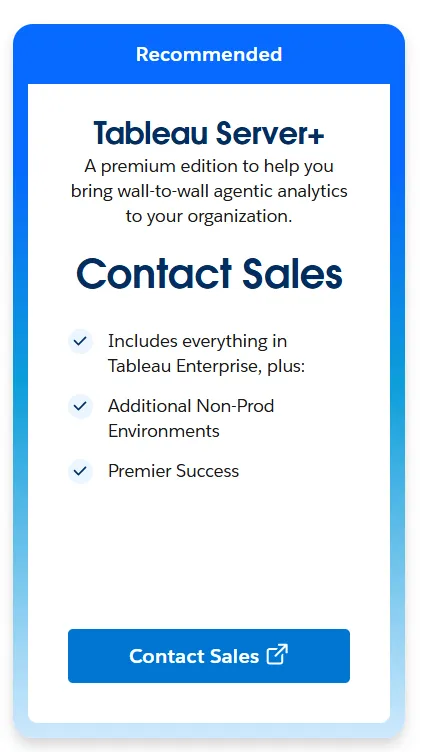
That allowance matters more than it sounds. Teams running staged deployments need somewhere to test upgrades, and on Server that capacity arrives through licensing.
Tableau Next Pricing
Tableau Next opens at $40/user/month on annual billing, and it's a separate product line, not another edition of Cloud or Server.
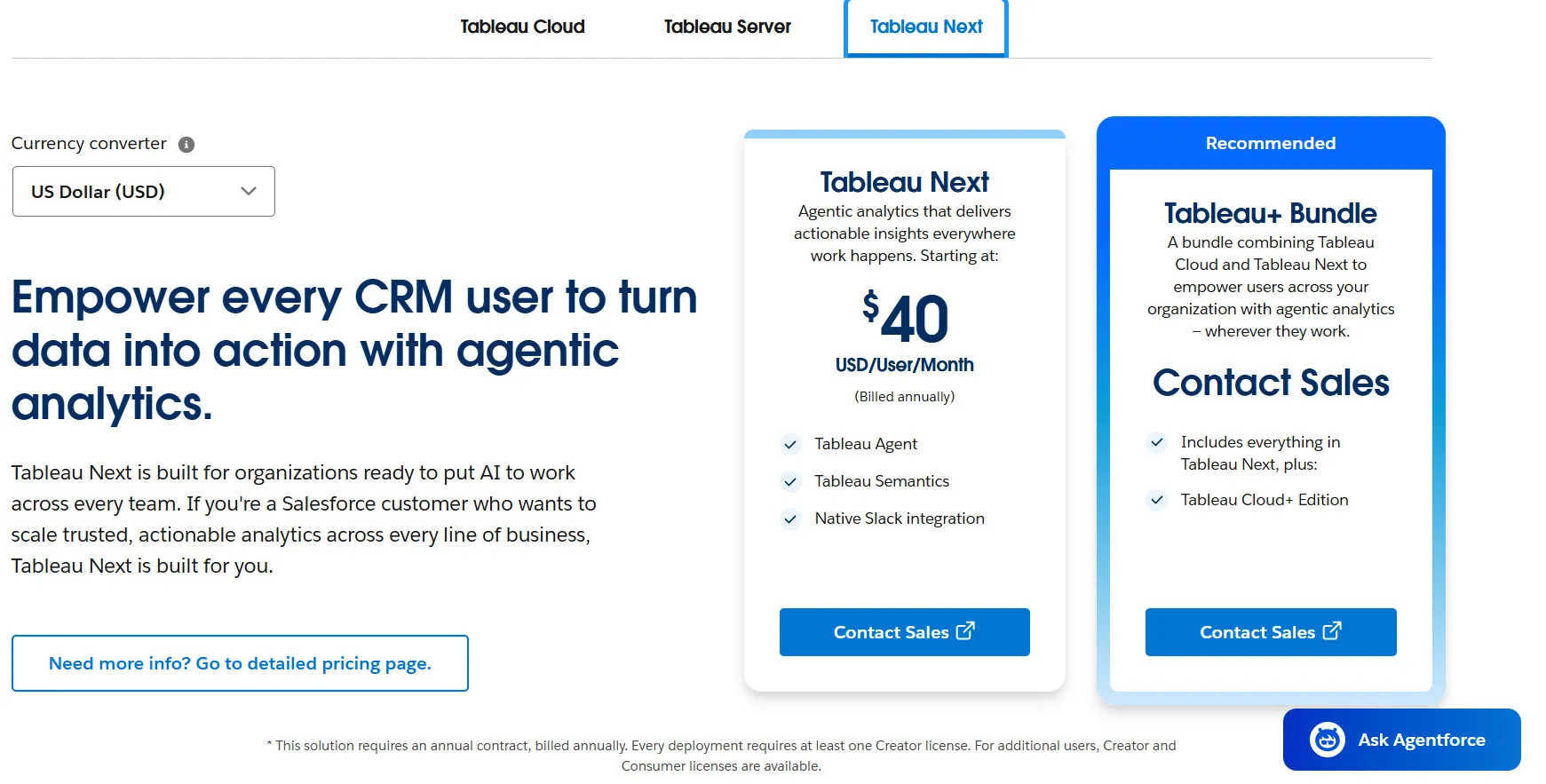
The entry tier includes Tableau Agent, Tableau Semantics, and native Slack integration. Licensing works through Creator and Consumer types, so the Explorer and Viewer structure doesn't apply here.
Above that, the Tableau+ Bundle pairs Next with the Cloud+ edition under a sales quote.
💡 Check what you already own before quoting this separately. Tableau Next licenses come bundled into several Salesforce editions, including Agentforce 1 and Agentforce for Sales, Service, and Industries.
Pricing is role-based, and Tableau notes that additional Data 360 costs can apply on top.
Next is built for Salesforce customers who want analytics reaching into Agentforce workflows.
What Would Tableau Cost Your Team?
Tableau's per-user rates look modest when read one at a time. The bill is set by how many people you're licensing and which edition you're on.
I've run four scenarios below at list price, annualized.
Small deployments on Cloud Standard:
- 2 Creators, 3 Explorers, and 10 Viewers: $5,112 a year, about $426 a month.
- 5 Creators, 10 Explorers, and 50 Viewers: $18,540 a year, about $1,545 a month.
Now hold that second deployment steady and move it to Enterprise for the governance features:
- The same 65 people on Enterprise: $36,300 a year, about $3,025 a month.
Identical headcount, roughly double the invoice. An extra $17,760 a year buys Advanced Management, Data Management, and eLearning, and the increase is driven mostly by the 50 Viewers repricing from $180 to $420 each.
Larger deployments on Enterprise:
- 20 Creators, 50 Explorers, and 300 Viewers: $195,600 a year, about $16,300 a month.
The pattern holds across every size I modeled. Readers are the line item that grows on its own, and they're the one Tableau reprices hardest when you upgrade:
- 50 Viewers: $9,000 a year on Standard, $21,000 on Enterprise.
- 100 Viewers: $18,000 a year on Standard, $42,000 on Enterprise.
- 200 Viewers: $36,000 a year on Standard, $84,000 on Enterprise.
⚠️ Note: these are list prices, so treat them as a ceiling to negotiate down from. Capacity-based Viewer Blocks on Cloud can also change the arithmetic for read-heavy deployments, though you'll need a quote to know by how much.
Looking For A Tableau Alternative?
Dot is shaped differently from Tableau.
It works as an AI data analyst connected to your warehouse, and it performs the analysis itself, so a business question put to it comes back as a written answer with reasoning and a recommendation attached.
Our conversational analytics software also turns out scheduled business reviews and maintains one agreed definition per metric, so two teams pulling the same figure land on the same answer.
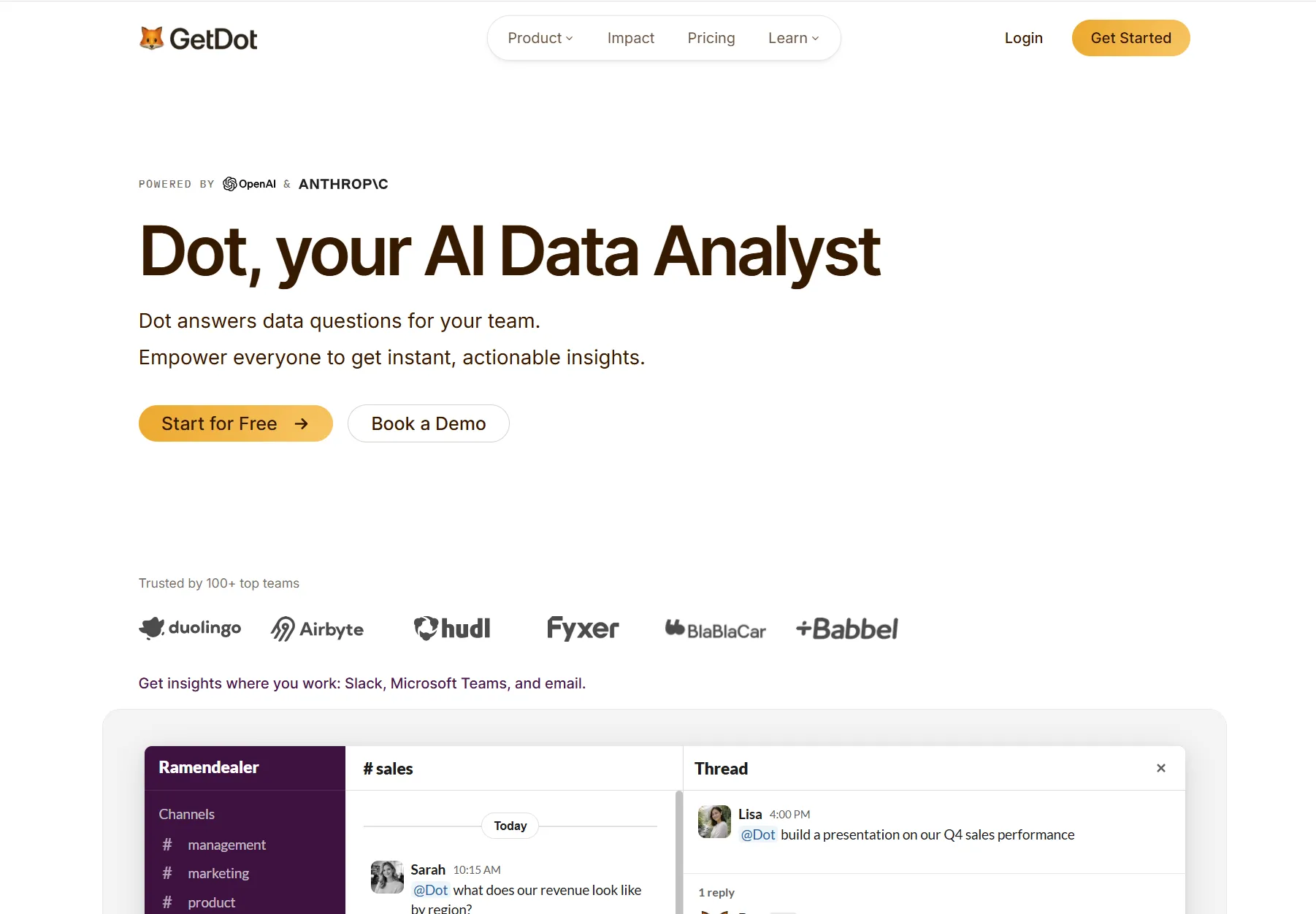
Dot builds dashboards too, generated from answers you've already got, not assembled panel by panel.
For a data team that values what Tableau produces but has no appetite for building dashboards all week and buying a seat for every reader, Dot is a serious option.
Here's what separates it: 👇
Deep analysis on demand, inside Slack or Microsoft Teams
Dot answers business questions asked in ordinary language, directly inside Slack or Microsoft Teams.
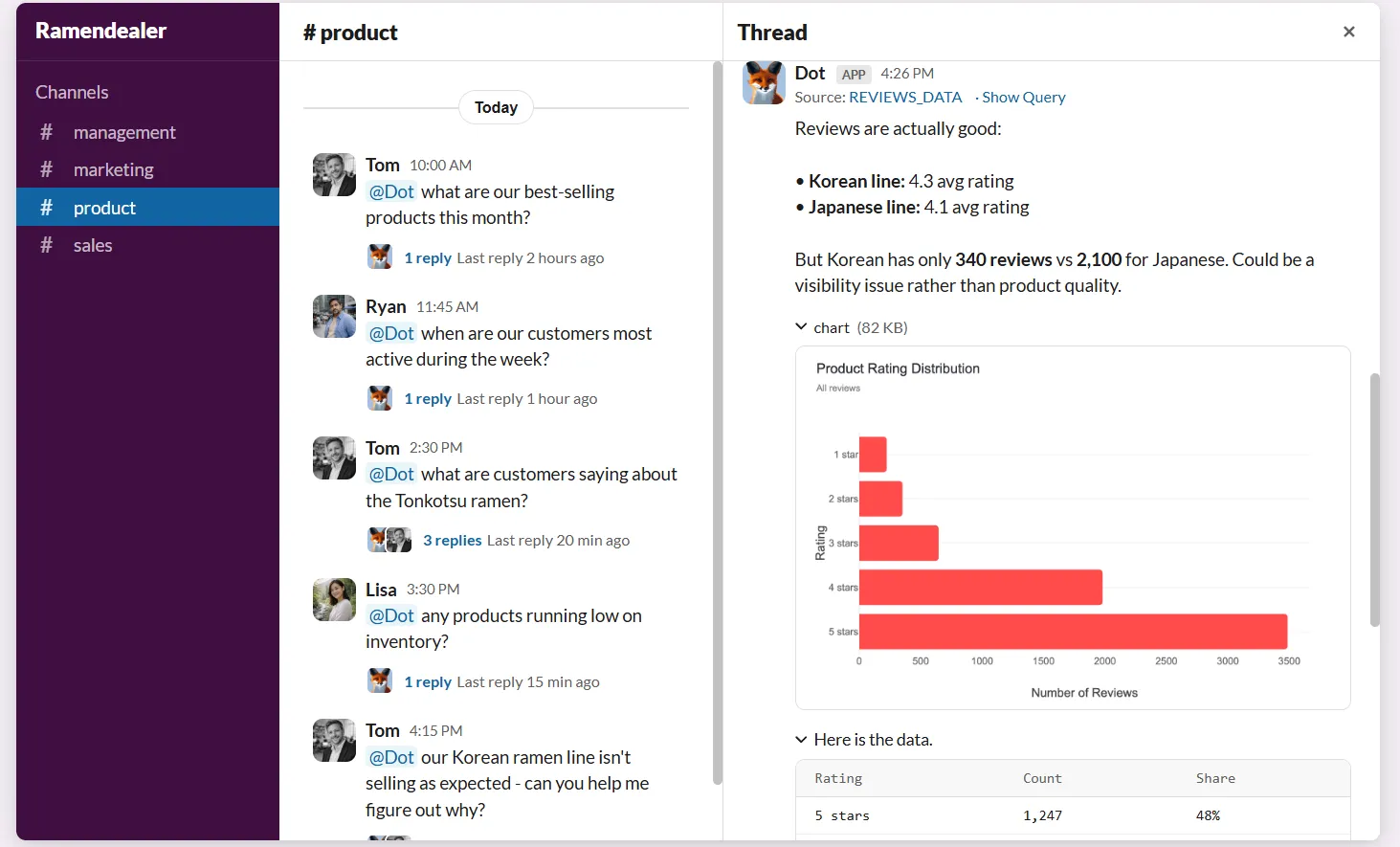
It queries the warehouse, performs the analysis, and returns the finished work. The answer identifies what moved, the most likely cause, and the segments carrying the change.
A RevOps lead who wants to know which pricing tier is behind this quarter's churn increase gets that resolved without opening a workbook or filing a ticket.
The licensing consequence is the part Tableau buyers tend to notice first: asking Dot a question doesn't require a seat, so the people consuming analysis aren't a per-head cost.
One definition for every metric
Dot's Context Agent holds your business definitions centrally and applies them to every answer it produces.
It holds the calculation logic, the source tables, the different words teams use for one concept, and the location of supporting documentation.
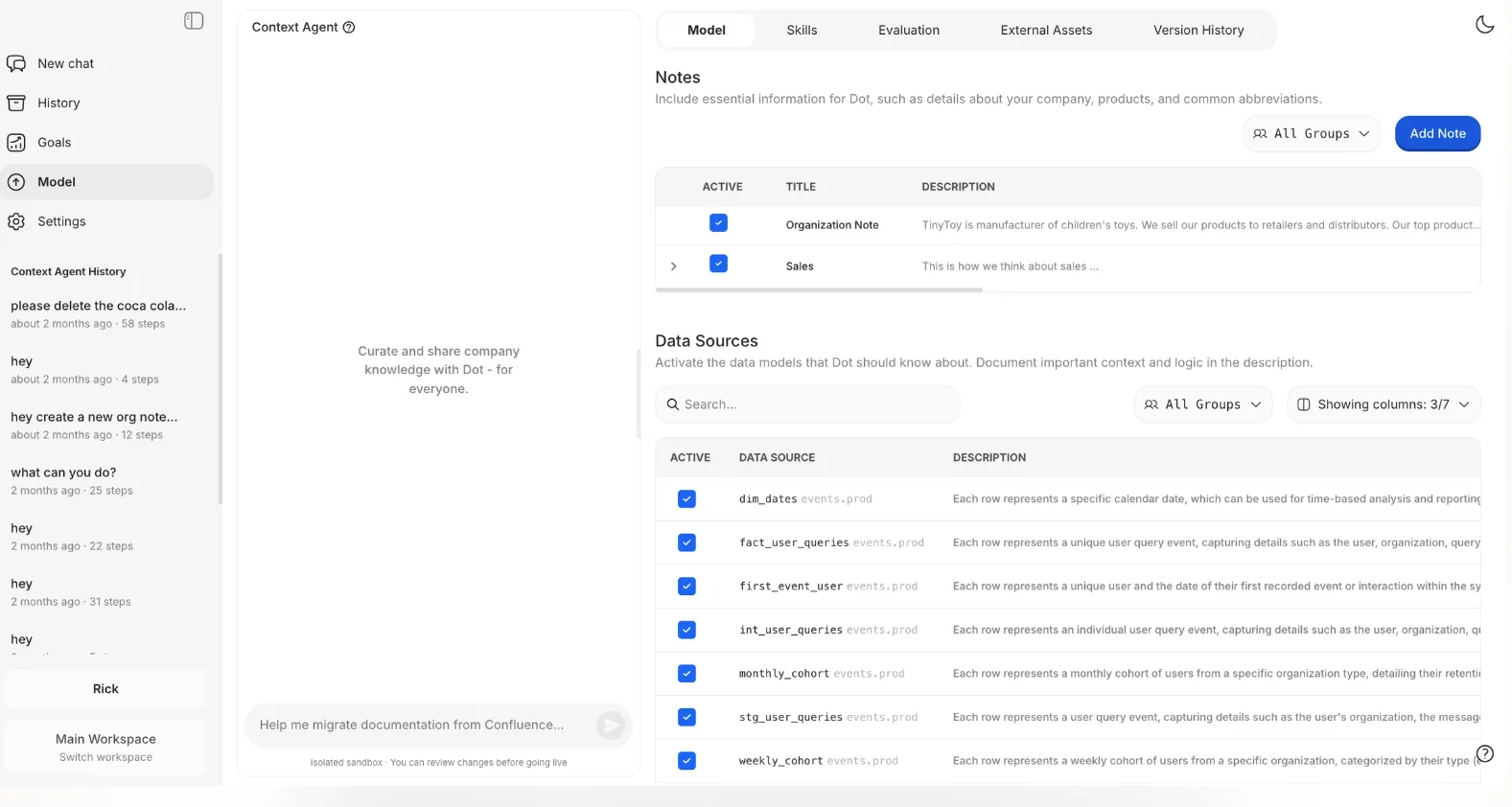
Large Tableau estates can accumulate competing definitions of the same metric across workbooks, and meetings can start going sideways over whose number is correct.
Dot removes that argument by grounding every response in one shared model.
The benefit compounds as you grow. New teams inherit the existing definitions on day one, with no dashboard archaeology required.
Scheduled business reviews, written for you
Dot writes recurring business reviews and delivers them on whatever cadence you set.
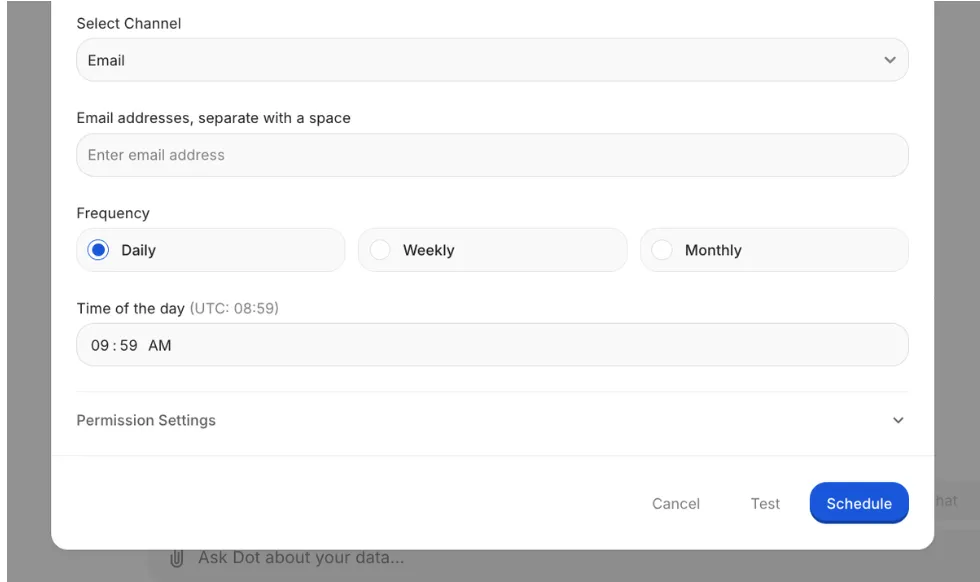
The output reads as written prose with no deck attached. It covers what happened in the period, how that compares with the one before, the reason behind the movement, and where someone should look more closely.
Leadership reads a finished analysis. Nobody spends the last two days of the month rebuilding the same deck.
Leaving Tableau without losing the numbers
Dot reads your Tableau estate closely enough to check its own work against it.
Connected through a Tableau Connected App, Dot pulls the values a dashboard tile actually renders, running under your own Tableau permissions.
An admin can then have Dot rebuild that dashboard on its own side, checking each tile against the original as it goes.
That matters for the part of a migration nobody budgets for. Switching tools usually means someone spends weeks proving the new numbers match the old ones, and a single unexplained discrepancy stalls the whole project.
How Is Dot's Pricing Different From Tableau's?
The unit of charge is the whole difference.
Tableau bills per seat, multiplied by whichever edition you're on, so your cost tracks headcount.
Credits do appear at the top of Tableau's range, where the Tableau+ Bundle includes 250,000 of them for select AI features, though seats remain the basis of the bill.
Dot bills per credit throughout, where a credit is consumed when Dot performs a piece of analysis, and every paid plan includes unlimited users.
That flips which growth curve you're exposed to.
Adding 200 readers to Tableau Enterprise costs $84,000 a year at list.
Adding 200 readers to Dot costs nothing, and your bill moves only if those people generate more analysis.
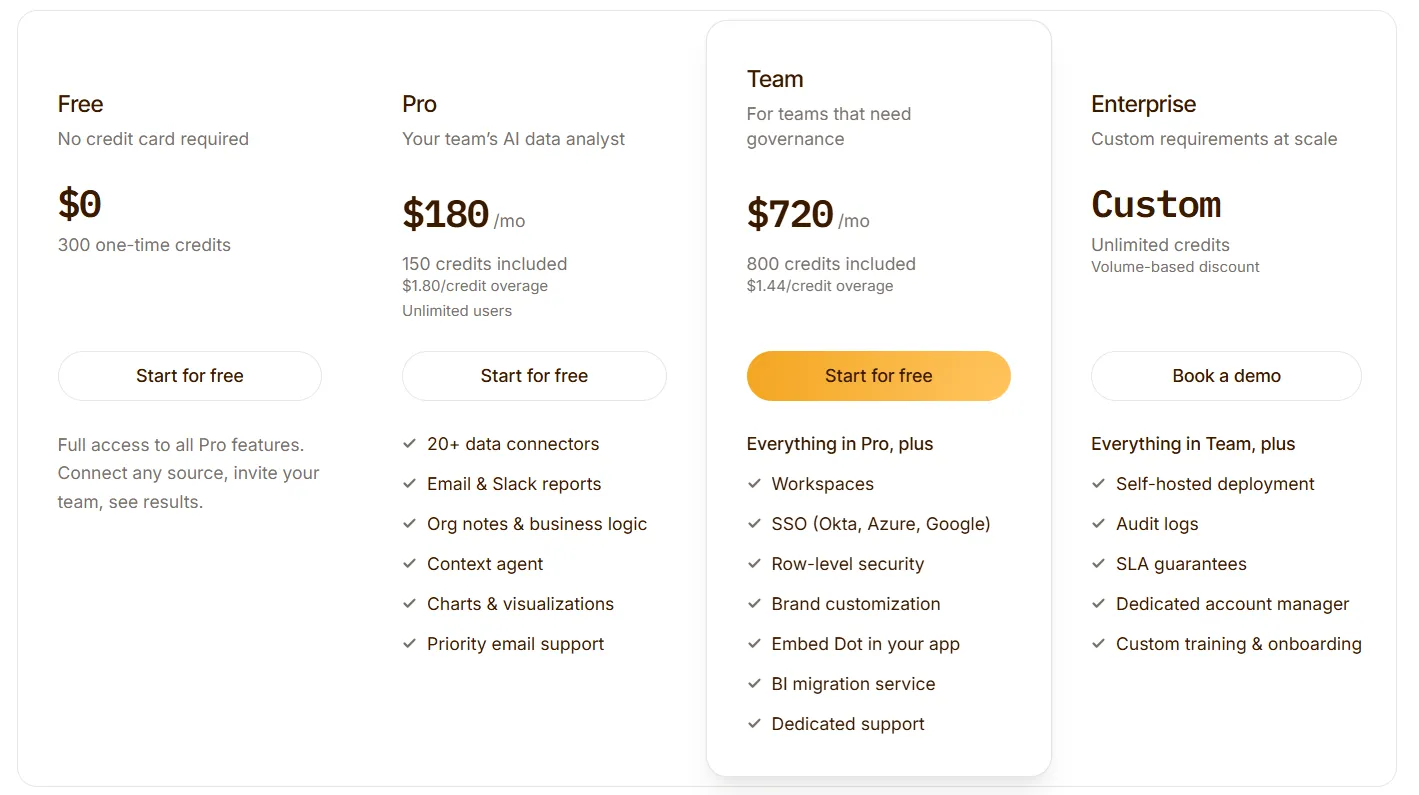
There's a free plan and three paid tiers:
- Free: $0, carrying 300 one-time credits and access to everything in Pro.
- Pro: $180 a month covering 150 credits, further credits at $1.80, and no cap on user count.
- Team: $720 a month covering 800 credits, further credits at $1.44, and admin controls spanning SSO, row-level security, embedding, BI migration help, and dedicated support.
- Enterprise: quoted directly, with credits uncapped, a volume discount, self-hosting, audit logs, an SLA, and a named account manager.
Annual billing saves 10% across the paid plans.
Two controls layer on top of that.
Energy Mode lets you pick how much horsepower a question gets, from an economy tier for routine lookups up to a frontier tier for the hard ones, with a balanced default in between. The choice holds for a thread, and admins can set the company default.
Weekly credit limits can run as a flat allowance, as a per-user cap, or as a pool a group shares, so one heavy team can't absorb the month.
Neither control has an equivalent on a per-seat contract, where the bill is fixed the day you sign.
Try Dot For Free
You arrived here to price Tableau out. If the per-seat maths on your reader count is looking heavy, evaluate Dot before you commit to another annual term.
Here’s what your team gets:
- Business questions resolved on demand through Slack, Microsoft Teams, email, or the web interface.
- Business reviews written from warehouse data on whatever cadence you set.
- A context layer that keeps metric definitions steady while your data estate expands.
- Query-level traceability behind everything Dot reports.
- Warehouse connections that reuse the dbt and semantic modelling you already maintain.
- No cap on user count under any paid plan, so readers never surface as a line item.
You can start on the free plan with 300 credits and the full Pro feature set, no credit card needed. Or, if you would rather see it against your own data first, book a demo with our team.
⚠️ Disclaimer: This article was last updated on the 5th of August, 2026, and if there's any misinterpretation of the information, please contact us, and we will fact-check it.
Theo Tortorici
Theo writes about AI-powered analytics, data tools, and the future of business intelligence at Dot.