
Introducing Deep Analysis: The Next Generation of AI-Powered Analytics Agents
We’re excited to introduce Deep Analysis, the latest version of our AI-powered analytics agent. At a high level, this new capability of Dot is designed to go beyond simple data retrieval and step into a new realm of AI-driven deep analysis.
In its previous iteration, our agent automated data retrieval — essentially, it could interpret a data consumer’s query, translate it into SQL aligned with the organization’s source of truth, execute the query, and return a chart. While this was a major step forward in automating data analysis, it still left much of the cognitive workload on the user to structure meaningful analytical investigations.
With this new feature, we’re introducing a powerful new capability: Deep Analysis AI Agents, designed to answer high-level, complex questions about business performance, making data-driven decision-making more intuitive and actionable than ever.
From Data Retrieval to Deep Analysis
The evolution from data retrieval to deep analysis marks a critical shift in how AI interacts with business data.
Phase 1: Data Retrieval (Establishing Trust)
Our initial focus was on trust and precision. Early on, when businesses experimented with AI-powered data analysis, excitement quickly met a roadblock — trust in the results. Traditional large language models could perform analysis, but they weren’t necessarily aligned with an organization’s source of truth.
For example, if you ask, “What is our revenue?” — the answer depends entirely on how your organization defines revenue. Is it gross or net revenue? Does it include discounts? How are refunds handled? The definition of key metrics varies across businesses, and an AI model generating responses without aligning with an organization’s internal logic would lead to misleading or incorrect conclusions.
To solve this, our first version of the agent:
✅ Ensured all data retrieval was based on precisely defined SQL queries
✅ Used governance practices to align results with internal data standards
✅ Provided transparent and auditable SQL outputs
However, while this approach allowed business users to access reliable data without writing SQL, it still required significant effort to formulate the right questions. Business stakeholders often ask vague questions, and refining them into structured queries required a deep understanding of the underlying data model.
This was a key limitation: Users needed to already know what they were looking for — which meant that AI was only solving part of the problem.
Phase 2: Deep Analysis (Automating Cognitive Work)
With this new feature, we’re introducing a new reasoning modality: Deep Analysis — which enables the agent to:
✅ Answer high-level strategic questions (e.g., “How has our sales team performed over the last six months?”)
✅ Break down the question into a structured analytical plan
✅ Automatically retrieve the relevant data points and compute insights
✅ Drill down into sub-metrics and find root causes of trends
✅ Generate recommendations based on the analysis
Now, instead of simply retrieving data, DOT 2.0 can think through the entire analytical process — just like a human analyst would.
Example: E-Commerce Sales & Product Performance Analysis
Let’s say an e-commerce business wants to assess its sales & product portfolio performance over the past 12 months.
❌ Old Approach (Data Retrieval AI agent Only)
- The user asks: “Which products are selling the most in the last 12 months?”
- DOT returns a chart of top-selling SKUs
- The user must then manually investigate factors influencing performance:
- Which categories are growing or declining?
- Are discounts impacting conversion rates?
🔹 See an example of DOT’s Data Retrieval reasoning modality:
👉 Example of Sales Performance Analysis using AI agent for Data Retrieval
✅ New Approach (Deep Analysis AI agent)
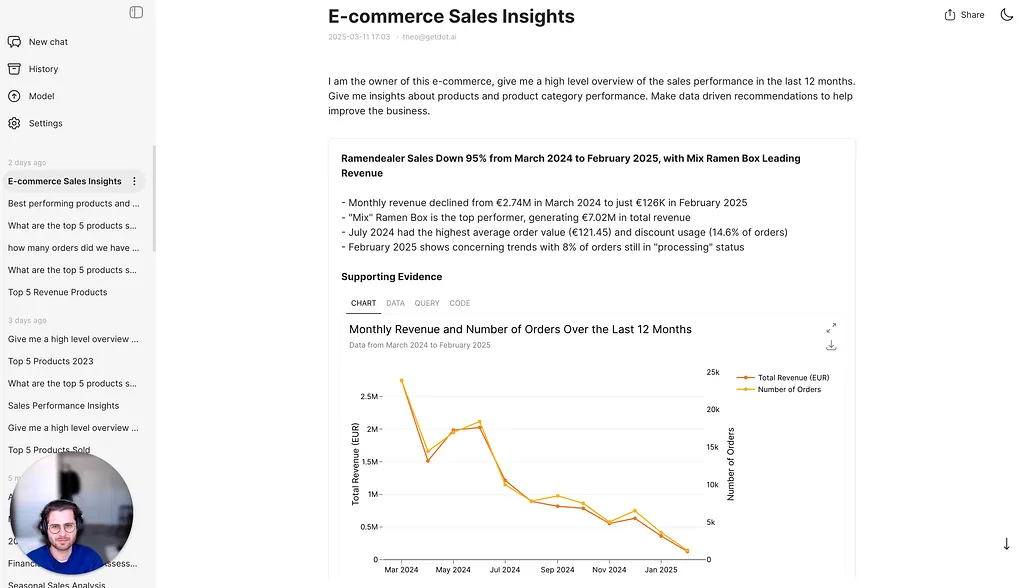
The user asks: “Give me an overview of the sales performance. Include product portfolio analysis and make data driven recommendations.”
1) Dot automatically structures the analysis, examining:
- Overall revenue, amount of order and AOV analysis
- Category-level revenue contribution
- Top-selling vs. underperforming products
- Customer segment-specific trends
- Impact discounts
2) Dot creates an executive summary of the main insights
3) Dot makes data driven recommendations
- If further investigation is needed, DOT proactively asks follow-up questions, ensuring a deeper understanding of what’s driving sales trends.
🔹 See an example of DOT’s Deep Analysis reasoning modality:
👉 Example of E-Commerce Sales Insights generated from Analysis AI agent
Why This Matters: AI That Thinks Like an Analyst
Deep Analysis bridges the gap between raw data and strategic decision-making. Instead of just pulling numbers, it can:
✅ Contextualize the data within an organization’s business objectives
✅ Automate complex multi-step analysis that would typically take hours
✅ Reduce cognitive workload for business users by surfacing only the most relevant insights
✅ Ensure trust by maintaining alignment with the company’s internal data logic and governance
By combining retrieval accuracy with deeper analytical reasoning, DOT moves AI-driven data and analytics closer to true autonomous decision support.
What’s Next?
This is just the beginning. As we continue improving DOT’s analytical capabilities, our goal is to fully automate high-level business analysis, making insights more accessible, proactive, and actionable for everyone — from data teams to executives.
With Deep Analysis, we’re moving beyond automated queries into the era of AI-powered data & analytics agents.
Related reading:
Ready to get Dot to analyze data for you? Onboard here!
Theo Tortorici
Theo writes about AI-powered analytics, data tools, and the future of business intelligence at Dot.