
Domo Pricing: Is It Worth It In 2026? [Reviewed]
Domo pricing runs on credits, and the pricing page is upfront about that much.
Unlimited users and no per-seat charge. No capability is held behind a paywall either, which is Domo's own description of the model.
What that page never prints is a dollar figure.
Two routes in are offered: a 30-day trial and a quote, and every dollar figure belongs to the second one.
Domo does publish what each action costs in credits, spread across the four consumption guides itspricing page links out to, so I worked through those to map the rate card, then gathered the contract values procurement platforms report and checked them against the model Domo sells today.
The figures in circulation are priced against a licensing scheme that no longer appears anywhere on Domo's pricing page, and I'll come back to what that does to a budget.
➡️ Later in this guide I'll cover a Domo alternative worth knowing about: Dot, an AI analyst that runs the investigation across your warehouse and reports back in Slack or Teams, with credit prices printed on the website.
TL;DR
- Everything at Domo runs off a pool of consumption credits sized to a contract term that Domo's own documentation puts at typically one to three years, replenished each billing cycle, with seats free and the drawdown coming from ingestion, transformation, storage, and AI work.
- No free tier exists, and the nearest equivalent is a 30-day trial with no credit card asked for, covering unlimited users, the whole platform, onboarding support, and a single training session.
- Credit rates are published, at one credit for each table ingested or refreshed and one for every million materialized rows stored each month, while the dollar value of a credit stays unpublished and falls as you commit to a larger pool or a longer term.
- Vendr records a $50,000 median annual contract across 91 purchases, with the observed range running from $10,920 up to $175,245.
- Teams that already load everything into a warehouse have a published-price alternative in Dot: our conversational analytics software prices every credit on its website, and it reads the warehouse where the data already sits without duplicating any of it.
How Does Domo Calculate Its Pricing?
Consumption has replaced license counting, and Domo is unambiguous about the change,describing the credit model as the replacement for what it charged before, per-seat licensing included.
You buy a pool of credits sized to your expected usage across the contract term, then spend from that pool as teams use the platform.
Seats cost nothing under this model, andDomo's documentation states that no products are held behind a paywall, which takes headcount off the table as the thing you negotiate.
The three credit categories
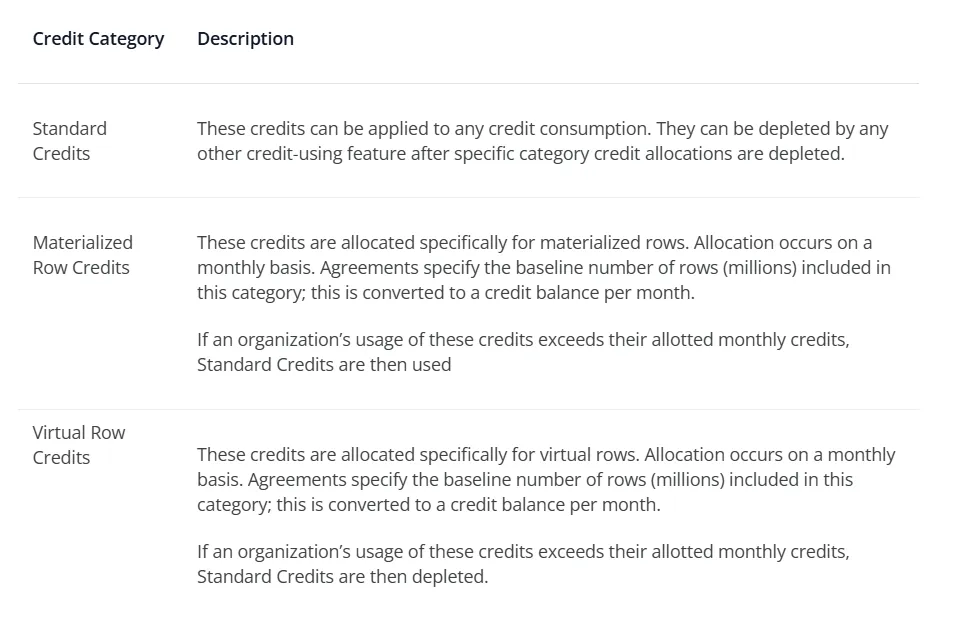
Domo's knowledge basesplits credits three ways, and the split matters because two of the categories refill on their own schedule.
Credit category | How it behaves |
Standard credits | Spendable against any consumption. Once a category-specific allocation is used up, the overage comes out of here. |
Materialized row credits | Allocated monthly for materialized rows. Your agreement names a baseline in millions of rows, which Domo converts into a monthly credit balance. Usage past that allocation draws on standard credits. |
Virtual row credits | The same monthly allocation mechanic applied to virtual rows, with overage again falling through to standard credits. |
What each action costs in credits
Domo divides consumption into four drivers and prints a credit rate against each one:
- Ingestion drawsone credit for every table a job creates or refreshes, with file size ignored, so a job pulling 100,000 rows costs what a job pulling 1,000 rows costs.
- Transformation drawsone credit per dataflow execution according to one Domo guide, andone to three credits per output table according to another, varying by execution type with Magic ETL and MySQL given as the examples. Custom Python scripts draw more on top, with the detail held in Domo'sConsumption Terms.
- Storagecosts nothing while your data stays in a warehouse Domo doesn't manage, naming Snowflake, BigQuery, and Databricks as examples. Under Domo-managed storage the rate is a credit for every million materialized rows each month, or every two million virtual rows.
- AI and workflow use draws fractional credits per interaction, with thebase Domo AI tier included in a contract and Domo AI Pro metered by consumption at rates that vary by model.
- External access draws3.2877 credits a day for each active end user account that needs its own instance, which is the figure to model before you promise partners their own environments.
The dollar value of a credit is the one number Domo withholds.
It also moves, and Domo says so directly:cost per credit drops as you commit to a larger pool or a longer term, which makes the credits-to-money conversion the part sales quotes you.
Consumption is visible in-product through theCredit Utilization interface, which carries a rate card alongside used credits, balance, and subscription detail, backed by a DomoStats credit usage report that refreshes daily.
Domo documents the tracking side separately undercredit monitoring.
Domo also publishes thescoping questionnaire its own team uses to size a pool, covering source counts, refresh frequency, transformation complexity, external access, and AI usage.
What doesn't draw credits?
- Cards, dashboards, and apps, at any volume.
- Headcount, since seats are free across the organization.
- Data held in a warehouse Domo doesn't manage.
- Query duration and server uptime, which Domocontrasts with compute-priced cloud platforms.
Where a Domo budget actually moves
Forecasting is the whole exercise, and a few mechanics matter more than any feature choice:
- Frequency is the meter up to a threshold, so one table refreshed every 15 minutes costs many times what the same table costs once a day. Volume re-enters above 25 million rows updated or written in a single day, where each further 25 million draws one credit. Billable executions per table per day are also capped, at 10 to 25 depending on how many tables a job touches.
- Storage is optional, and keeping your warehouse under your own management removes storage credits from the calculation.
- Materialized and virtual row allocations are granted monthly, and once the baseline is passed the overage pulls from standard credits, quietly draining the general pool.
- Credits arereplenished when a billing cycle begins, on the terms of your agreement, and the level can be raised at renewal or topped up mid-term.
- Jobs that fail are not billed, and Domo describesbuilt-in protections against runaway cost on high-frequency work.
- Some accounts still seemanual or legacy credit types in their reporting, left over from the move to generally available consumption pricing.
Whether unused credits carry over is worth pinning down in writing, since it isn't settled anywhere alongside the rates.
➡️ Note: usage-based billing and free seats describe a single Domo model, not two options to pick between.
Domo'scurrent pricing page shows no seat-priced plan at all, and Domo states that the credit modelreplaced its earlier per-seat pricing, so any cost estimate you find that prices Privileged, Participant, or Social licenses is describing an arrangement Domo no longer sells.
Legacy row and user contracts still run, so if you are renewing rather than buying, the old figures may describe your own paper and not the offer on the table.
Does Domo Have a Free Plan or Free Trial?
Domo has no free plan.
What it does offer is a30-day trial, and Domo asks for no credit card to start one.
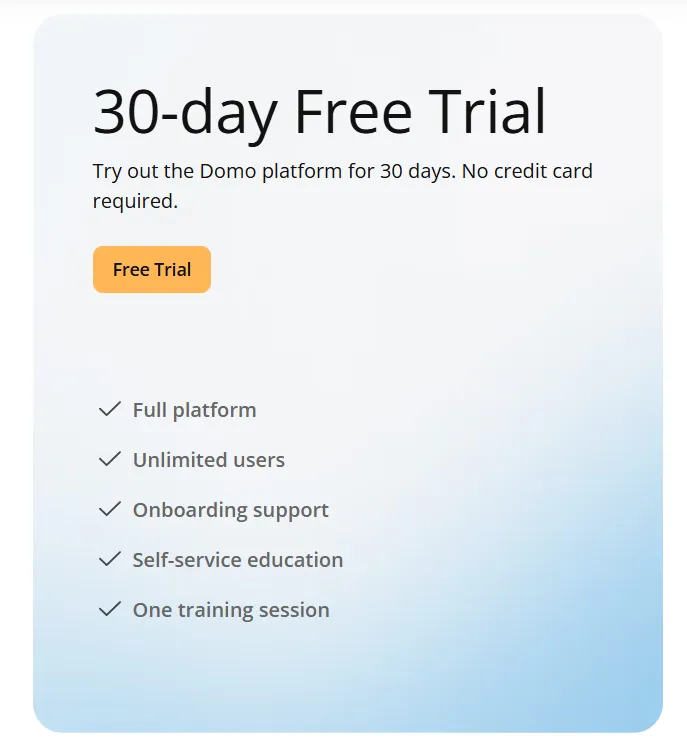
The trial covers:
- The full platform, with no capability withheld.
- Unlimited users.
- Onboarding support and self-service education.
- One training session.
After the 30 days, a quote is the only way forward, and Domo directs you to Contact Sales.
Domo's Plan Breakdowns
There is one paid arrangement, and Domo labels it Custom Pricing.
Custom Pricing
Domo quotes this tier directly, with no published price and no ladder of packages underneath it.
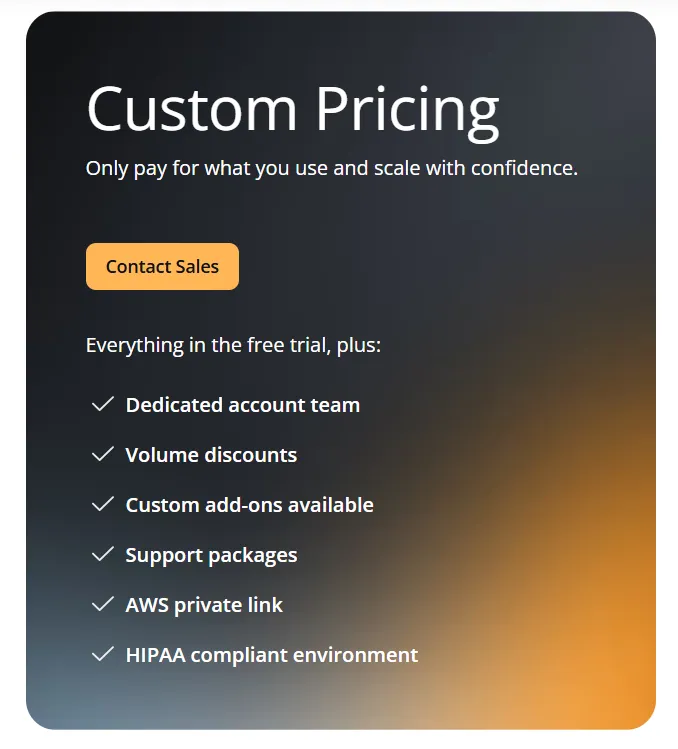
Everything in the trial carries over, and the commercial arrangement adds:
- A dedicated account team.
- Volume discounts.
- Custom add-ons.
- Support packages.
- AWS PrivateLink.
- A HIPAA-compliant environment.
Domo states thatcost per credit falls as the pool or the term grows, so two companies buying different volumes are not paying the same rate for the same credit.
What the credit pool covers
Domo folds thewhole platform into consumption, which is the part that makes side-by-side comparison with per-seat BI tools difficult.
Capability group | Included |
Data integration | Connectors, drag-and-drop ETL, Cloud Amplifier, sub-second queries |
BI and analytics | Low-code app builder, dashboards, embedded analytics, visualizations |
Domo AI | Custom AI agents, AI chat, model management, AI readiness |
Workflows and automation | Workflows, alerts, scheduled reports, AI agents |
Governance and security | UMCD, SSO, encryption, observability |
Nothing in that table carries a separate license fee, though the parts that move or process data draw credits whenever they run.
Domo AIsplits in two, with the base tier included in a contract and Domo AI Pro metered by consumption, so the AI row in that table is not uniformly free.
What Do Third-Party Sources Report Domo Costs?
⚠️ Disclaimer: not one figure below came from Domo.
These are procurement platform estimates and reported contract values, unverified by us, and none of it is a rate card.
Treat all of it as ballpark until your own quote says otherwise.
Vendr's Domo marketplace page reports a $50,000 median annual contract drawn from 91 recorded purchases.
Its recorded low is $10,920 against a high of $175,245, with average savings of roughly 13%.
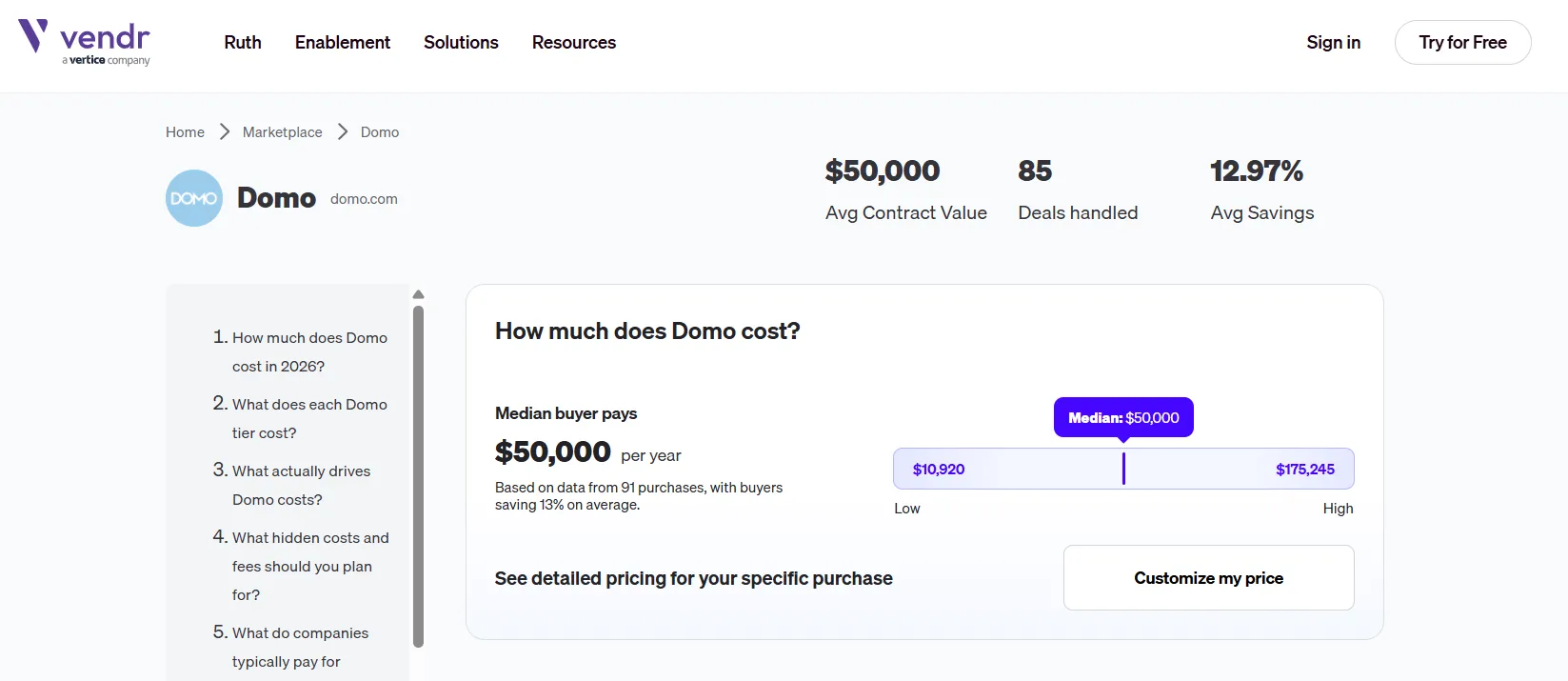
That median is the most defensible number in circulation, though I would treat the sample loosely.
Looking For A Domo Alternative?
Dot is the best Domo alternative in 2026 for organizations that already centralize data in a warehouse and want the analysis delivered as writing, in whichever channel the question came from.
Your warehouse stays the system of record, because Dot queries it in place and keeps no copy of your data.
Anyone on the team can ask in ordinary business language and read a written answer, with the query behind it a click away.
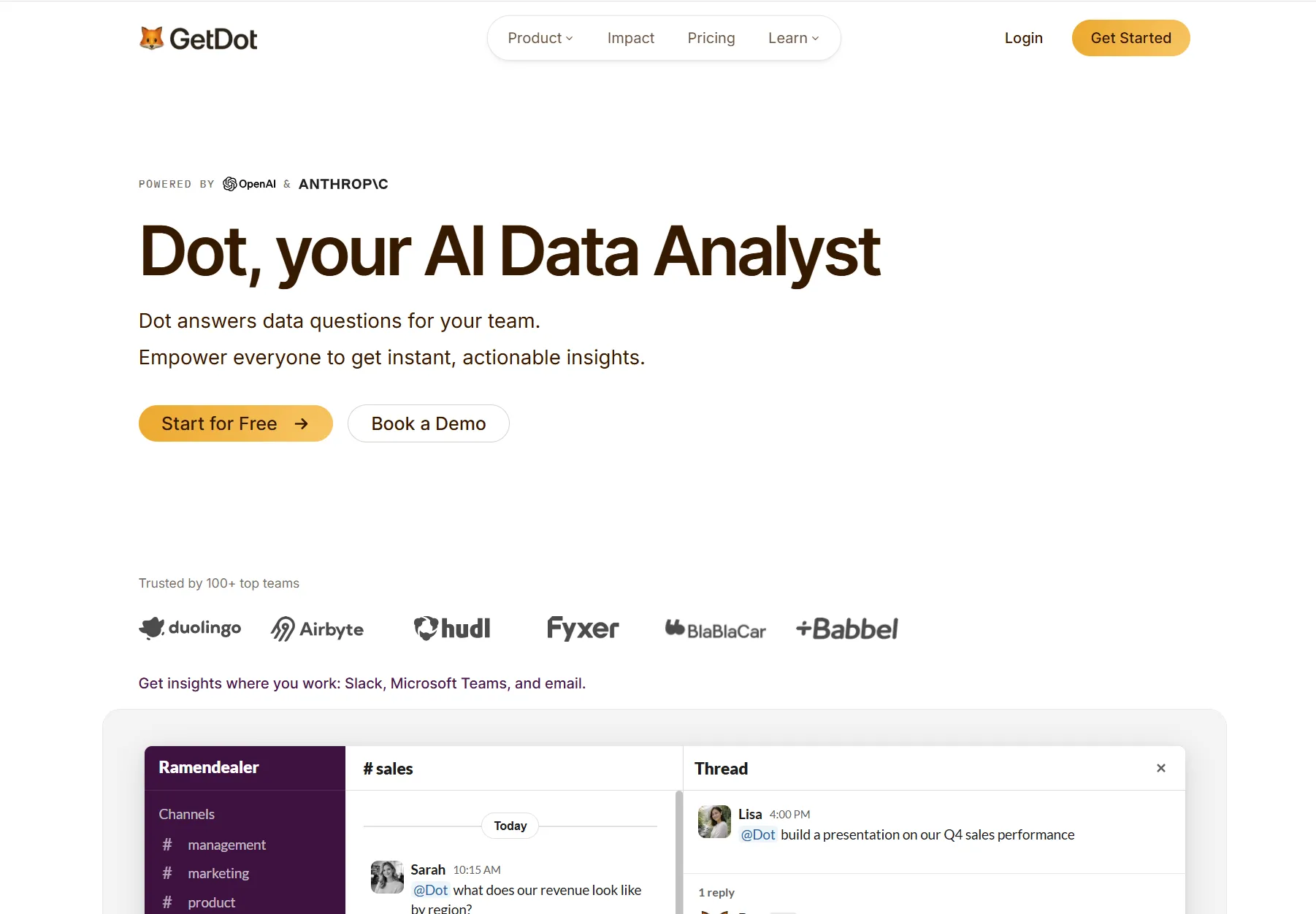
Four capabilities carry most of the load: 👇
Questions answered where they get asked
Dot's Chat takes a business question written in ordinary language and returns a written analysis with the supporting figures underneath it and a short read on what to do next.
Simple lookups return in seconds.
Questions needing genuine investigation run longer, and the answer quantifies the movement and names the segment behind it.
Delivery happens through Slack, Microsoft Teams, email, and a browser app, with the reply landing in whichever thread the question started in.
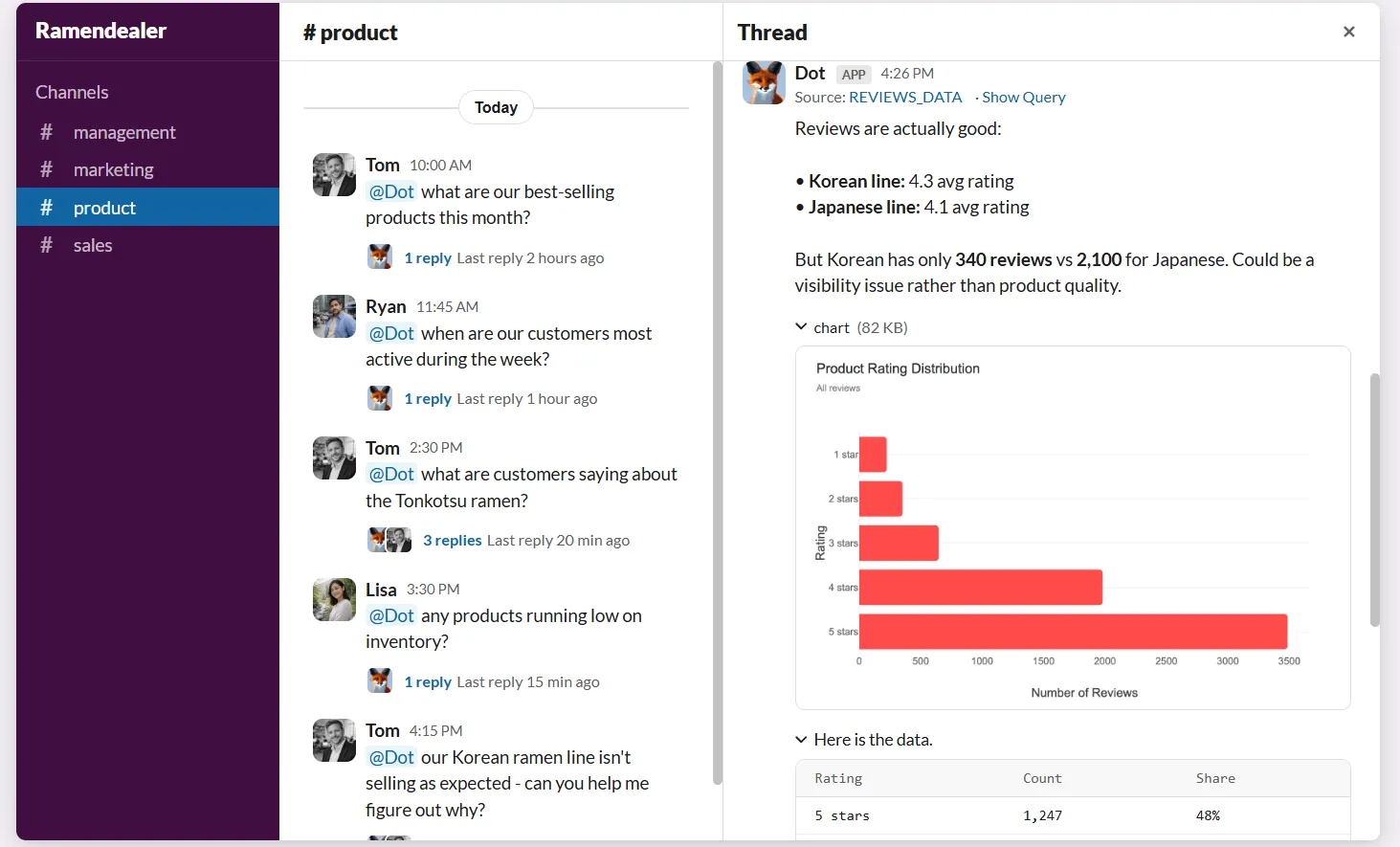
No dashboard is involved, so nobody has to build one first.
A finance lead who asks why margin slipped last month gets the answer in the channel, and the data team is spared rebuilding the same manual pull it built last cycle.
Recurring business reviews that arrive finished
Dot assembles recurring business reviews at an interval you choose, pulling current warehouse data and posting a leadership-ready write-up to Slack or email.
Each one carries the period-over-period movement alongside an explanation of what caused it.
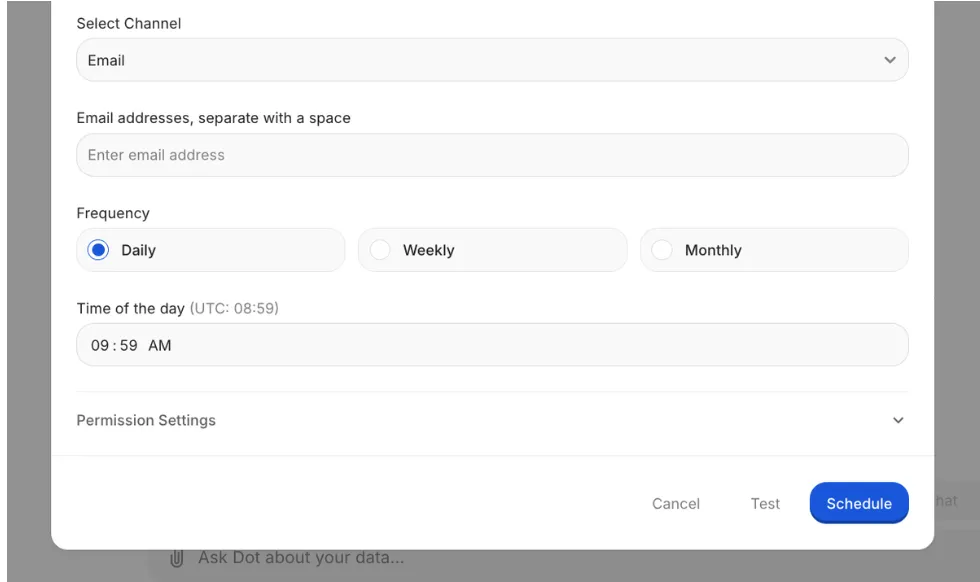
Building that review by hand usually means rerunning dashboards, reconciling totals, dropping charts into slides, and drafting the narrative around them.
Configure the schedule and the source once.
Delivery can be pinned to half an hour ahead of the meeting a review feeds.
A Context Agent that holds the definitions steady
Dot's Context Agent ingests your dbt models, then whatever catalog entries and documentation it can access, and keeps the DotML semantic layer current so every query has something governed to validate against.
As it works from the models your data team already version-controls, the definitions Dot enforces are the ones you have already agreed on.
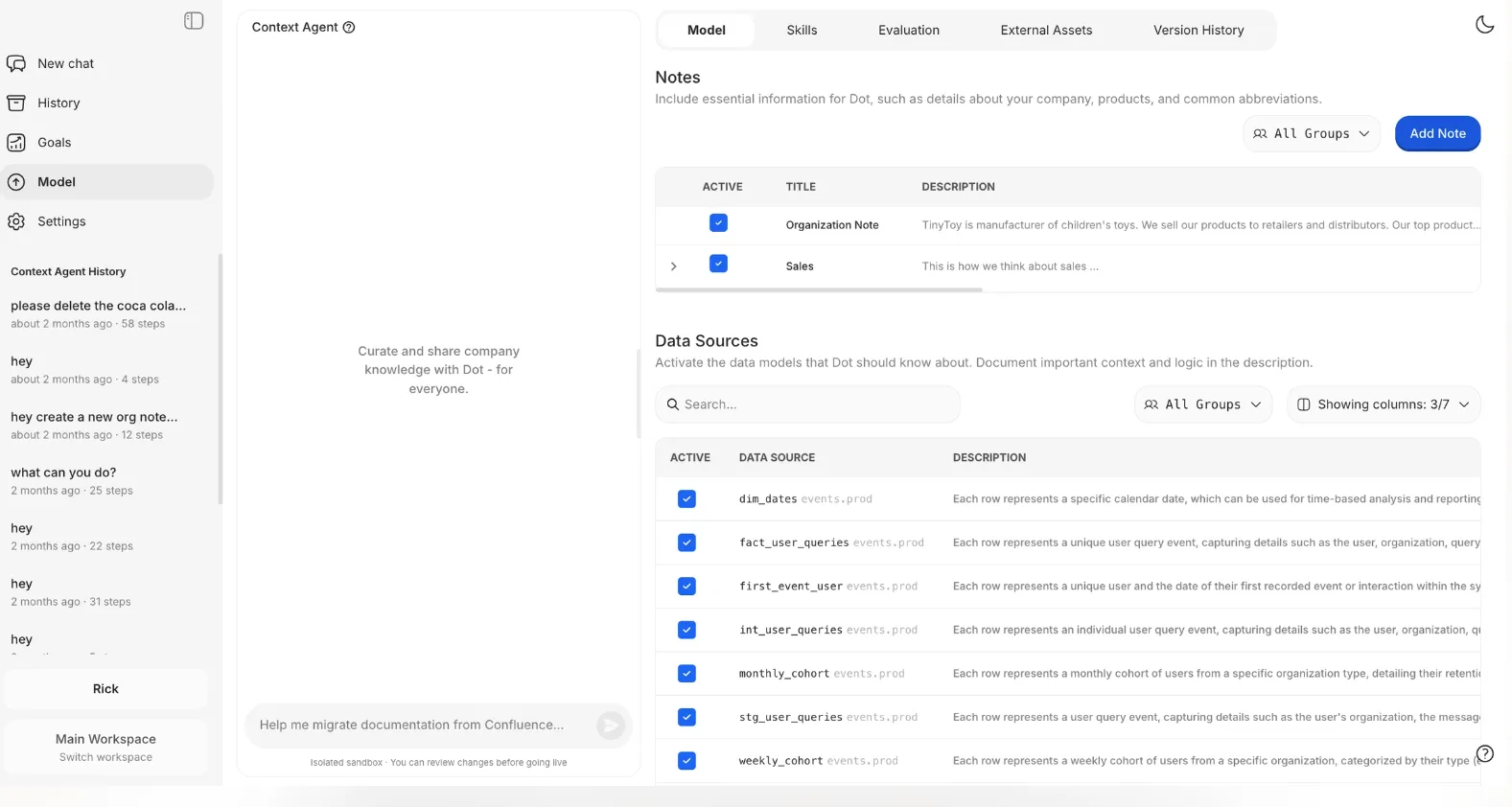
Finance and product can run the same question independently and receive one number, which spares everybody the argument over whose qualified-lead count is right.
When a definition moves, or an upstream table gains or loses a column, the agent proposes the edit inside a sandboxed branch and stops there.
Production only sees it once an admin has read the diff and approved it.
How Is Dot's Pricing Different From Domo's?
Both platforms meter usage in credits, so the meter is common ground.
Domo prints what each action costs in credits and leaves the price of a credit to sales, while Dot prints the price of a credit.
Dot publishes every figure, so the arithmetic is available before a sales conversation, and Pro bills monthly.
Domo's credits pay for pipeline work, so every ingestion job and every dataflow run draws the pool down whether or not anybody reads the result.
Dot's credits pay for analysis, and the warehouse you already run stays your storage.
- Free: costs nothing and carries a one-time grant of 300 credits, with the same features Pro users get.
- Pro: $180 a month with 150 credits included, extra credits at $1.80 apiece, and no ceiling on how many people log in.
- Team: $720 a month with 800 credits included and extras at $1.44, adding single sign-on, row-level security, embedded analytics, migration support off your incumbent BI tool, and a dedicated support contact.
- Enterprise: priced on request, with no credit ceiling, volume rates, a self-hosted option, audit logging, an SLA, and a named account manager.
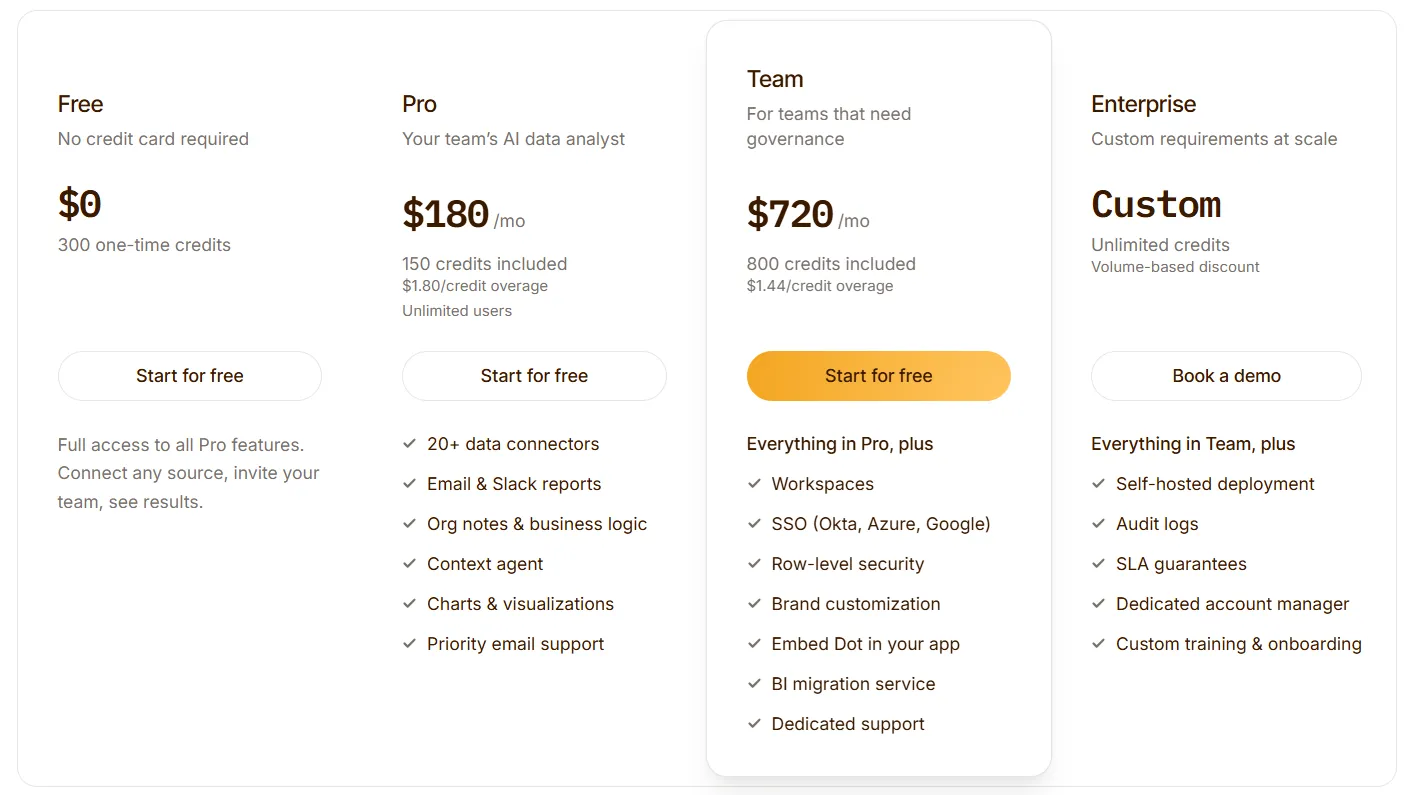
Annual billing takes 10% off.
What’s more, there are two controls layer on top of that:
- Energy Mode lets you pick how much horsepower a question gets, from an economy tier for routine lookups up to a frontier tier for the hard ones, with a balanced default in between.
The choice holds for a thread, and admins can set the company default.
- Weekly credit limits can run as a flat allowance, as a per-user cap, or as a pool a group shares, so one heavy team can't absorb the month.
Neither control has an equivalent on a per-seat contract, where the bill is fixed the day you sign.
Try Dot For Free
You came here to work out what Domo would cost, and the honest answer is that you can count the credits yourself while only Domo can price them.
Waiting on a sales call before you can put a figure into a budget is a cost of its own, so Dot is worth a look before you commit to a term.
What you get on day one:
- An analyst reachable from Slack, Microsoft Teams, email, or a browser, however many colleagues you invite in.
- Multi-step investigations that identify what shifted a metric and recommend a response.
- Leadership write-ups composed from warehouse data at the interval you pick.
- A single agreed figure per metric, with the Context Agent proposing updates and an admin approving them.
- Full lineage under every answer, down to the SQL and the source tables.
- Direct connections into Snowflake, BigQuery, Databricks, and Redshift, plus the dbt models your team already runs.
- Credit prices you can read before booking a call.
You can start on the free plan with 300 credits and the full Pro feature set, no credit card needed. Or, if you would rather see it against your own data first, book a demo with our team.
⚠️ Disclaimer: This article was last updated on the 13th of August, 2026, and if there's any misinterpretation of the information, please contact us, and we will fact-check it.
Theo Tortorici
Theo writes about AI-powered analytics, data tools, and the future of business intelligence at Dot.