
Analytics LLM assistants + Semantic Layer = Easy data adoption
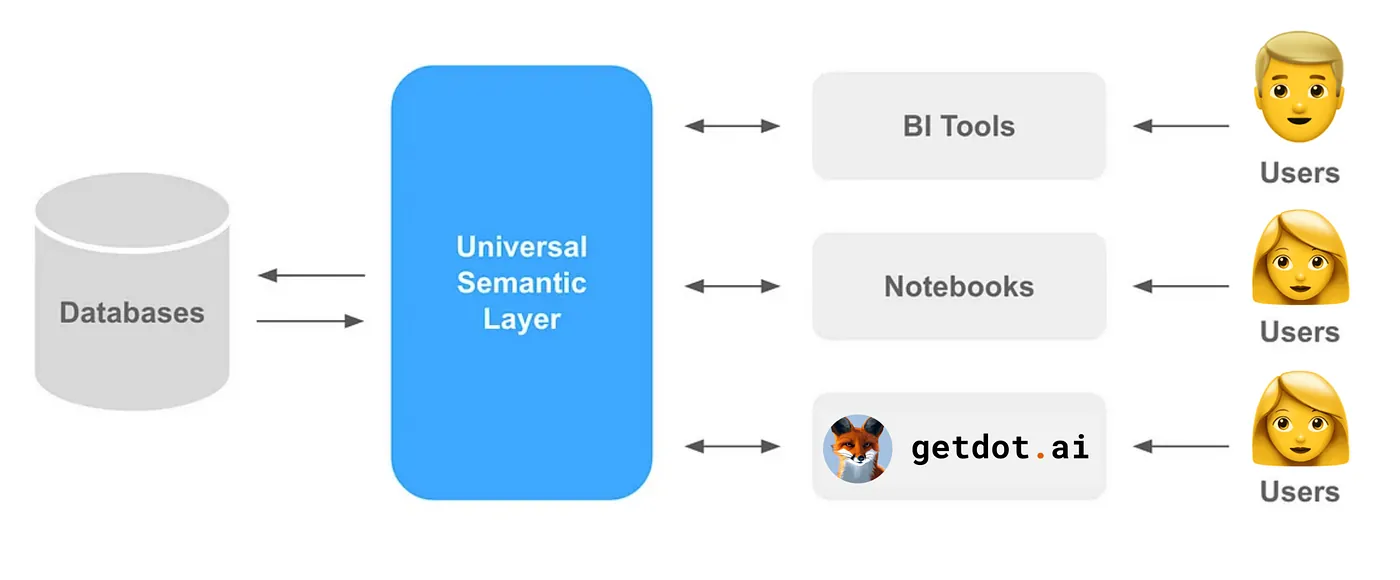
1. What is a Semantic Layer?
A semantic layer is an abstraction that sits atop raw data, providing a user-friendly interface to access and understand complex datasets. It translates intricate technical data structures into business-friendly terms, enabling users from various departments to interact with data without requiring deep technical expertise. This layer essentially bridges the gap between technical data storage and business-oriented data consumption.
At its core, a semantic layer defines and maintains consistent metrics and dimensions across an organization. It ensures that terms like "revenue," "customer count," or "profit margin" have a standardized definition and calculation method, regardless of who is querying the data. This consistency is crucial for accurate reporting and analysis, as it prevents discrepancies that arise from different interpretations of the same data.
The semantic layer typically includes a set of metadata that describes the data's structure, relationships, and meaning. This metadata can be used by various tools and platforms to generate reports, dashboards, and analytical insights. By abstracting the underlying data complexities, the semantic layer enables a more intuitive and seamless data interaction experience for users.
Example of Semantic Layers: dbt, LookML.
2. What Business Problems Does It Solve?
The semantic layer addresses several critical business problems, particularly for executives across different departments, and alleviates challenges faced by data teams:
Consistent Reporting: Executives often face discrepancies in reports due to different interpretations of key metrics. A semantic layer standardizes these metrics, ensuring that all reports are based on the same definitions and calculations. This leads to more reliable and consistent decision-making.
Reduced Dependency on Data Teams: Business leaders frequently rely on data teams to generate reports and insights, creating bottlenecks. The semantic layer empowers non-technical users to generate their own reports, reducing the burden on data teams and speeding up the decision-making process.
Enhanced Collaboration: Different departments often have varied definitions for similar metrics. The semantic layer promotes a unified understanding of data across the organization, enhancing collaboration and reducing conflicts arising from data discrepancies.
Improved Data Governance: Executives are increasingly concerned with data compliance and governance. The semantic layer enforces standardized data definitions and calculations, ensuring that data usage complies with governance policies and regulatory requirements.
3. What Technical Problems Does It Solve?
The semantic layer solves several technical problems that data teams encounter:
Data Complexity Management: Raw data is often complex and difficult to navigate. The semantic layer abstracts this complexity, providing a simplified and consistent view of the data, which is easier for non-technical users to understand and work with.
Data Consistency: Different systems and sources may store and interpret data differently. The semantic layer harmonizes these discrepancies, ensuring consistent data interpretation and reporting across the organization.
Centralized Logic: In the absence of a semantic layer, business logic is often duplicated across multiple reports and dashboards, leading to maintenance challenges and potential errors. The semantic layer centralizes this logic, ensuring that updates are made in one place and reflected everywhere.
Scalability: As organizations grow, so does the volume and complexity of their data. The semantic layer helps scale data operations by providing a structured and consistent way to access and interpret large datasets, reducing the risk of errors and inconsistencies.
Accessibility: Technical barriers often prevent non-technical users from accessing and analyzing data. The semantic layer provides an intuitive interface, enabling users to interact with data without needing specialized technical skills.
4. How does it facilitate data adoption coupled with AI Data Assistants?
Integrating a semantic layer with an AI data assistant offers significant advantages:
Instant Access to Consistent Metrics: An AI data assistant can leverage the semantic layer to instantly access standardized metrics and dimensions. This eliminates the need for the agent to generate complex business logic in SQL or other query languages, speeding up the analysis process and ensuring consistency.
Accurate Source of Truth: The semantic layer serves as a single source of truth for all metrics and dimensions. When an AI data assistant queries this layer, it ensures that the data used is accurate and consistent, reducing the risk of discrepancies and errors in the analysis.
Simplified Data Interaction: AI data assistants can navigate the semantic layer more efficiently than raw data sources. This simplified interaction allows the AI to generate insights and recommendations more quickly and accurately, enhancing its utility for business users.
Enhanced Documentation and Governance: The semantic layer often includes detailed metadata and documentation. An AI data assistant can utilize this information to better understand the data context, leading to more informed and relevant insights. Additionally, this documentation supports better data governance and compliance.
Reduced Redundancy: By connecting to the semantic layer, AI data assistants avoid reinventing the wheel each time they need to analyze data. They can rely on the predefined metrics and logic, making the analysis process more efficient and less error-prone.
Overall, the semantic layer enhances the capabilities of AI data assistants by providing a structured, consistent, and user-friendly data environment. This synergy between human-friendly interfaces and AI analytics leads to more accurate, reliable, and timely business insights.
Related reading:
If you are curious to test Dot for free, register at getdot.ai. If you have any questions contact us at hi@getdot.ai.
Theo Tortorici
Theo writes about AI-powered analytics, data tools, and the future of business intelligence at Dot.