
Has Product Hunt Peaked? AI data analysis of 76,822 Launches
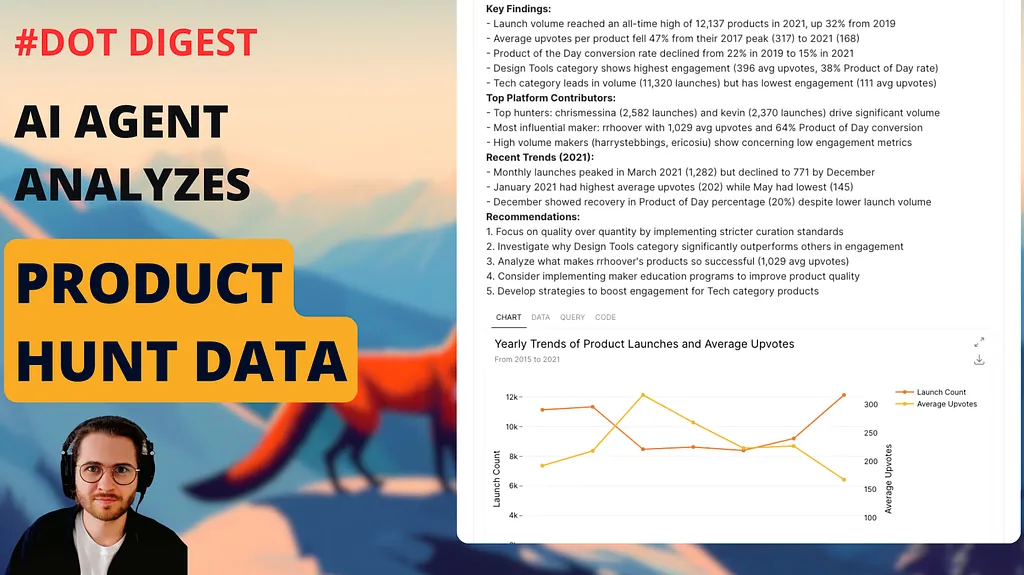
Product Hunt — once Silicon Valley’s darling platform for launching groundbreaking apps and tech products — finds itself at an intriguing crossroads. After analyzing data from 76,822 launches on Product Hunt from 2015 to 2021, some compelling insights emerge, painting a vivid picture of shifting engagement and evolving user behaviors.
What’s really happening at Product Hunt, and what can makers, investors, and tech enthusiasts learn from these trends? Let’s dive in.
Read the full Dot AI data analysis of Product Hunt data here.
📈 By The Numbers: A Paradox of Volume vs. Engagement
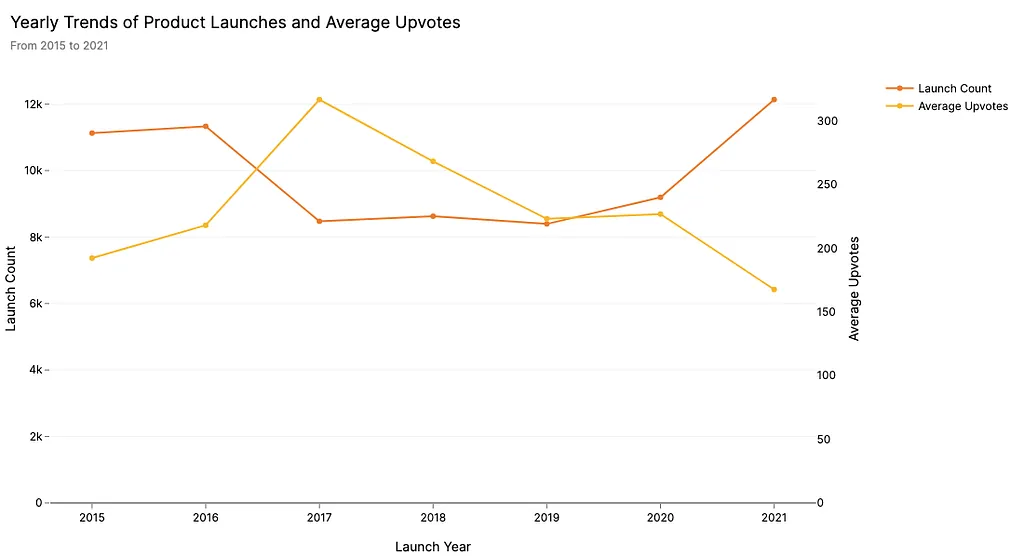
At first glance, Product Hunt looks healthier than ever. In 2021 alone, it saw a record 12,137 launches — a 32% jump compared to 2019.
But here’s the kicker: while launch quantity exploded, average engagement dramatically dropped.
- Launch Volume: Up 32% since 2019, peaking at 12,137 launches in 2021.
- Engagement: Average upvotes per product dropped 47% from its 2017 peak (316) to just 168 in 2021.
- Conversion Decline: The Product-of-the-Day conversion rate shrank from 22% in 2019 down to 15% in 2021.
This data reveals a stark paradox — more makers are using the platform, yet each is capturing less of the community’s attention.
🏆 Quality Over Quantity? Engagement by Category
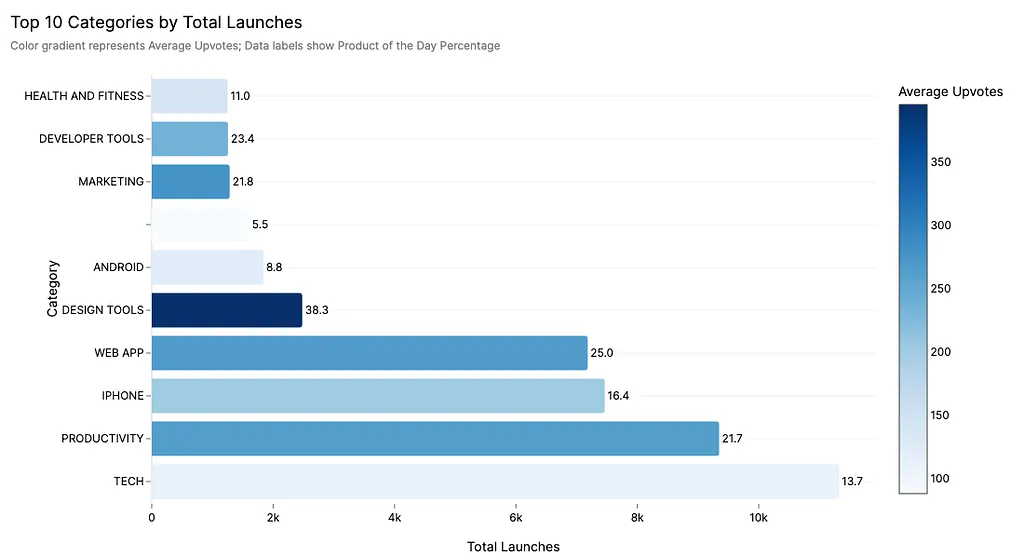
Some categories buck the declining engagement trend, highlighting a key insight:
- Quality trumps quantity.
- Design Tools products stand out: averaging 396 upvotes per launch, with an impressive 38% Product-of-the-Day rate.
- Tech products, despite launching 11,320 times (the highest of any category), averaged just 111 upvotes per launch — the lowest engagement of any category.
What’s special about design products? According to industry insiders, it’s the visual-first nature, ease of understanding, and immediate user excitement. This category might provide clues for other makers on capturing the community’s attention.
🌟 The Influencers Driving Traffic & Trends
Product Hunt’s dynamics are highly influenced by prominent figures in the tech community. The data highlights some standout individuals:
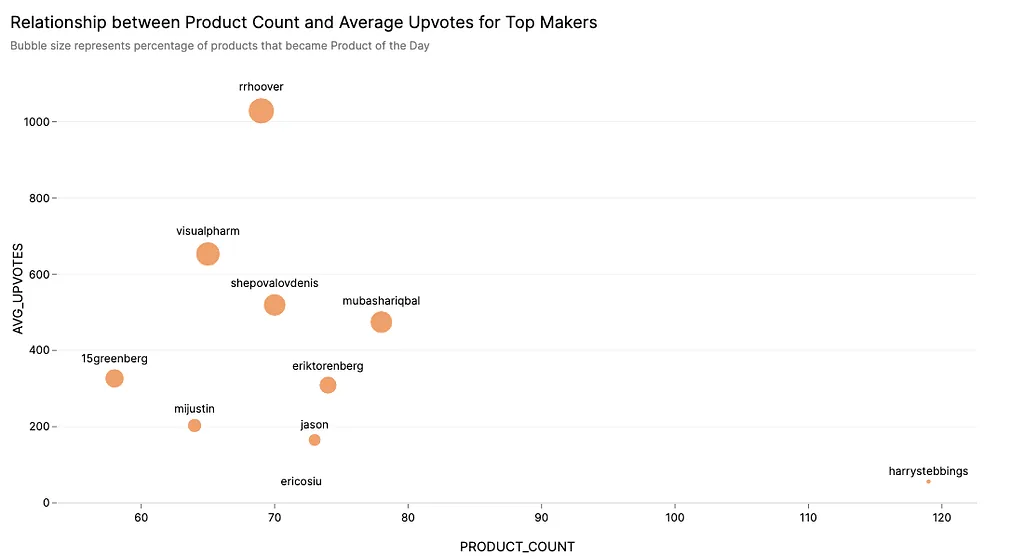
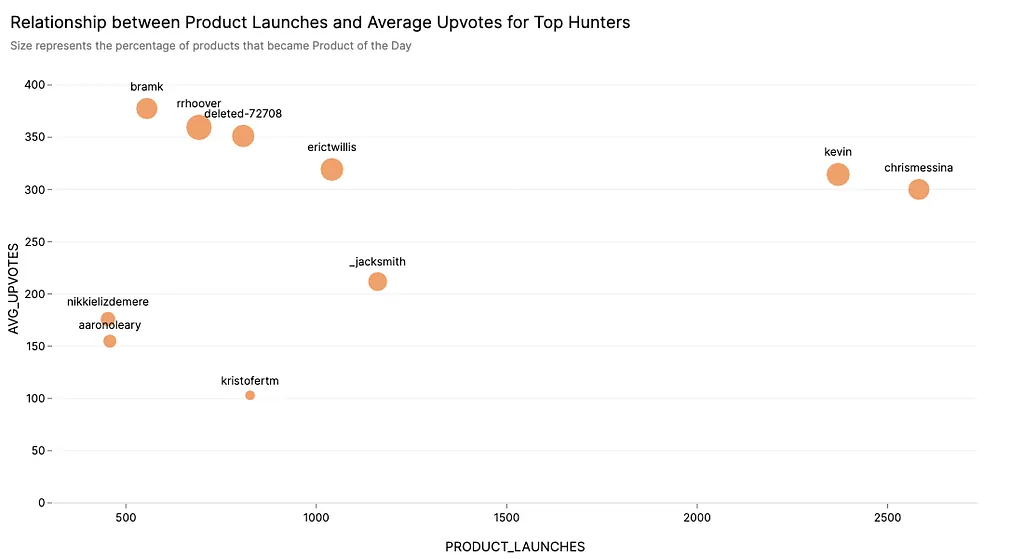
- Top Hunters: chrismessina (2,582 launches) and kevin (2,370 launches) have greatly influenced launch volumes, becoming gatekeepers who shape what’s trending.
- Top Makers: The highest engagement goes to founder and former CEO Ryan Hoover (rrhoover), averaging an incredible 1,029 upvotes per product with a staggering 64% Product-of-the-Day conversion rate. What sets Hoover apart? Credibility, authenticity, and active community participation seem key.
However, some high-volume makers like harrystebbings and ericosiu show concerningly low engagement. Volume alone clearly isn’t the magic formula.
🔄 The Monthly Rollercoaster of Launches (2021)
A deeper monthly look reveals intriguing patterns:
- March 2021 had the highest number of launches (1,282), while December dipped to 771.
- Peak average upvotes occurred in January (202 avg. upvotes per launch), hitting a low point in May (145).
- Interestingly, December 2021 saw an engagement rebound, achieving a 20% Product-of-the-Day conversion despite lower launch volume.
Why the variability? External research suggests seasonal patterns in tech enthusiasm, burnout in community engagement, and even impacts from global events (e.g., pandemic fatigue, shifts toward remote work tools).
🔎 Contextualizing Product Hunt’s Decline in Engagement
Why exactly has Product Hunt’s engagement declined even as more products than ever hit its homepage? Let’s explore deeper industry contexts:
🔺 Oversaturation & Platform Changes
Product Hunt’s own success became its Achilles’ heel. The platform evolved from a tight-knit community with few daily launches to a crowded bazaar with 30+ products daily, resulting in diminished individual visibility. The result: community fatigue. Engagement is concentrated on a select few outstanding launches, while others languished unnoticed.
🚨 Rise of Alternative Platforms
Since Product Hunt’s peak, new platforms have emerged:
- Indie Hackers became the place for long-form conversations and thoughtful engagement.
- Twitter and LinkedIn’s “Build in Public” movement created new channels for product launches, directly competing with Product Hunt’s traffic.
- Substack and niche newsletters now serve as potent alternative discovery tools, diluting Product Hunt’s exclusive status as the go-to discovery hub.
⚖️ Gaming the System
As competition intensified, makers resorted to gaming the system, buying upvotes, and orchestrating vote rings. Though Product Hunt has worked to eliminate this manipulation, such tactics have undeniably affected community trust and authenticity, further contributing to declining engagement.
🎯 How Product Hunt is Responding
Product Hunt has recognized these challenges and begun shifting their strategy:
- New Engagement Metrics: The introduction of a broader scoring system beyond pure upvotes rewards deeper interaction and curbs gaming.
- Stricter Moderation and Curation: Efforts increased to maintain authenticity and quality. Golden Kitty Awards celebrate standout products annually, reinforcing quality and innovation.
📌 Recommendations & Takeaways
Based on the comprehensive dataset analysis and contextual industry research, here’s what makers, investors, and enthusiasts should consider:
- Makers: Prioritize audience-building before your launch. Quality, authentic engagement is crucial. Use Product Hunt as part of a broader, multi-channel launch strategy rather than your sole focus.
- Investors: Look beyond Product Hunt’s rankings when scouting potential investments. A high-engagement launch can signal strong early interest but isn’t the entire story — deep community engagement, retention, and authentic growth are more important signals.
- Tech Enthusiasts: Don’t limit your discovery to Product Hunt’s homepage. Explore Indie Hackers, niche Substacks, and Twitter communities for hidden gems. Engage thoughtfully to help surface quality products.
🔥 Has Product Hunt Peaked?
Despite declining individual engagement, Product Hunt remains influential in tech’s ecosystem. Yet, it’s undoubtedly transformed:
- From intimate early-adopter enthusiasm to broad-market saturation.
- From singular go-to launchpad to one player among many in the crowded startup landscape.
While Product Hunt’s dominance has shifted, opportunities for innovation and meaningful engagement persist — if approached strategically.
The tech launch landscape is more vibrant and diverse than ever, and savvy founders understand the value of leveraging multiple channels alongside Product Hunt. Ultimately, the future of Product Hunt — and product launches generally — belongs to those who can combine authentic engagement, quality content, and strategic cross-channel storytelling.
With Dot, we’re building an AI analytics agent that perform automatically high level analysis. We believe in a future where sense-making and decision-making is the result of a seamless collaboration between humans and AI agents. As we’ve seen through this deep dive into Product Hunt data, the real magic happens when human intuition and perspective meets AI-driven insights. Together, we aim to amplify clarity, accelerate understanding, and empower smarter decisions — one dataset at a time.
Enjoyed this analysis? Found it insightful? Share your thoughts and experiences in the comments. Forward this to friends, colleagues, and fellow tech enthusiasts. Let’s keep the conversation rolling! 🚀
Related reading:
Curious to have Dot analyze your data? Test our agent here.
Theo Tortorici
Theo writes about AI-powered analytics, data tools, and the future of business intelligence at Dot.