
How Airbnb Built an AI Platform That Actually Works (2024)
When Airbnb's CEO Brian Chesky decided to tackle customer support with AI, he chose what he calls "the hardest problem": high stakes, real-time responses, and zero tolerance for hallucination. The result is a system built on 13 different models that has reduced human agent contact by 15% and cut agent manual processing time by 13%. Here's what data leaders can learn from their approach.
The Problem: Static Workflows Don't Scale
Before diving into the solution, it's worth understanding what Airbnb was up against. Their original Automation Platform relied on rigid, predefined workflows. Every possible conversation path had to be mapped out by hand in advance.
Sound familiar? Most enterprise AI systems start here. It's safe, predictable, and completely unmaintainable at scale.
The limitations became obvious:
- Brittleness: Any new scenario required engineering work to add new workflow branches
- Poor language understanding: Static workflows struggle with the infinite ways customers express the same issue
- Maintenance burden: Thousands of workflows to maintain, each requiring manual updates when policies changed
Airbnb needed something smarter. But not so smart that it would hallucinate refund policies or make up reservation details.
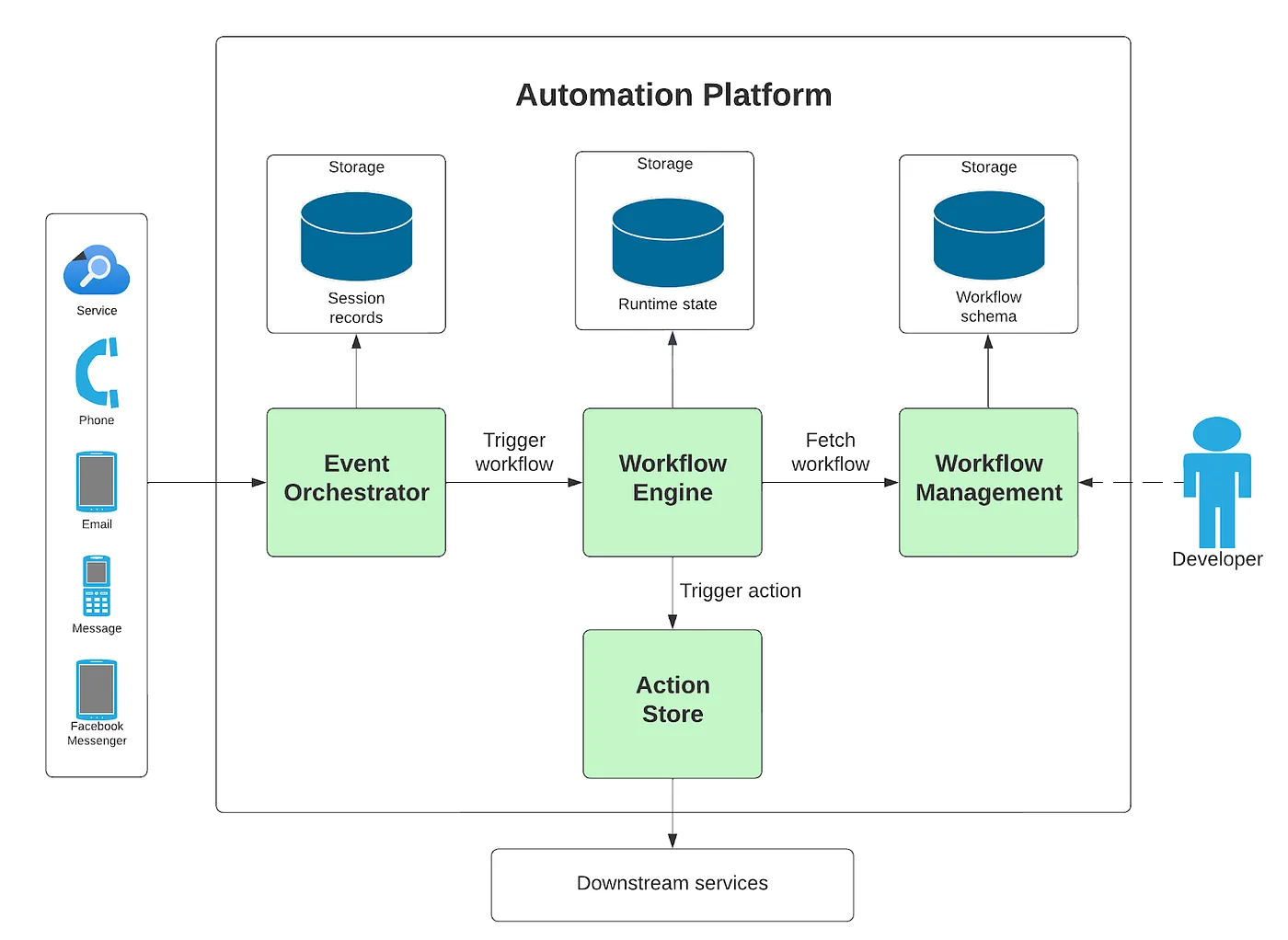
The Solution: A Hybrid Architecture That Respects Reality
Airbnb's key insight was that the choice between "traditional ML" and "LLMs" is a false dichotomy. Their Automation Platform v2 combines both. LLMs where they excel, natural language understanding and flexible reasoning. Deterministic workflows where precision is non-negotiable.
The Core Architecture
The platform has three major components:
1. Chain of Thought Workflow Engine
Airbnb implemented Chain of Thought (CoT) as an actual workflow system, not just a prompting technique. The flow works like this:
- Prepare context: Assemble prompt, contextual data, and conversation history
- Enter reasoning loop: Ask LLM for next action, execute it, process the outcome
- Repeat until resolution: Stay in the loop until the LLM determines the task is complete
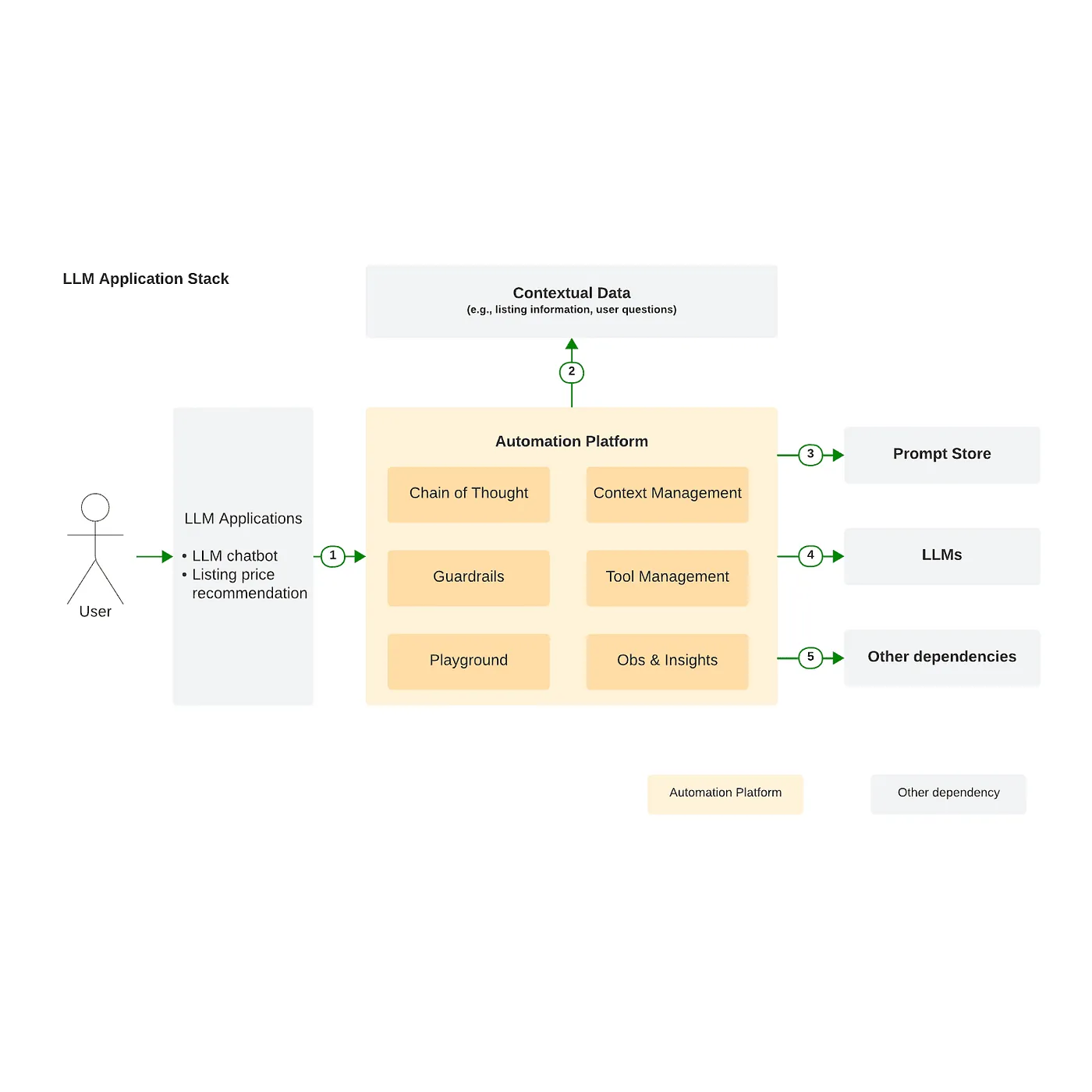
2. Tools as the Interface to Reality
Here's where Airbnb's platform gets interesting. Rather than letting LLMs generate arbitrary outputs, they constrain them to selecting and invoking pre-defined tools. The LLM is a reasoning engine that decides which action to take, not how to execute it.
Tools include:
- Checking reservation status
- Verifying listing availability
- Processing refund requests
- Retrieving help articles
Each tool has a unified interface and runs in a managed execution environment. This means the LLM can decide "we need to check this reservation" but the actual database query runs through validated, tested code.
3. Guardrails Framework
This is Airbnb's answer to the hallucination problem. DoorDash achieves 90% hallucination reduction with comparable multi-stage validation. The Guardrails Framework monitors all LLM communications and can execute multiple validation checks in parallel. Uber's QueryGPT uses similar agent decomposition for text-to-SQL, splitting tasks across four specialized agents.
The architecture allows engineers from different teams to create reusable guardrails:
- Content moderation guardrails: Call various LLMs to detect policy violations in communications
- Tool guardrails: Use rules to prevent bad executions (e.g., updating listings with invalid data)
- Response validation: Verify outputs before they reach customers
The Numbers: What Actually Improved
Agent Efficiency
The counterintuitive finding: a smaller, fine-tuned model outperformed larger models in production because latency matters as much as accuracy. A brilliant answer that takes 46 seconds is worse than a good answer in 4.5 seconds.
Their fine-tuned Mistral-7B with Chain of Thought achieved a 13% reduction in manual processing time - compared to a 3% increase with larger models due to latency.
Customer Impact
- 50% of customers now use the AI bot for customer service (Q1 2025)
- 15% reduction in customers needing to contact human agents
- 100% of US users now have access to the AI customer service agent
Technical Metrics
- Word error rate in voice support: Reduced from 33% to ~10% through domain-specific ASR tuning
- Intent detection latency: Under 50ms on average
- Help article retrieval: 30 relevant articles retrieved within 60ms using vector similarity
The ICA Format: Making Knowledge LLM-Friendly
One of Airbnb's most transferable innovations is their Intent, Context, Action (ICA) format for representing business knowledge.
The problem: Enterprise workflows are written for humans with specific training. They're full of colloquial language, complex nested conditions, and implicit assumptions. LLMs struggle to parse them reliably.
The solution: Transform all workflows into a structured ICA format:
- Intent: What is the customer trying to accomplish?
- Context: What conditions and situational factors apply?
- Action: What specific response should the agent take?
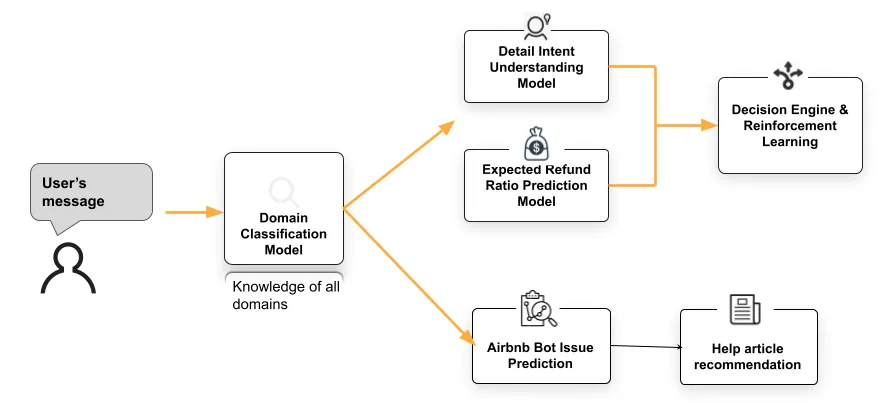
Impact of ICA Format Alone (No Fine-Tuning)
The format change alone provided substantial accuracy gains before any model fine-tuning:
- Large proprietary model: +13% accuracy improvement with ICA (CoT alone: +25% combined)
- Mistral-7B: +35% accuracy improvement
This suggests that how you represent knowledge to LLMs matters as much as which model you use.
The 13-Model Architecture
Airbnb doesn't rely on a single model. Their production system uses 13 different models, each selected for specific strengths:
- Alibaba's Qwen models: CEO Chesky noted these are "very good" and "fast and cheap." Better suited for their needs than ChatGPT
- OpenAI models: Used for specific capabilities
- Google models: Part of the ensemble
- Fine-tuned Mistral-7B: For customer support reasoning with ICA format
Why 13 models? Different tasks have different requirements:
- Content moderation needs different capabilities than intent detection
- Voice transcription requires specialized ASR models
- Ranking retrieved help articles needs different training than response generation
What Airbnb Chose NOT to Do with LLMs
Perhaps the most instructive lesson is where Airbnb deliberately limits LLM involvement:
- Claims processing: Uses traditional workflows for "sensitive data and strict validations"
- Financial transactions: Deterministic rules, not probabilistic models
- Policy enforcement: Rule-based guardrails, not LLM judgment
As their engineering team notes: "It's more suitable to use a transition workflow instead of LLM to process claims that require sensitive data and strict validations."
That is not a failure of LLMs. It is mature engineering judgment about where each technology belongs.
Lessons for Data Teams Building Similar Tools
1. Latency is a Feature, Not a Bug
Fine-tuned Mistral-7B beat larger models in production because it answered in 4.5 seconds instead of 46. When your users are waiting for help, response time matters as much as response quality.
Takeaway: Benchmark your models on latency, not just accuracy. A 10% accuracy drop might be worth a 90% latency improvement.
2. Format Your Knowledge Before You Fine-Tune Your Models
The ICA format provided 13-35% accuracy improvements before any fine-tuning. Restructuring how you present information to LLMs is often higher ROI than model optimization.
Takeaway: Audit how your business knowledge is structured. Complex, nested documents should be transformed into clear Intent-Context-Action formats.
3. Tools > Tokens
By constraining LLMs to select from predefined tools rather than generate arbitrary outputs, Airbnb maintains control while gaining flexibility. The LLM reasons about what to do; validated code handles how to do it.
Takeaway: Design your agent architecture around tool selection, not open-ended generation. Define clear interfaces and execution environments for each capability.
4. Guardrails Are Architecture, Not Afterthoughts
Airbnb's guardrails run in parallel during every LLM interaction: content moderation, tool validation, response checking. Not bolted on. Designed in.
Takeaway: Plan your safety mechanisms from the start. Design for parallel execution so guardrails don't become latency bottlenecks.
5. Hybrid Beats Pure
The best results came from combining LLM reasoning with deterministic workflows. Use LLMs for natural language understanding and flexible reasoning. Use traditional systems for validation, transactions, and policy enforcement.
Takeaway: Don't try to replace everything with LLMs. Identify where each technology's strengths align with your requirements.
The Broader Pattern: AI-Native, Not AI-Replaced
Airbnb isn't replacing their customer support organization with AI. They're making every human agent more effective through AI augmentation. The 13% reduction in manual processing time means agents can handle more complex cases, not that Airbnb needs fewer agents. Netflix's LORE prioritizes explainability over raw capability, validating that user trust often matters more than accuracy.
This is the pattern that works: AI handles the routine, surfaces the relevant, and recommends the next action. Humans handle the exceptions, make the judgment calls, and build the relationships.
For data teams considering similar investments, Airbnb's playbook offers a roadmap:
- Start with your existing workflows and knowledge base
- Transform knowledge into LLM-friendly formats (ICA)
- Build a tool-based architecture that constrains LLM outputs
- Implement guardrails as parallel validation, not sequential gates
- Choose models based on production requirements (latency, cost), not benchmark scores
- Keep humans in the loop for sensitive operations
The future of enterprise AI isn't replacing human judgment with machine learning. It's amplifying human capability with intelligent automation. Airbnb's Automation Platform v2 shows what that looks like in practice.
Sources: Automation Platform v2: Improving Conversational AI at Airbnb, Task-Oriented Conversational AI in Airbnb Customer Support, LLM-Friendly Knowledge Representation for Customer Support (arXiv)
If this excites you, we'd love to hear from you. Get in touch.
Rick Radewagen
Rick is a co-founder of Dot, on a mission to make data accessible to everyone. When he's not building AI-powered analytics, you'll find him obsessing over well-arranged pixels and surprising himself by learning new languages.