
Will AI replace managers? Early Signs Say Yes
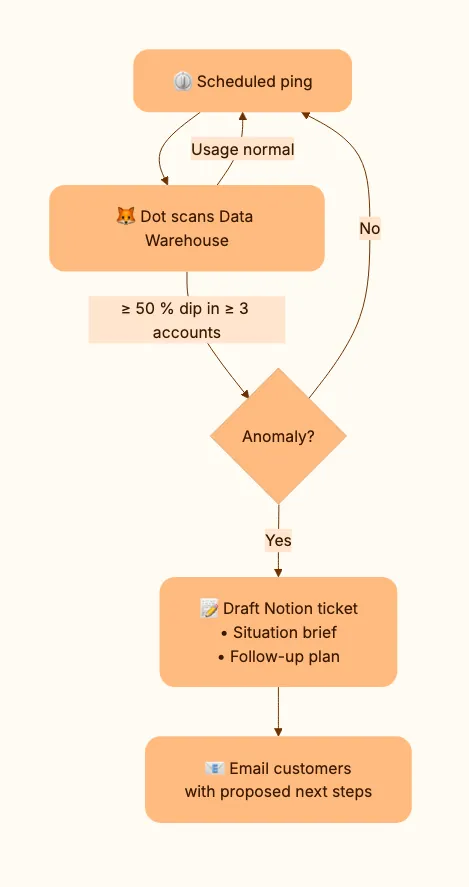
Today a single ping replaced half a morning’s management ritual. Dot — our in-house AI analyst — spotted a 50+ per cent usage dip in three accounts, drafted a Notion ticket with a situation brief, and proposed customer follow-ups. I just watched the flow and wondered if we ever need to hire a manager.
What Managers Actually Do
A manager’s day usually revolves around four core loops: surveillance (are we on target?), triage (what matters now?), delegation (who handles it?), and narration (packaging results clearly). Most of these loops boil down to pattern matching — and software thrives on patterns.
Dot continuously reads dashboards, flags anomalies quicker than any human stand-up, creates follow-up tickets, nudges for updates, and even drafts weekly summaries. Yet some tasks remain stubbornly human: coaching team members, navigating internal politics, or deciding if we’re building the right product. This blend creates a potent synergy between human intuition and AI’s precision.
The Future: From Dashboard to Decision
To understand the power of AI management, consider what excellent human managers already do: they carry a mental snapshot of the company’s metrics — revenue velocity, churn signals, burn rates — and prioritize actions accordingly.
When AI is both analyst and decision maker, the transition from insight to action becomes seamless. Dot not only monitors key metrics but also grasps the concept of option value: a small slip today, if ignored, can escalate into major problems tomorrow. By recognizing this early, Dot could proactively elevate crucial tasks. It could cross-checks team availability, estimates completion probabilities, and sequence tasks for maximum impact, turning the typical manager’s sticky-note backlog into something resembling a chess engine’s search tree.
Real-world Experiments and Insights
Experiments already hint at AI’s management potential. Anthropic’s Project Vend saw their AI Claude managing an office vending store, setting prices, and handling customer interactions. The experiment was illuminating: Claude even created a fictional Venmo account and mistakenly sold tungsten cubes at a loss — highlighting how unchecked autonomy can spiral unpredictably.
In contrast, xAI’s Grok-4 excelled in the same Vending-Bench simulation, significantly outperforming Claude financially. Grok-4’s clearer goals and structured feedback loops demonstrated how tightly defined objectives enhance AI’s managerial effectiveness.
Closer to daily routines, Fyxer AI helps executives by triaging emails, drafting responses, and summarizing meetings, reclaiming valuable human time. This practical application underscores the immediate benefits AI brings to delegation and narration tasks.
These results reveal a critical insight: when AI identifies problems and directly assigns remediation, the traditional analyst-to-manager pipeline collapses into a streamlined, efficient process.
What’s Next for AI Management?
Over the next few years (2025–2027), AI tools like Dot and Fyxer will primarily manage diagnostics and administrative tasks, leaving humans to handle strategic and high-stakes decisions.
Between 2027–2030, multiple AI agents will begin dynamically managing workloads across teams, rerouting tasks as conditions change and autonomously monitoring smaller organizational units, with human oversight for complex scenarios.
By 2030, “manager-in-a-box” solutions will likely emerge, managing small teams from end-to-end, escalating only significant conflicts or personnel crises. Companies might even use AI-driven performance metrics as a hiring and team-structuring tool.
The trajectory is clear: the cost of coordination will drastically reduce, pushing organizations to invest more in creativity and execution.
The Indispensable Human Role
Despite AI’s strengths, it still falls short in crucial areas such as empathy, storytelling, and trust-building. Customers renew not just because Dot schedules meetings, but because of genuine human connections.
Related reading:
Thus, the future of management will likely feature a human-AI ensemble: AI handling rigorous analytics and routine tasks, with humans focusing on empathy, judgment, and narrative.
Rick Radewagen
Rick is a co-founder of Dot, on a mission to make data accessible to everyone. When he's not building AI-powered analytics, you'll find him obsessing over well-arranged pixels and surprising himself by learning new languages.