
10 Best Vanna AI Alternatives & Competitors In 2026
When people search for Vanna AI alternatives, it's usually not because the tool can't generate SQL.
It's because SQL generation alone isn't getting their team to actual decisions.
I've seen the pattern enough times: someone sets up Vanna AI, trains the model, asks a question, and gets a query back. But then what?
The chart is basic. The narrative is missing. And the next question still requires another round of training and tweaking.
I'll cover the 10 best Vanna AI alternatives in 2026, based on tools I've evaluated across real analytics workflows, including what each one does well, where Vanna AI falls short, and which option fits depending on how your team works with data.
TL;DR
- The best alternative to Vanna AI on the market is Dot, because it goes beyond text-to-SQL by acting as a full AI data analyst that connects to your warehouse, delivers narrative insights with recommendations, and produces automated executive reports.
- ThoughtSpot and Tellius are strong picks for enterprise teams that want AI-powered natural language analytics with governed data, automated dashboards, and explainable insights at scale.
- Metabase is the most budget-friendly option on this list, offering a free open-source tier with basic AI assistance that gives startups and lean data teams production-ready analytics with minimal setup.
Why Look For A Vanna AI Alternative?
Vanna AI earned its reputation as an open-source text-to-SQL tool with real developer traction, over 22,000 GitHub stars and support for most major databases.
But once teams move beyond demos into production use, the gaps start showing.
Here are the most common reasons people look for alternatives:
1. Accuracy can break down on complex, real-world databases
Vanna AI works well on clean, well-structured schemas. But real databases aren't clean.
They have deprecated columns, confusing naming conventions, and logic that changes over time.
Users on G2 have flagged that complex scenarios lead to wrong queries and wrong results.
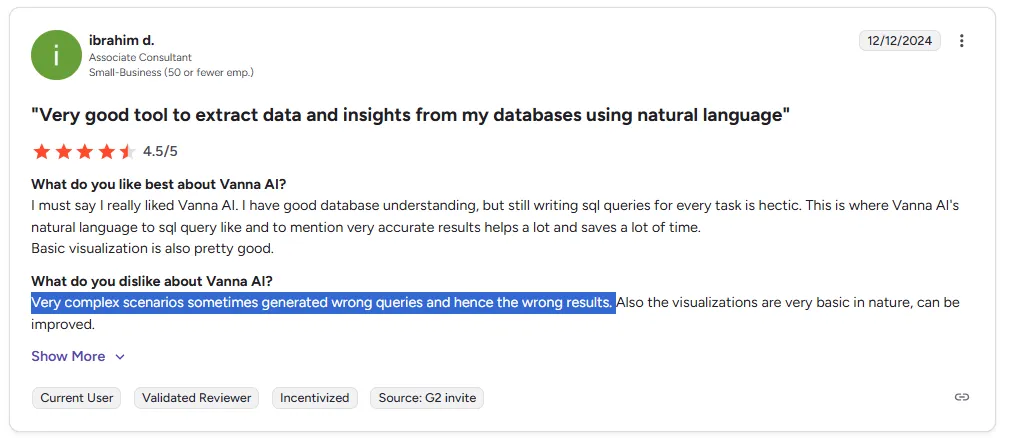
One verified reviewer noted: "Very complex scenarios sometimes generated wrong queries and hence the wrong results."
2. The UI is rather basic, and there doesn’t seem to be self-correction
Both G2 reviewers pointed out that the front-end needs polishing and that visualizations are limited.
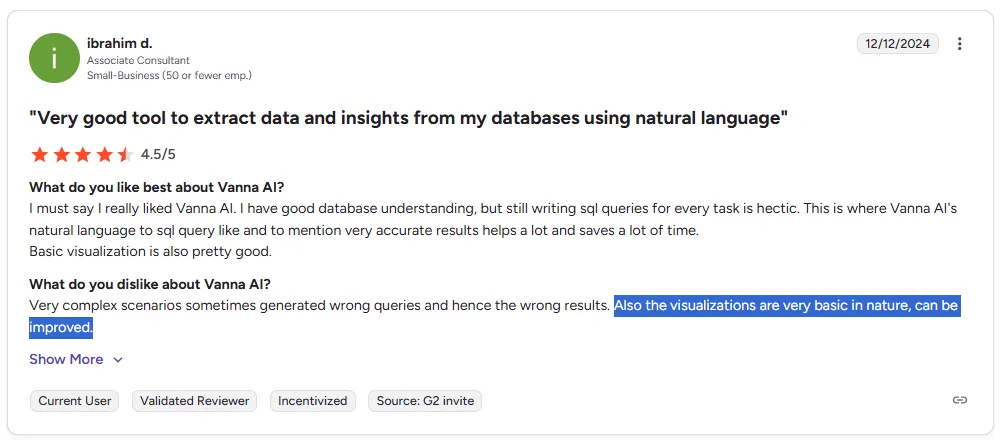
‘’Also the visualizations are very basic in nature, can be improved.’’ – G2 Review.
And when a query fails, Vanna AI doesn't retry or attempt a fix automatically.
According to aMedium comparison article, Vanna AI follows a straightforward flow: generate SQL, generate a chart, and done. If either step fails, there's no fallback.
3. Training the model takes real effort
Unlike tools that learn your business context automatically, Vanna AI requires manual training to get accurate results.
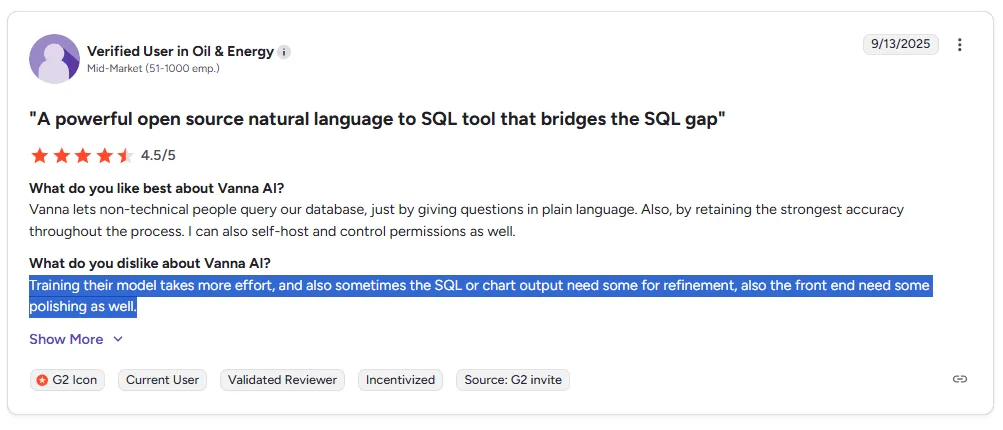
One G2 reviewer noted that "training their model takes more effort."
For teams that need fast time-to-value, this front-loaded investment in training and documentation can slow adoption down significantly.
What Are The Best Alternatives To Vanna AI In 2026?
The best alternatives to Vanna AI in 2026 are Dot, ThoughtSpot, and Supaboard.
Here's my shortlist of the 10 best Vanna AI alternatives on the market:
Tool | Best For | Pricing |
Dot | AI data analyst that connects to your warehouse and delivers narrative insights, recommendations, and automated executive reports instead of raw SQL. | Free plan; Paid from $180/month. |
ThoughtSpot | Organizations that want AI-powered, self-service analytics with natural language querying and automated dashboards, without relying on traditional BI workflows. | Starts from: $25/user/month |
Supaboard | Teams that want AI-powered business intelligence with no-code dashboards and natural-language analytics instead of traditional BI modeling workflows. | Starts from: $85/month |
Tellius | Business and analytics teams that need fast, explainable answers to complex business questions without relying on dashboards, SQL, or constant analyst support. | Pricing not public. |
DataGPT | Decision-makers and analytics teams that want analyst-grade answers to complex "why" questions without relying on dashboards, SQL, or shallow text-to-SQL tools. | Starts from: $2,750/month |
Zenlytic | Data teams that want governed, explainable self-serve analytics and business users who need fast, trustworthy answers without breaking the semantic layer. | Pricing not public. |
Sigma | Teams that want spreadsheet-like analytics and AI-powered workflows on live warehouse data, without complex BI setup. | Pricing not public. |
Holistics | Teams that need governed self-service analytics with a flexible semantic layer and strong collaboration between analysts and business users. | Starts from: $960/month |
Metabase | Startups, product teams, and data teams that want fast, affordable, open-source analytics with light AI assistance. | Free (Open Source), Cloud from $100/month |
Microsoft Power BI | Organizations already invested in the Microsoft ecosystem that want standardized dashboards, reporting, and self-service analytics at scale. | Starts from: $14/user/month |
#1: Dot
Dot is the best alternative to Vanna AI in 2026 for data teams with its AI-powered analysis engine that connects directly to your data warehouse and delivers narrative insights, recommendations, and automated executive reports.
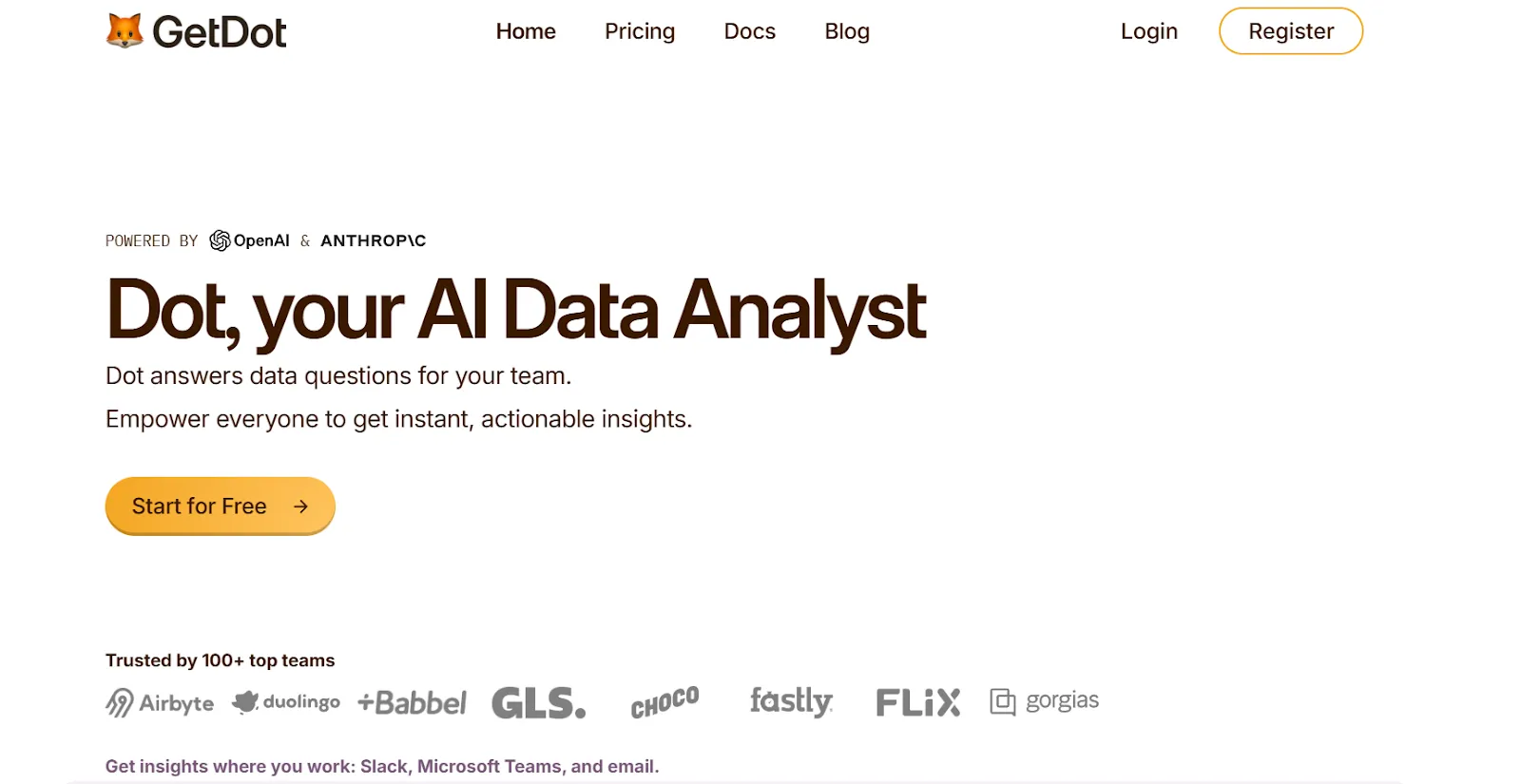
Unlike Vanna AI, which returns raw SQL output and basic charts, Dot acts as a full AI analyst on your team.
You ask a business question in plain English, and Dot investigates the data, explains what's happening and why, and tells you what to do about it.
It also generates executive-ready business review reports on a schedule, handles ad-hoc questions through Slack or Teams, and keeps business definitions consistent across your entire organization with a Context Agent.
Here are some of the key features that make Dot the strongest Vanna AI alternative. 👇
Ad-Hoc Analysis Through Slack or Microsoft Teams
Vanna AI requires users to interact through a web interface or Jupyter notebook, then manually interpret the SQL output.
Most business users won't do that.
Dot takes a different approach by letting anyone on the team ask data questions directly in Slack or Microsoft Teams and get a full analysis back in minutes.
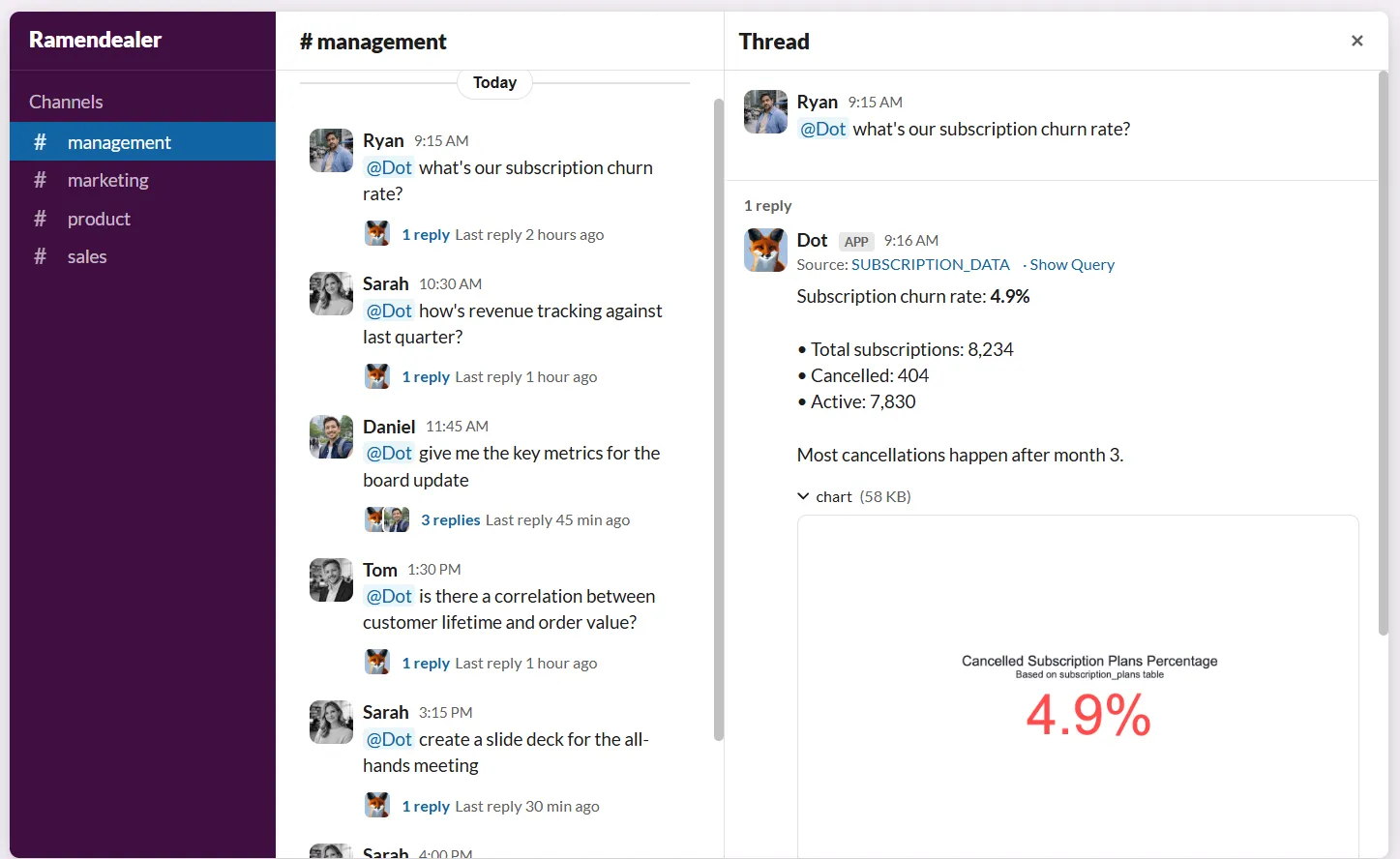
The response goes beyond surface-level numbers. It explains what's changing, why it's likely changing, and which segments or regions are driving the shift.
This is especially valuable for data teams because it absorbs the constant stream of ad-hoc requests that would normally pull analysts away from deeper work.
Business stakeholders get answers faster without needing to learn SQL, and analysts reclaim time for the analysis that actually moves the needle.
Context Agent for Shared Business Definitions
One of the biggest challenges with tools like Vanna AI is context drift.
You train the model on your schema, but as metrics evolve and definitions shift, the training data becomes stale.
Dot's Context Agent handles this differently. It continuously learns and maintains business definitions, metric logic, and documentation across your data environment.
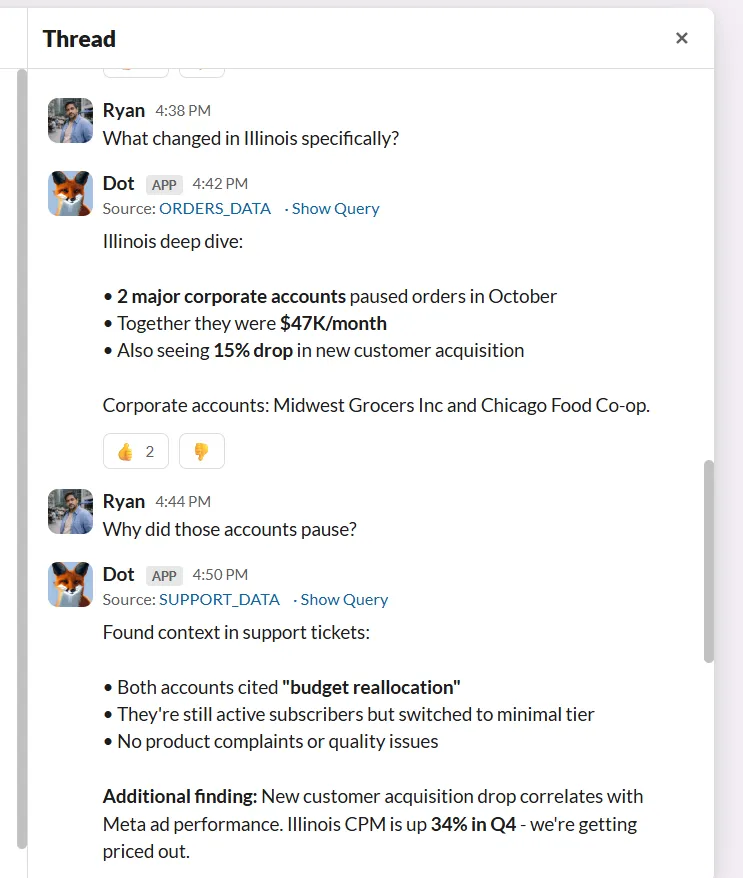
So when someone asks about "active users" or "churn rate," Dot uses the same logic every time, regardless of who's asking or where they're asking from.
Dot's context stays aligned automatically, pulling from your existing documentation and flagging inconsistencies before they become problems.
Automated Executive Business Review Reports
Vanna AI doesn't produce reports. It produces SQL results.
Dot goes further by generating executive-ready PowerPoint reports on a set schedule, whether that's daily, weekly, or monthly.
These aren't just data dumps. Each report pulls live data from your warehouse and turns it into a written narrative explaining what happened, what changed compared to previous periods, and where leadership should focus attention.
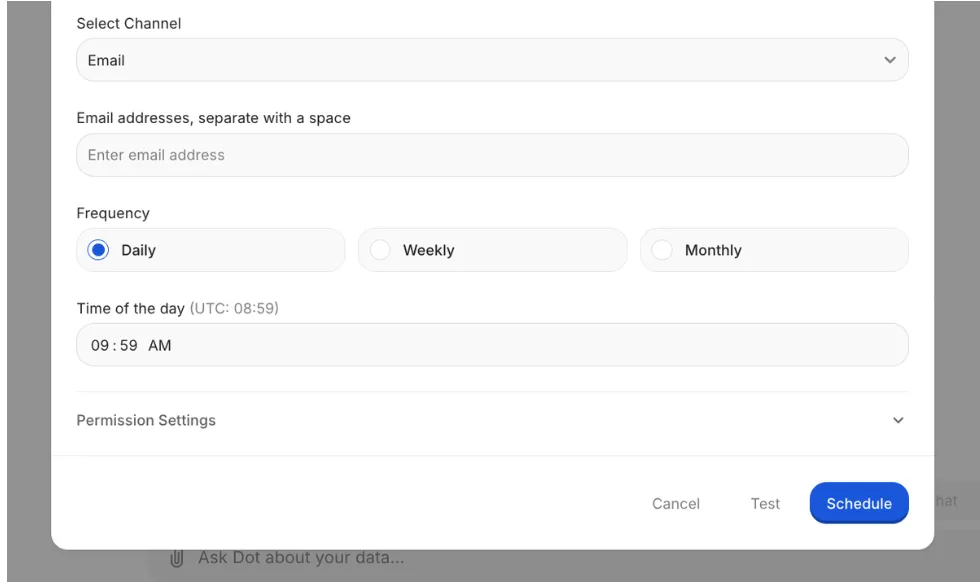
For data teams, this means the recurring reporting that eats hours every week now builds itself.
For leadership, it means a consistent, easy-to-read business update that doesn't require interpreting dashboards or chasing down analysts.
Full Audit Trail for Every Insight
One reason teams hesitate to trust AI-generated analytics is the black box problem. You get a number, but you don't know how it was calculated.
Dot solves this by attaching a complete audit trail to every insight it produces.
Each answer links directly back to the underlying SQL queries, Python logic, and datasets used. There's no guessing, as everything is inspectable.
This matters especially for data leaders who need to stand behind the numbers in executive meetings or compliance reviews.
Unlike Vanna AI, where the generated SQL is the only artifact, Dot gives you full transparency from question to answer to source of truth.
Dot’s integrations
Dot is designed to sit on top of the tools teams already use, rather than forcing data into a new BI-specific model.
It connects directly to modern data warehouses like Snowflake, BigQuery, Redshift, and Databricks, as well as operational databases such as Postgres, MySQL, and SQL Server, so analysis happens where the data already lives.
Dot also integrates with semantic layers and transformation tools like dbt, Looker models, Power BI models, and Cube, allowing it to reuse existing business logic and metric definitions instead of recreating them.
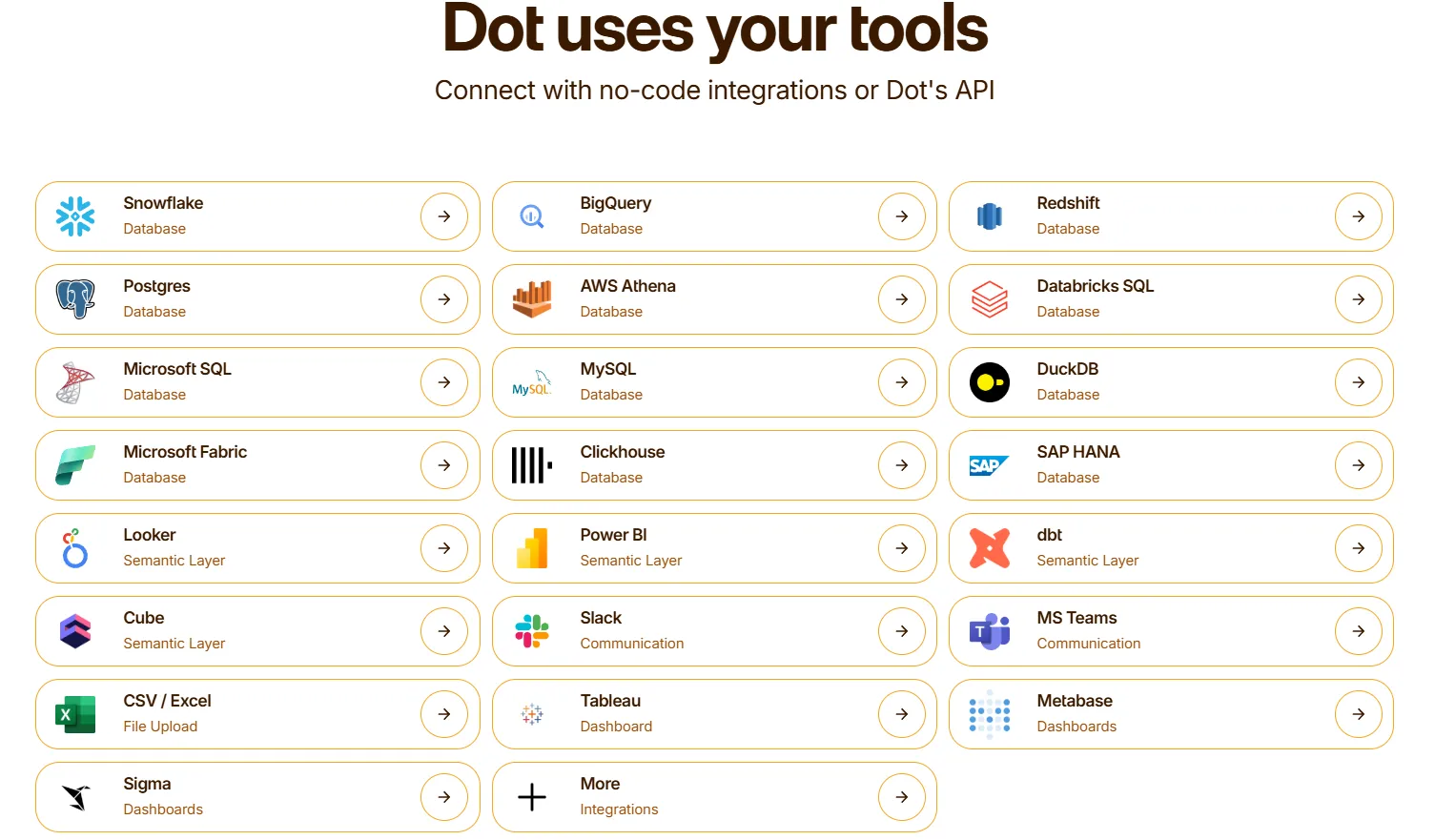
On the delivery side, Dot fits naturally into daily workflows by sharing insights in Slack, Microsoft Teams, email, and its web app.
It can also run alongside existing BI tools like Tableau, Metabase, or Sigma, complementing dashboards rather than replacing them overnight.
The result is analytics that stay connected to the warehouse, respect the work data teams have already done, and show up where decisions actually happen.
How Does Dot Compare To Vanna AI?
Vanna AI is built for developers who want an open-source framework for converting natural language to SQL.
Dot is built for teams that want an AI analyst who actually understands their business.
The difference shows up in practice.
Vanna AI gives you a SQL query. Dot gives you a narrative with recommendations.
Vanna AI requires manual model training and retraining as your data changes. Dot learns and maintains context automatically through its Context Agent.
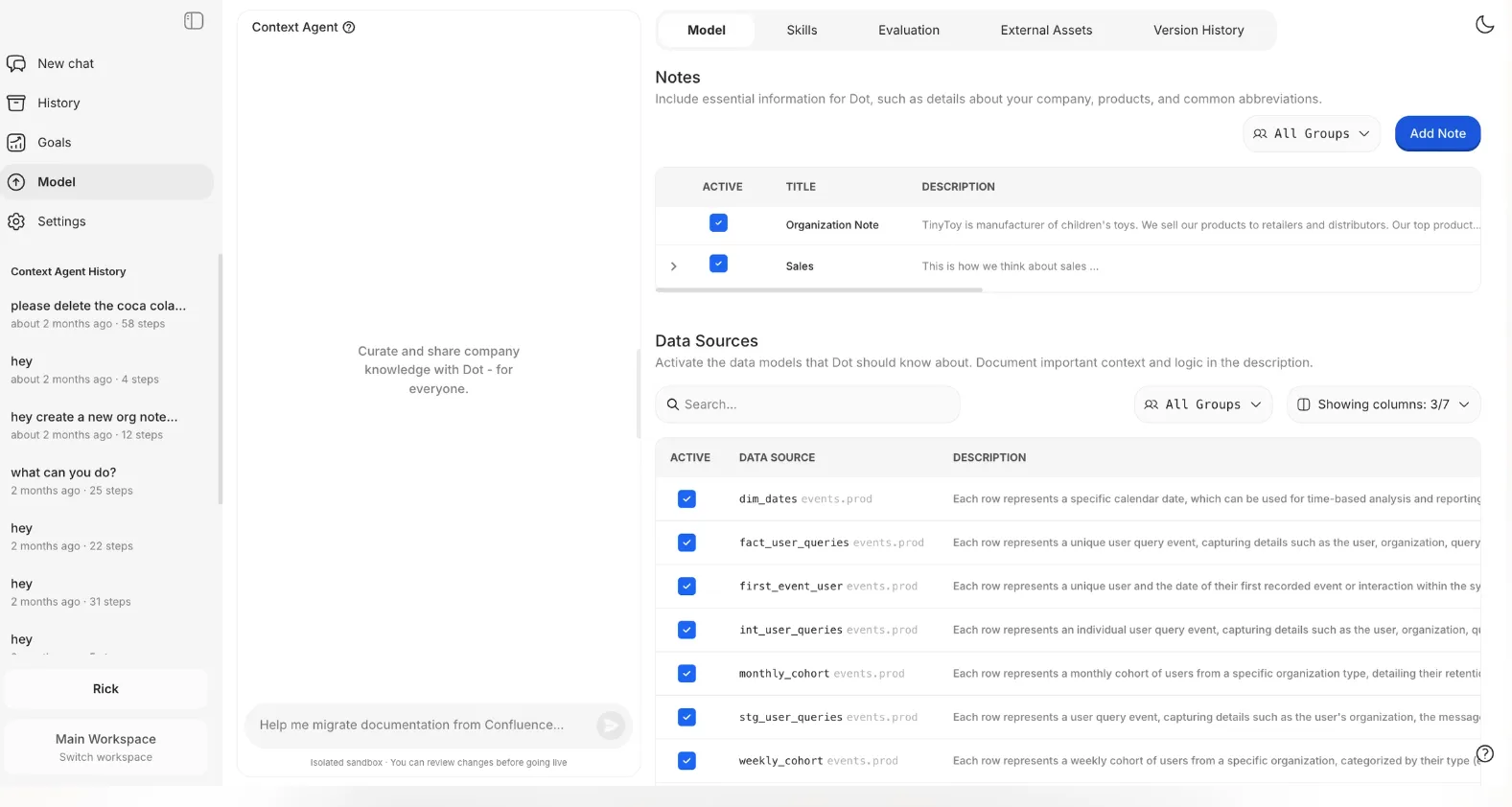
Vanna AI delivers through a web UI or notebook. Dot meets your team where they work, in Slack, Microsoft Teams, email, or the web app.
And where Vanna AI stops at query generation, Dot goes all the way to automated executive reports with full audit trails.
For teams that have outgrown the "give me a SQL query" stage and want analytics that drive actual decisions, Dot fills the gap that Vanna AI leaves open.
Pricing
Dot offers a free plan with 300 one-time credits and full access to Pro features, so teams can try the platform before spending anything.
There are three paid plans:
- Pro: $180/month, includes 150 credits per month, $1.80 per credit overage, and unlimited users.
- Team: $720/month, includes 800 credits per month, $1.44 per credit overage, SSO, row-level security, embedded analytics, BI migration support, and dedicated support.
- Enterprise: Custom pricing, includes unlimited credits, volume discounts, self-hosted deployment, audit logs, SLA, and a dedicated account manager.
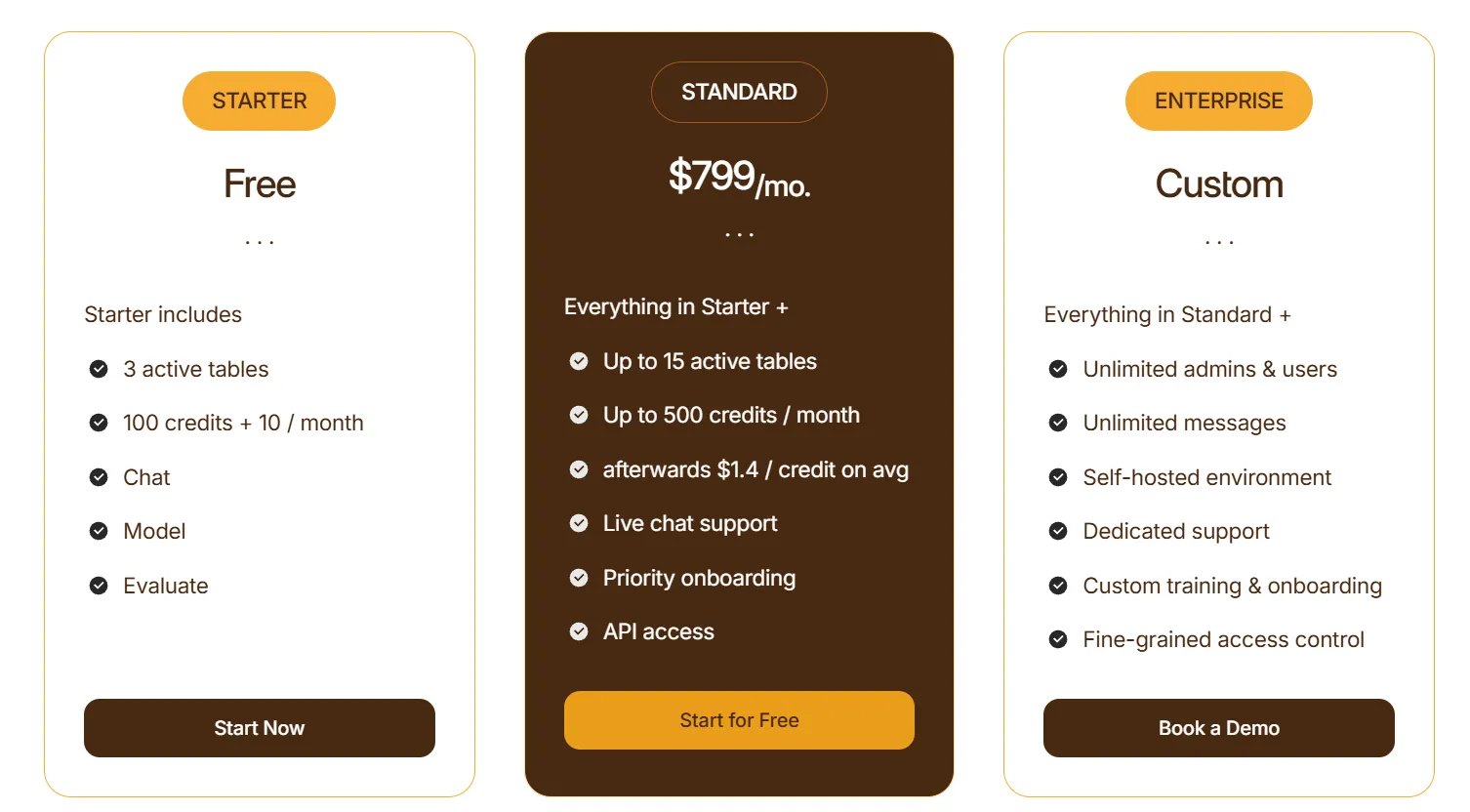
Unlike Vanna AI's usage-based pricing that can get unpredictable at scale, Dot's credit model lets teams budget with clarity and upgrade as their analytics needs grow.
➡️ Sign up for Dot's free plan or book a demo to see how it compares to Vanna AI for your team.
Pros & Cons
✅ Delivers clear explanations and recommendations in minutes via Slack or Teams.
✅ Shared business context and definitions that aim to reduce metric drift.
✅ Full audit trail on every insight.
✅ Warehouse-native architecture that works directly on modern data stacks without copying or reshaping data.
✅ Flexible pricing model based on usage rather than per-seat licensing.
❌ Not a traditional BI or dashboarding tool, which may be a drawback for teams that rely heavily on custom visuals.
#2: ThoughtSpot
Best for: Organizations that want AI-powered, self-service analytics with natural language querying and automated dashboards, without relying on traditional BI workflows.
Similar to: Qlik Sense, Looker.
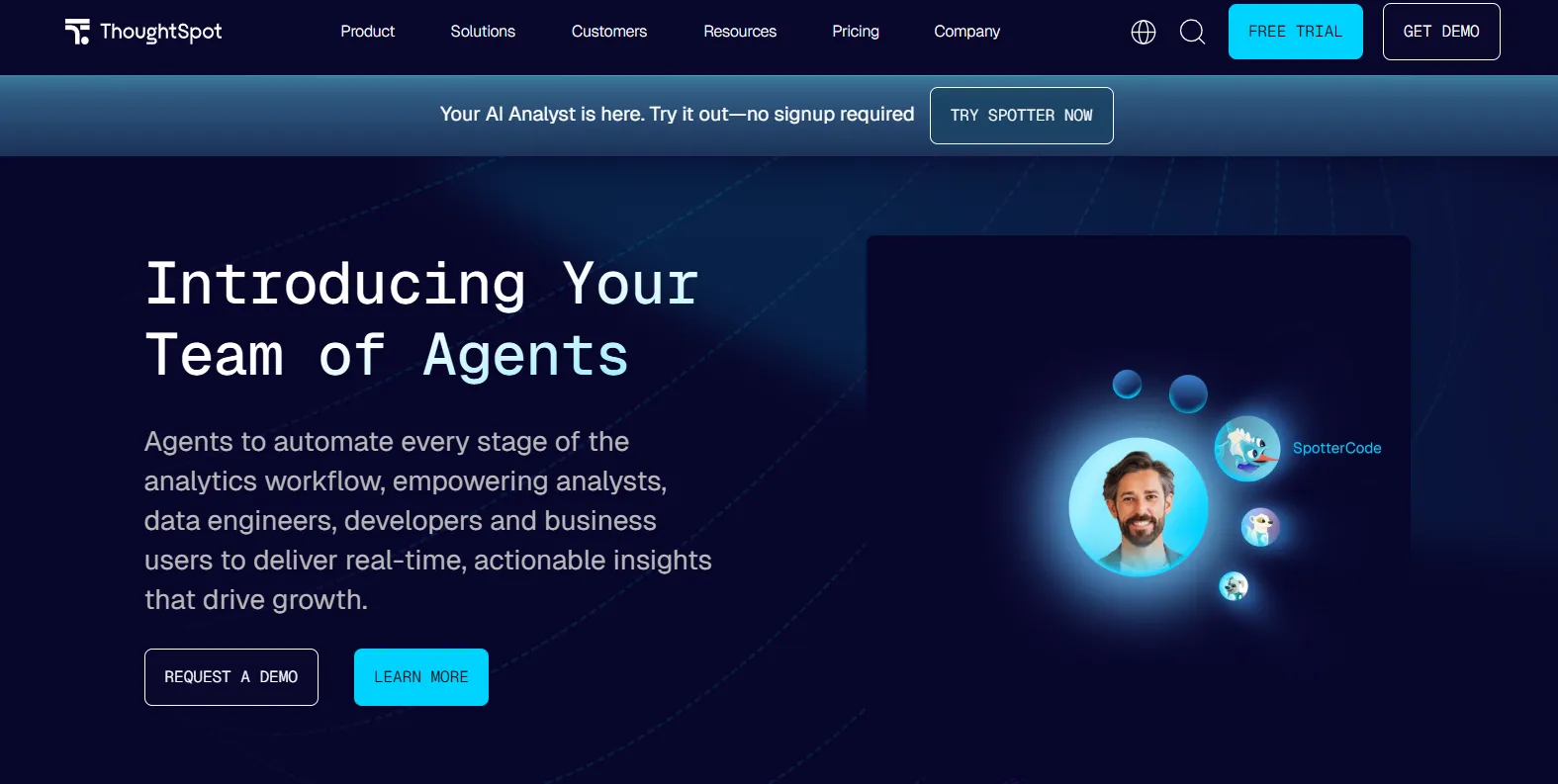
ThoughtSpot is an AI-driven analytics platform designed to help users ask questions in plain language and receive instant answers from live data.
It targets teams that want faster insights, less manual dashboard work, and analytics that surface directly inside business workflows rather than sitting behind a SQL editor like Vanna AI.
ThoughtSpot's Top Features
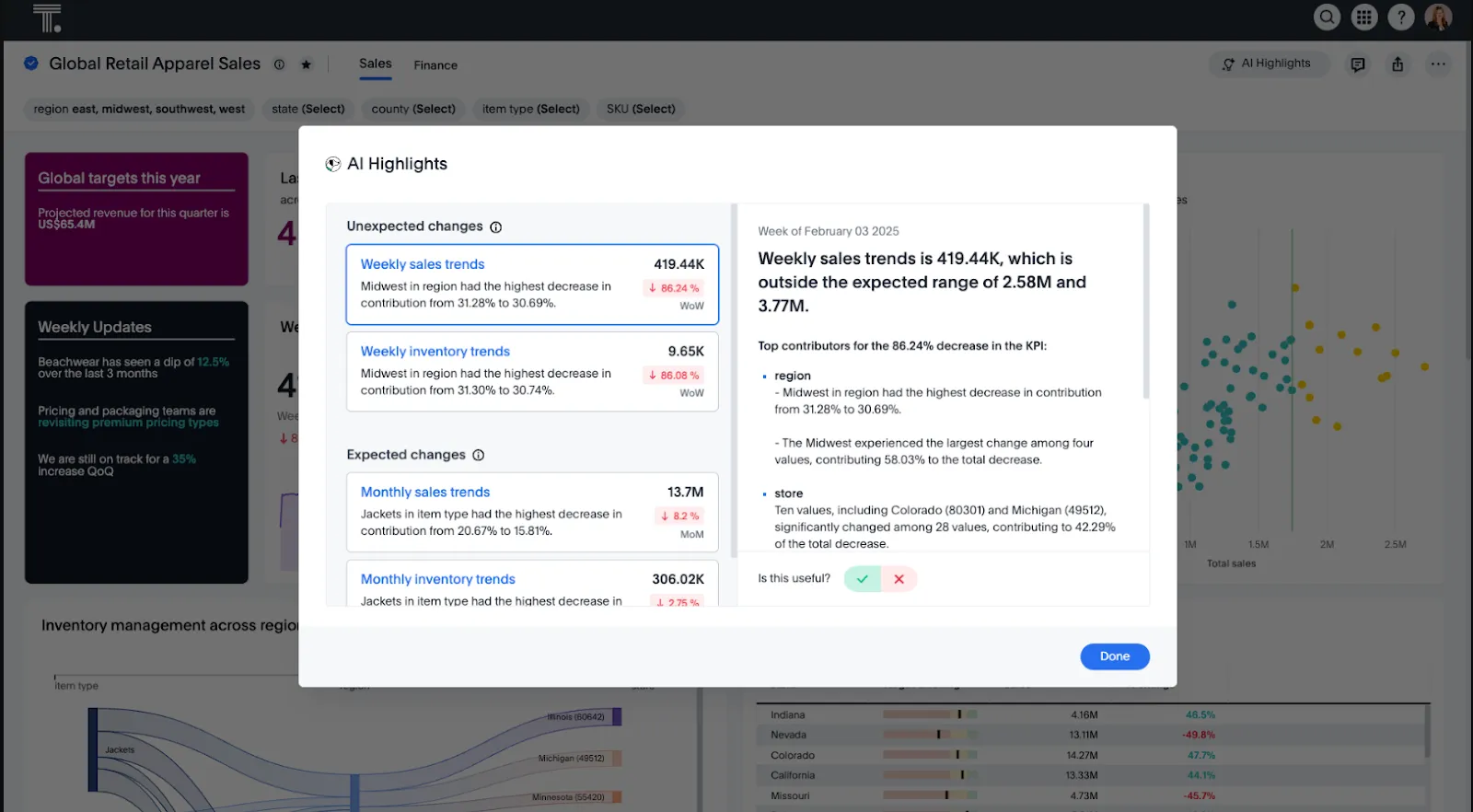
- Natural language analytics: Type questions in plain English and get instant, governed results from live data without building or navigating dashboards.
- AI agents for analytics workflows: Agentic tools like Spotter automatically generate analyses, dashboards, and insights from structured and unstructured data, cutting down on manual reporting.
- Automated dashboards with SpotterViz: Turn data into complete, styled dashboards instantly without manual layout, formatting, or chart configuration.
ThoughtSpot Pricing
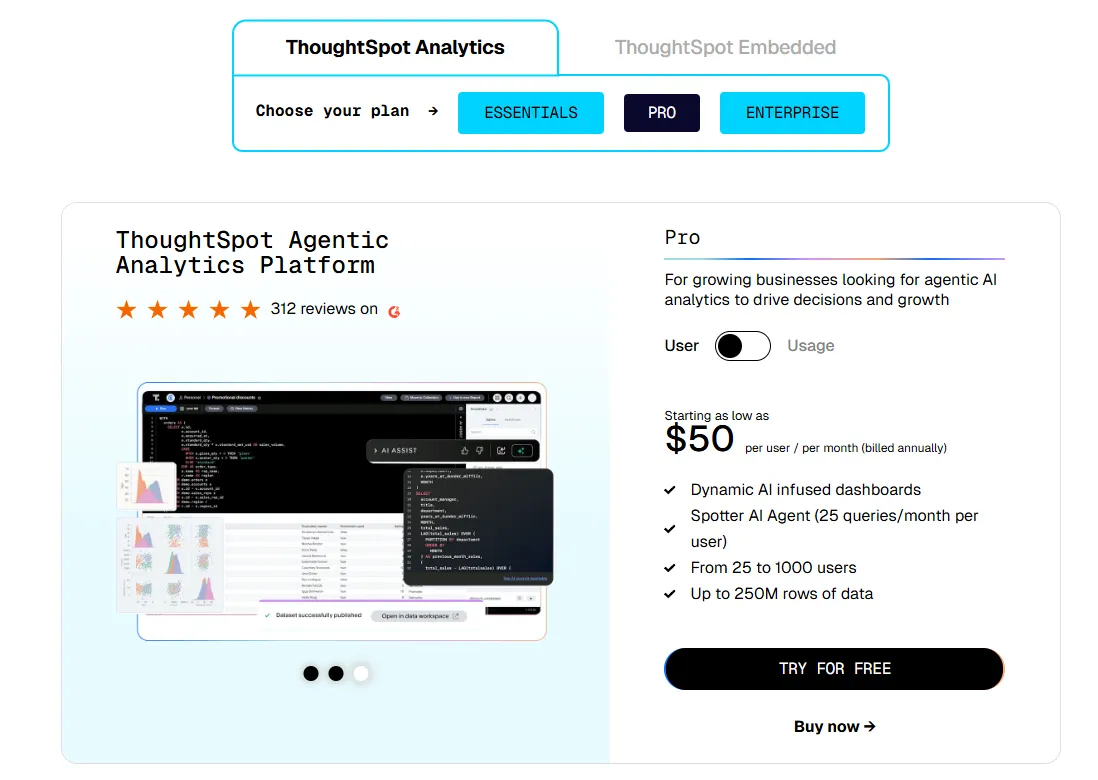
ThoughtSpot offers two separate products - ThoughtSpot Analytics for internal BI and ThoughtSpot Embedded for building analytics into applications - each with flexible pricing depending on scale and usage:
- ThoughtSpot Analytics:
- Essentials: From $25 per user per month (billed annually), for teams of 5-50 users, includes dynamic interactive dashboards and AI-powered insights and supports up to 25M rows of data.
- Pro (per user pricing): From $50 per user per month (billed annually), for 25–1,000 users, includes everything in Essentials, plus AI-infused dashboards and Spotter AI Agent (25 queries per user/month), and supports up to 250M rows of data.
- Pro (usage-based): From $0.10 per query, includes everything in Pro per user, and adds Analyst Studio.
- Enterprise (user or usage-based): Custom pricing, includes everything in Pro, plus unlimited users and data.
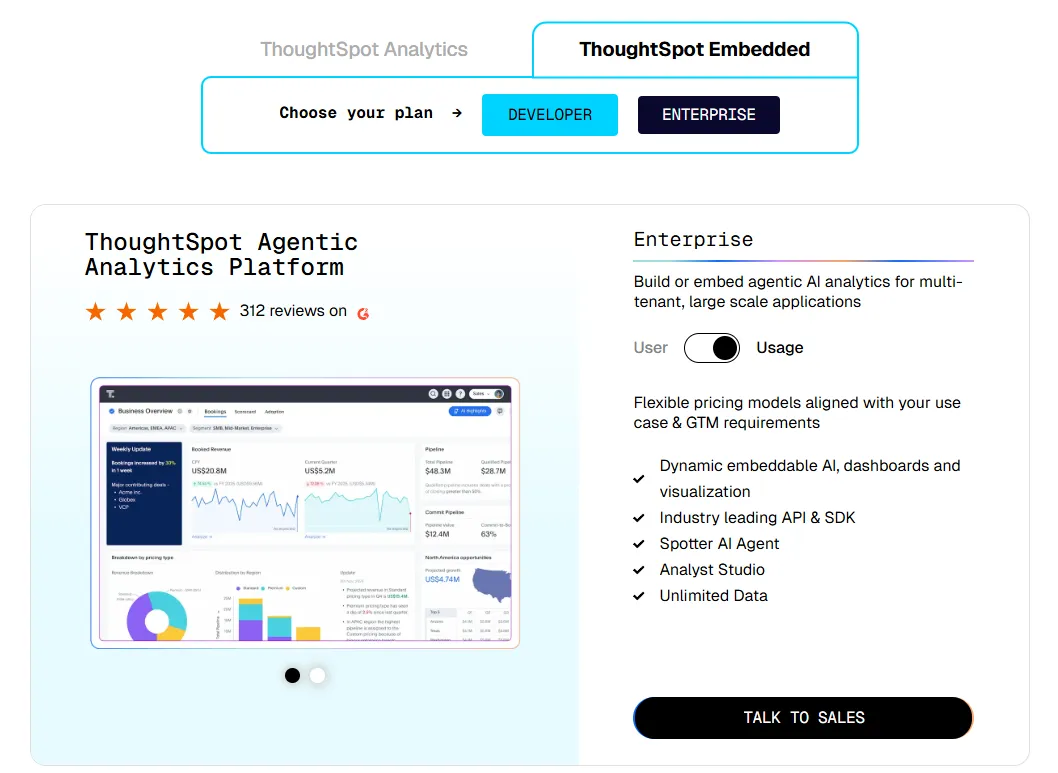
- ThoughtSpot Embedded:
- Developer: Free for 1 year, includes embeddable AI analytics, dashboards, and visualizations, APIs and SDKs, up to 10 users and 25M rows of data.
- Enterprise (user-based): Custom pricing, includes everything in Developer, plus unlimited data.
- Enterprise (usage-based): Custom pricing, everything in Enterprise, plus Spotter AI Agent and Analyst Studio.
ThoughtSpot Pros and Cons
✅ Accessible to non-technical users thanks to natural language search and guided analytics, which removes the SQL barrier that Vanna AI still requires users to work around.
✅ Built-in AI helps surface patterns, trends, and explanations faster than traditional dashboards or manual query generation.
❌ Custom and usage-based pricing makes costs harder to predict, especially at scale.
#3: Supaboard
Best for: Organizations that want AI-powered business intelligence with no-code dashboards and natural-language analytics instead of traditional BI modeling workflows.
Similar to: Zenlytic, Tellius.
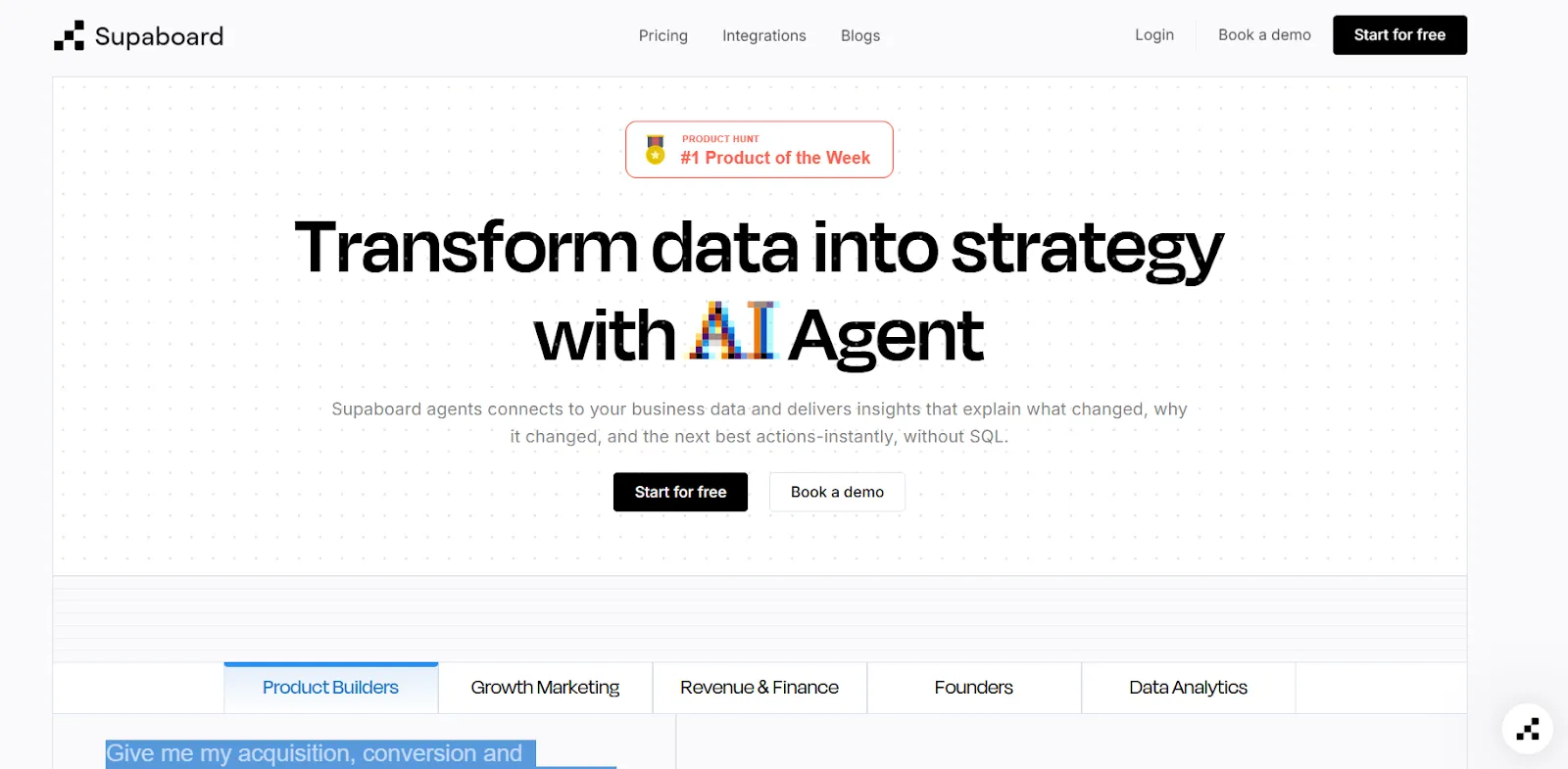
Supaboard is an AI-driven analytics platform that connects to your data sources and automatically generates dashboards, insights, and reports without requiring SQL or complex setup.
Where Vanna AI focuses on converting natural language to SQL for developers, Supaboard focuses on speed and simplicity, letting business users ask questions in plain English and get visual answers without depending on a data team.
Supaboard's Top Features
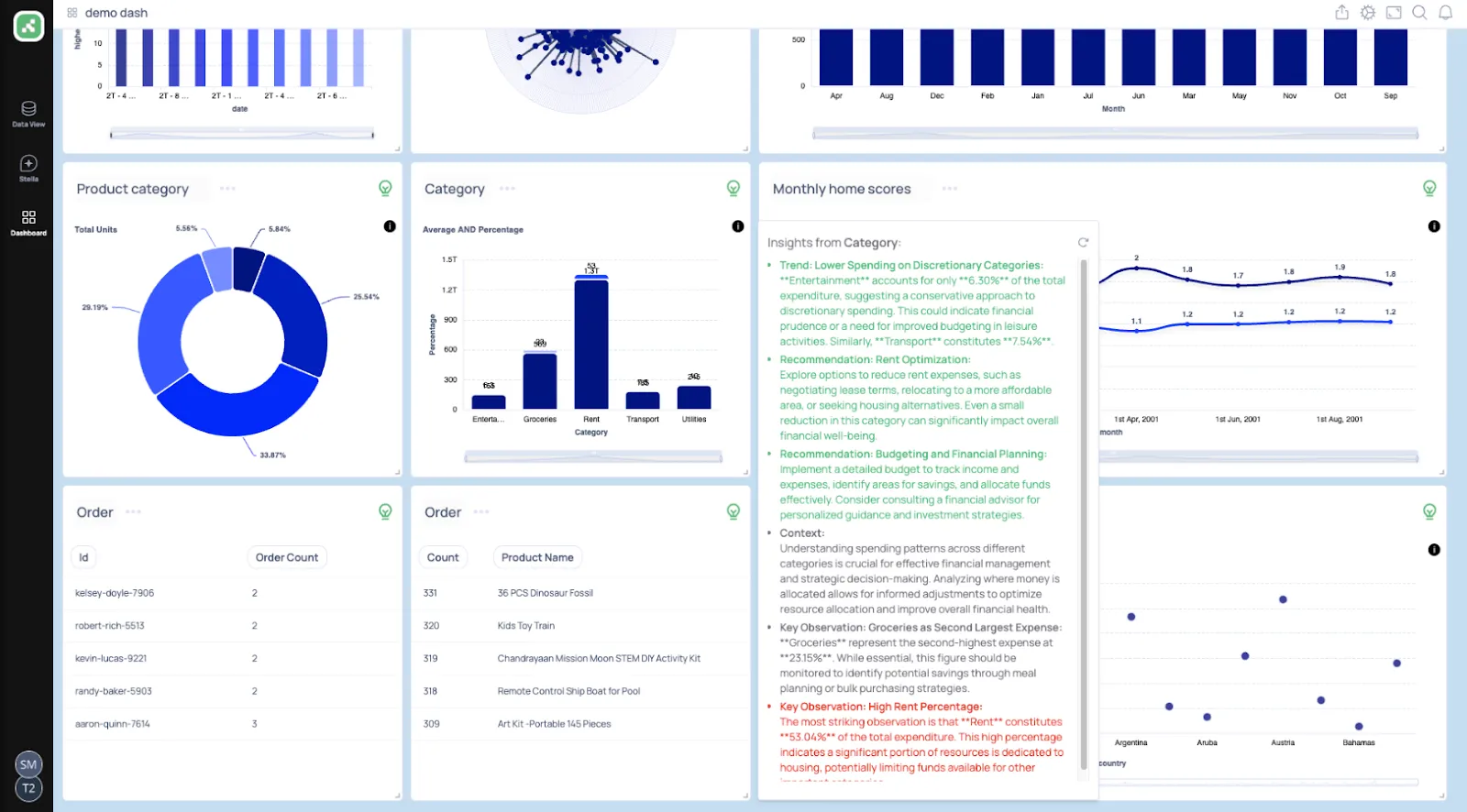
- Trainable AI agents: Create AI agents trained on your business logic, rules, SLAs, and definitions to deliver context-aware insights without building or maintaining data models.
- Natural language data chat: Ask questions conversationally and instantly receive metrics, charts, explanations, and recommended actions.
- AI-generated real-time dashboards: Describe what you need, and Supaboard automatically builds interactive dashboards, KPIs, and tables that update live.
Supaboard Pricing
Supaboard offers three main pricing tiers:
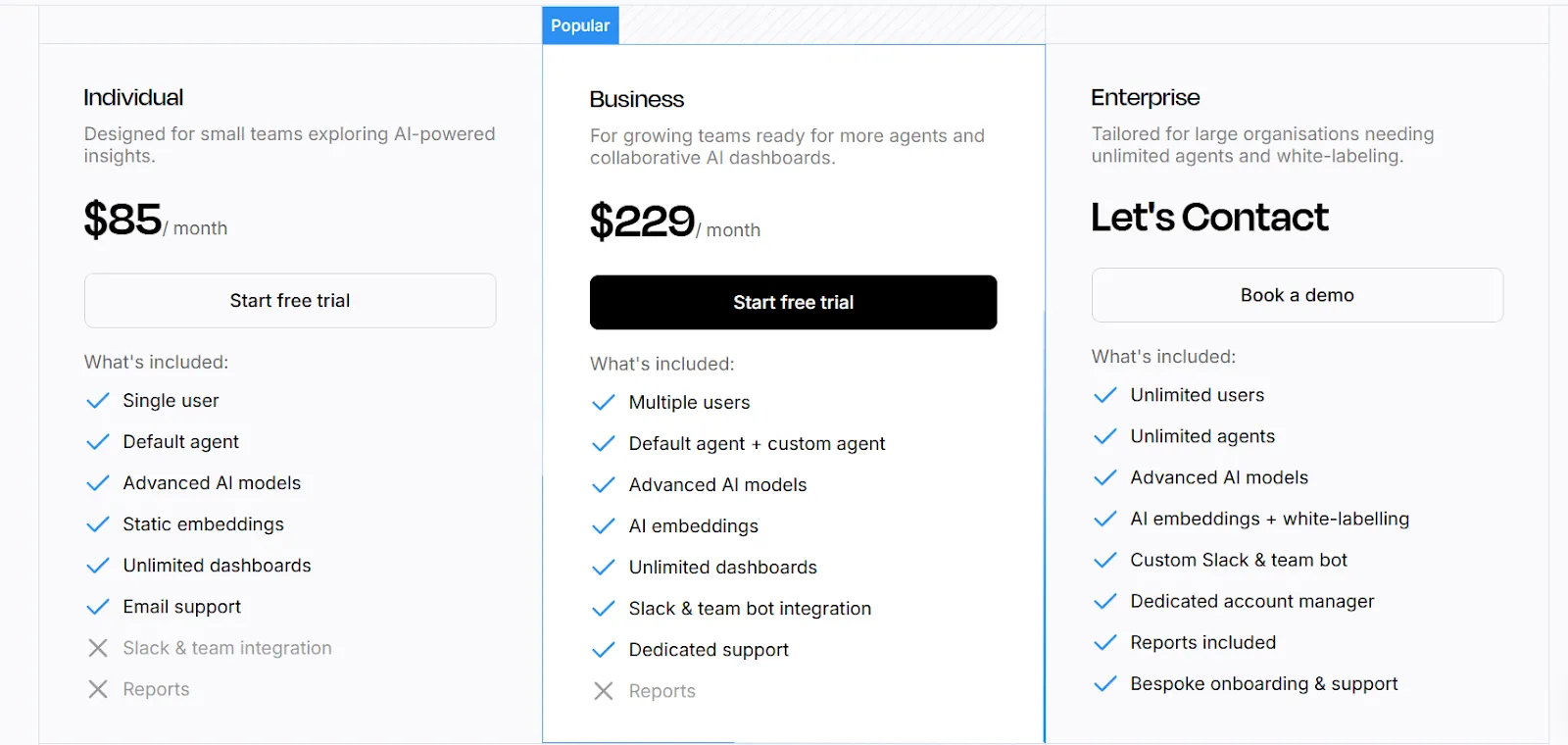
- Individual: $85/month, includes a single user, default AI agent, advanced AI models, static embeddings, unlimited dashboards, and email support.
- Business: $229/month, includes everything in Individual plus multiple users, custom agents, AI embeddings, Slack and team bot integration, and dedicated support.
- Enterprise: Custom pricing, includes everything in Business plus unlimited users and agents, AI embeddings with white-labeling, custom Slack and team bot integrations, a dedicated account manager, reports, and bespoke onboarding.
Supaboard Pros and Cons
✅ Very easy to connect data sources, including large CSV and KPI files, which makes getting started faster than training a Vanna AI model from scratch.
✅ Natural-language querying makes data analysis fast and accessible for non-technical team members.
❌ Limited dashboard customization compared to traditional BI tools, which may frustrate teams that need precise visual control.
❌ Still a newer platform, so the ecosystem and community support are smaller than more established alternatives.
#4: Tellius
Best for: Analytics teams that need fast, explainable answers to complex business questions without relying on dashboards, SQL, or constant analyst support.
Similar to: ThoughtSpot, DataGPT.
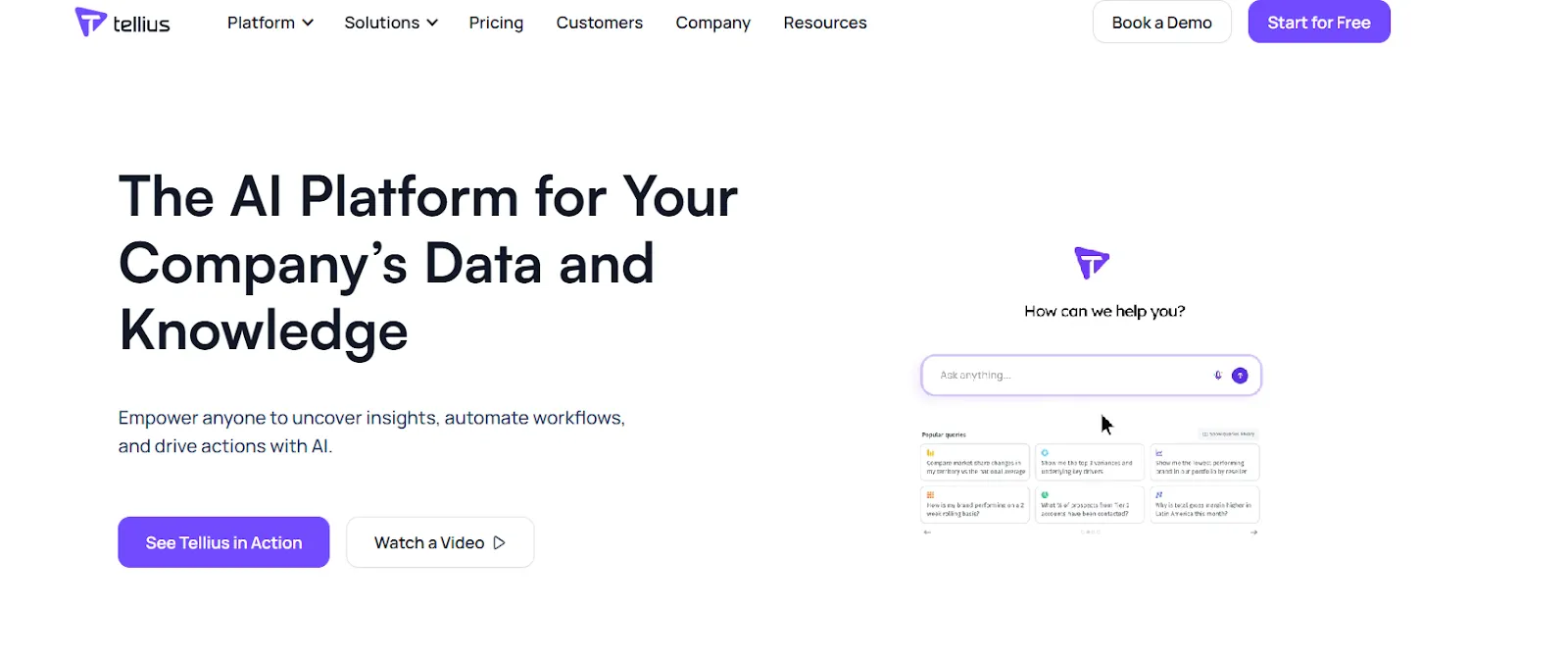
Tellius is an analytics platform that lets anyone ask natural-language questions across enterprise data and get instant answers backed by automated root cause and key driver analysis.
It combines conversational analytics, explainable AI insights, and GenAI narratives to move teams from dashboards to decisions quickly.
Tellius' Top Features
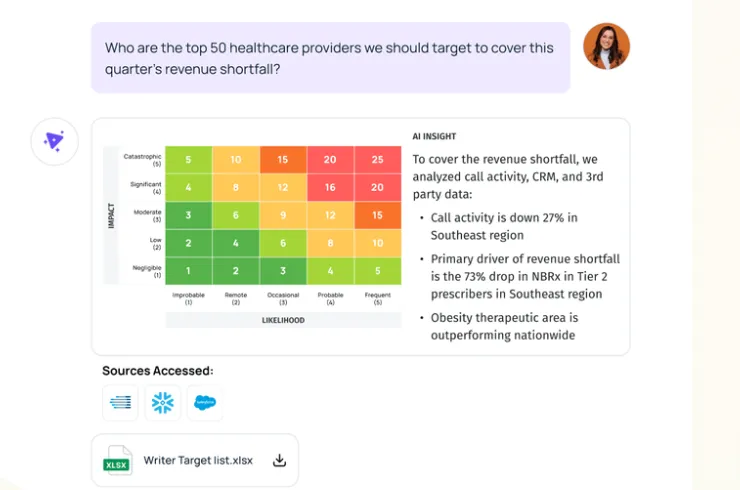
- Chat-based analytics on enterprise data: A conversational interface sits on top of governed datasets and lets users ask multi-layered business questions, receiving context-aware answers instead of raw SQL output.
- Automated root cause and driver analysis: The platform digs into billions of data points to surface the factors behind metric changes, including trends, cohort shifts, and anomalies, and delivers proactive alerts when something important shifts.
- AI-generated narratives and visualizations: Instead of handing back a table and a chart, Tellius turns complex analysis into interactive visuals paired with written explanations that teams can explore and share without rebuilding anything from scratch.
Tellius Pricing
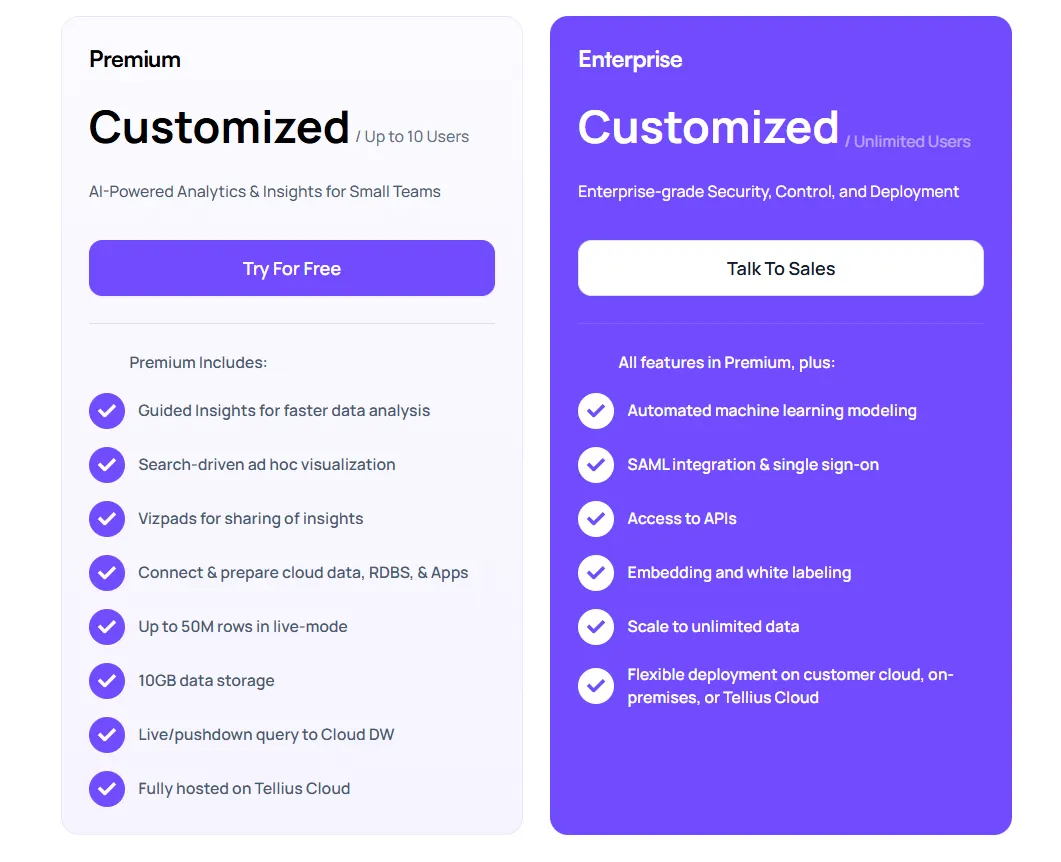
Tellius has not publicly disclosed fixed pricing, but offers two plans:
- Premium: Custom pricing for up to 10 users, includes conversational analytics, guided insights, search-driven ad-hoc visualizations, Vizpads for sharing insights, live queries to cloud data warehouses, data prep across cloud apps and databases, up to 50M rows in live mode, and 10GB storage.
- Enterprise: Custom pricing with unlimited users, includes everything in Premium plus automated machine learning modeling, SAML and SSO, API access, embedding and white-labeling, unlimited data scale, and flexible deployment options.
Tellius Pros and Cons
✅ The visual-first interface is easy to navigate, making it possible for business users to explore data and understand results without leaning on analysts.
✅ The depth of AI-powered analysis goes well past what any text-to-SQL tool can deliver, with automated explanations that actually tell you why something changed.
❌ No public pricing or free tier means smaller teams have to commit to a sales conversation before they can even evaluate the platform.
❌ The platform carries more weight than lightweight open-source tools, so onboarding and initial setup take longer for smaller organizations.
#5: DataGPT
Best for: Decision-makers and analytics teams that want analyst-grade answers to complex "why" questions without relying on dashboards, SQL, or shallow text-to-SQL tools.
Similar to: Tellius, Zenlytic.
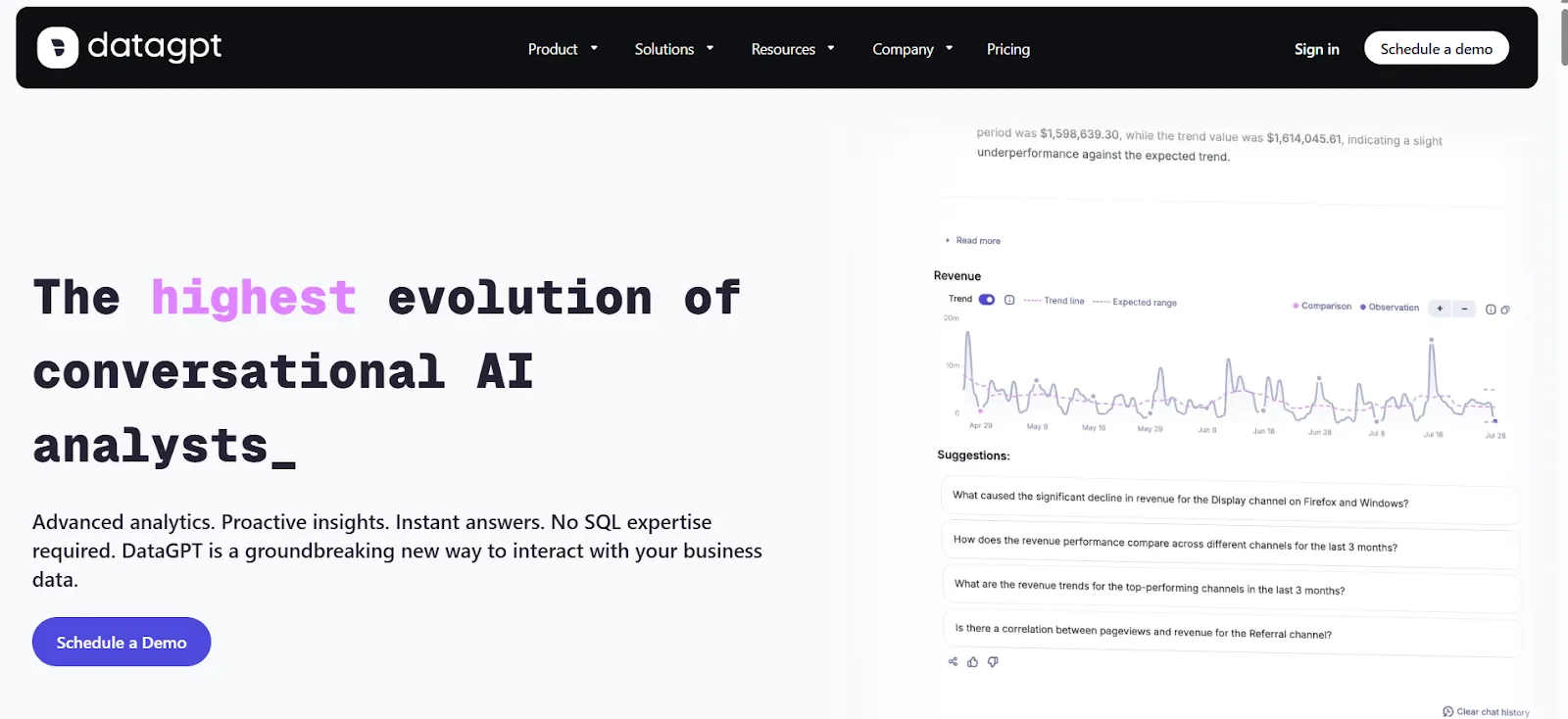
DataGPT operates on a completely different level from Vanna AI's single-query model.
Where Vanna AI generates one SQL query per question, DataGPT plans an entire investigation, executes thousands of queries and statistical tests behind the scenes, and curates the results into a trusted answer about why your metrics are moving.
DataGPT's Top Features
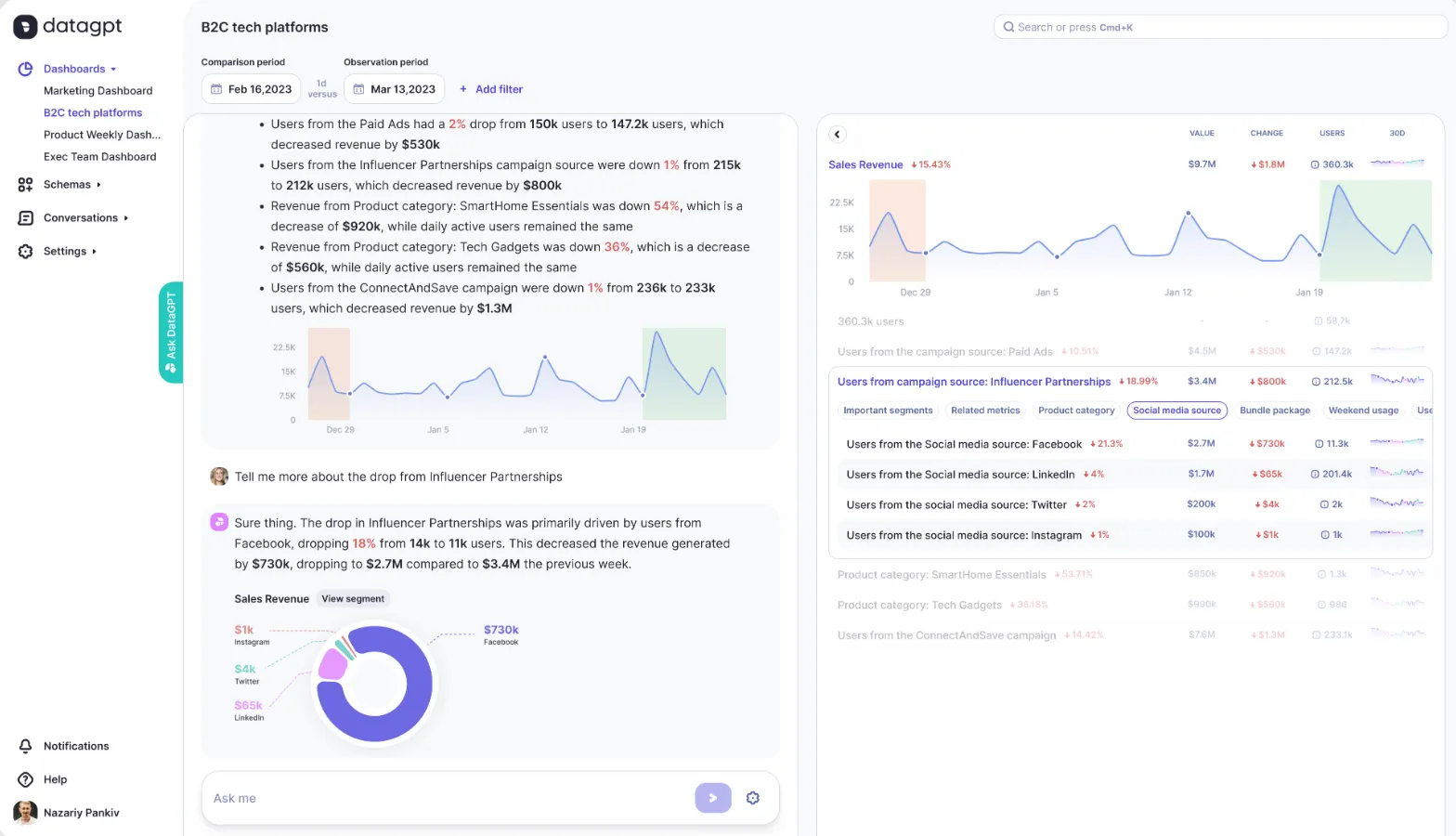
- Multi-step investigative analytics: Instead of translating a question into a single SQL statement, DataGPT builds a full research plan and runs hundreds of queries to deliver analyst-caliber answers about what's driving metric changes.
- Continuous monitoring and alerts: The platform watches your data around the clock and sends daily summaries that highlight key drivers, emerging anomalies, and shifts you might otherwise miss until they show up in a monthly review.
- Self-serve data exploration (Data Navigator): A visual interface lets users drill into any metric, slice by dimensions, and investigate root causes without writing queries or building dashboards.
DataGPT Pricing
DataGPT's Classic product comes in three annual tiers:
- Plus: $2,750/month for 10 users, covering up to 250M rows, 24 months of history, AI Analyst Mode, core and advanced analysis types, and standard support. There's also a $3,000 one-time onboarding fee per additional schema.
- Premium: $5,000/month for 50 users with up to 500M rows, premium support, and a $5,000 onboarding fee per schema.
- Enterprise: Starting at $7,500/month with custom user and data volumes, enterprise security, and premium support.
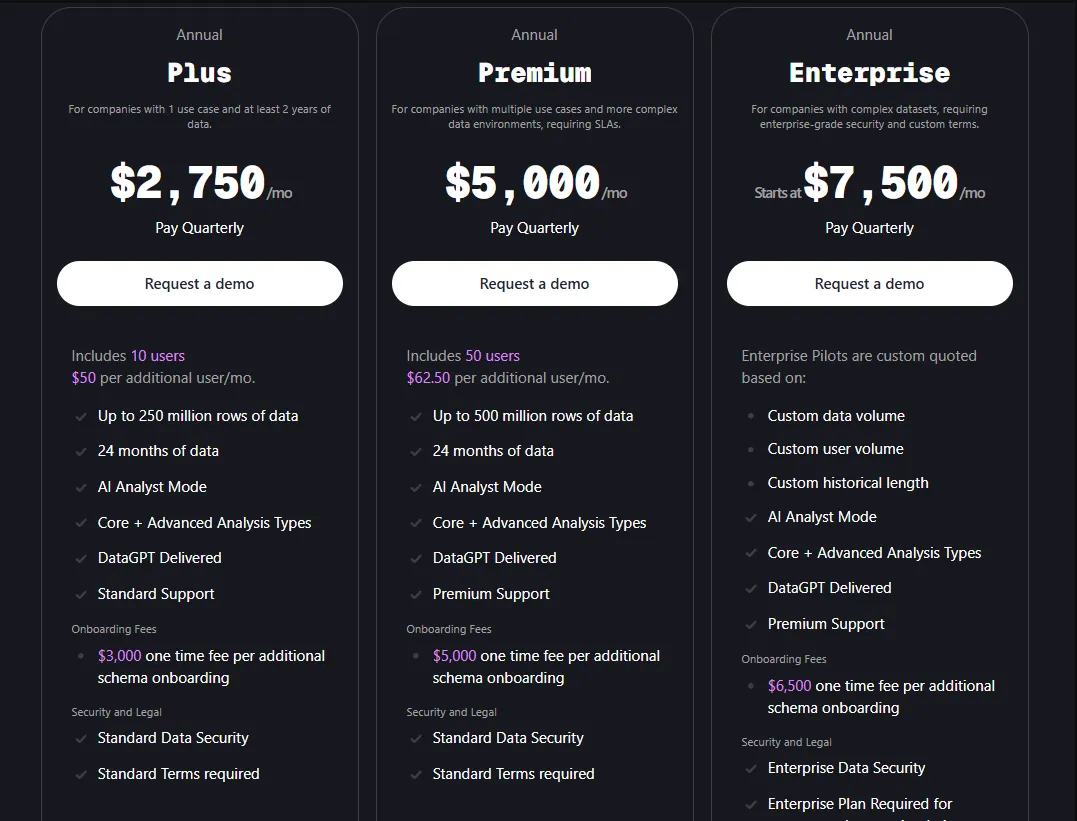
If you want to test it before committing annually, three-month pilots start at $10,000 for the Plus tier.
DataGPT Pros and Cons
✅ Breaks down large datasets and compares segments with real depth, explaining exactly why metrics shifted across products, regions, or time periods, something Vanna AI has no mechanism for.
✅ The interface is approachable enough that business users can run analyst-level investigations on their own.
❌ Can be expensive for smaller teams.
❌ The platform is heavily optimized for "why" analysis, so if you need broad BI functionality like dashboarding or scheduled reports, you'll likely need another tool alongside it.
#6: Zenlytic
Best for: Data teams that want governed, explainable self-serve analytics and business users who need fast, trustworthy answers without breaking the semantic layer.
Similar to: ThoughtSpot, Holistics.
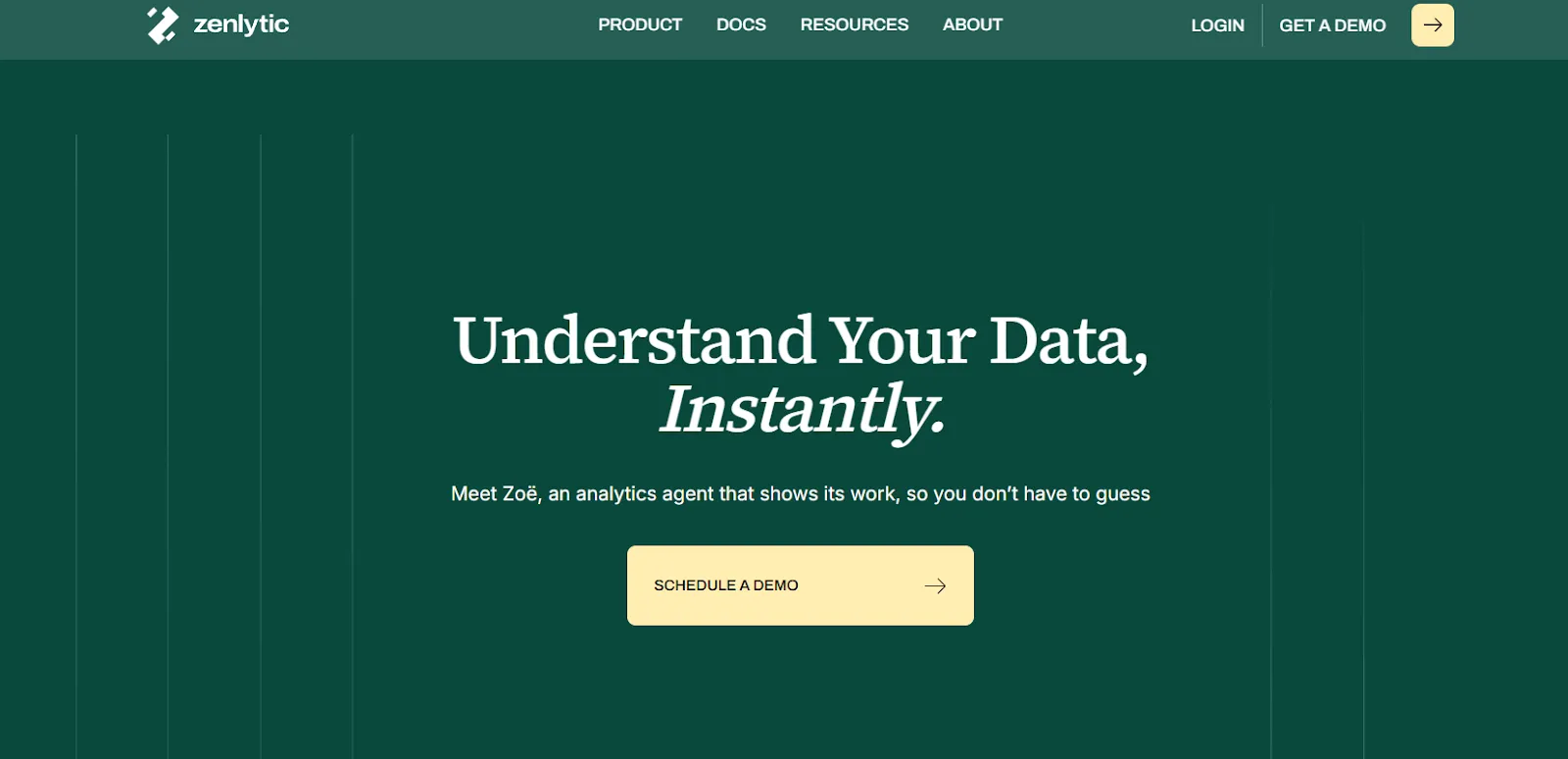
Zenlytic tackles one of the biggest issues with text-to-SQL tools like Vanna AI: trust.
Its AI agent, Zoe, sits on top of a governed semantic layer and shows exactly how every answer was produced, including the logic, the data sources, and the calculations behind each number, so users can verify results instead of hoping the generated SQL was correct.
Zenlytic's Top Features
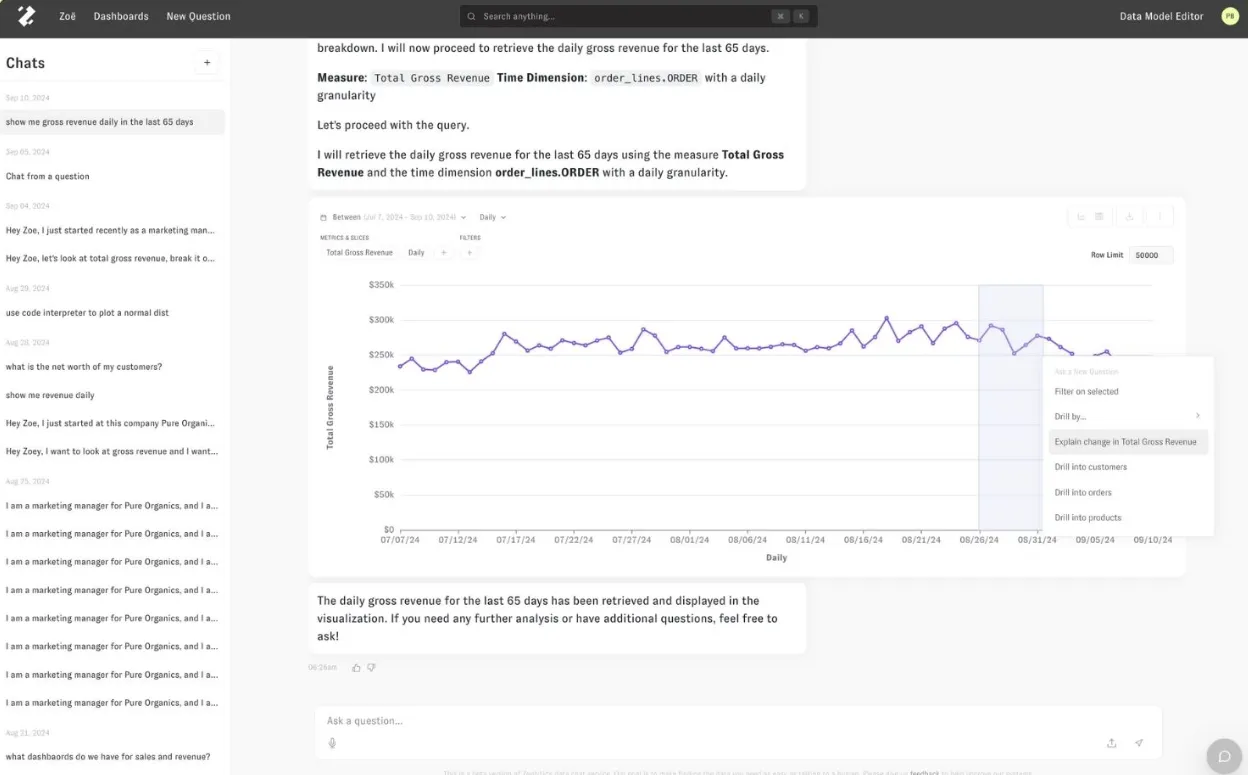
- AI agent with full explainability (Zoe): Answers natural-language questions across messy, multi-source data while showing its reasoning at every step, so both technical and business users can trust the output and ask follow-up questions confidently.
- Locked-in metric consistency (Memories): Teams pin down definitions, assumptions, and calculation methods with a single click, which guarantees the AI returns the same answer to the same question regardless of who's asking or when.
- Full citation trail: Every number links back to its source data and calculation path, letting users click through and verify exactly where a result came from instead of guessing whether the AI got it right.
Zenlytic Pricing
Zenlytic doesn't share fixed prices on its website.
You'd need to book a demo with their team to see the platform and get a custom quote based on your setup.
Zenlytic Pros and Cons
✅ Quick to get running and low-maintenance, with a semantic layer that enforces metric consistency without requiring heavy data engineering effort.
✅ Self-serve analytics actually work here because the governed layer prevents business users from accidentally breaking metric logic or pulling incorrect numbers.
❌ Questions that fall outside the boundaries of the semantic layer can feel constrained, which limits the kind of open-ended exploration some teams need.
❌ Without public pricing or a free tier, smaller teams have no way to test it without going through a sales process first.
#7: Sigma
Best for: Teams that want spreadsheet-like analytics and AI-powered workflows on live warehouse data, without complex BI setup.
Similar to: Omni, Holistics.
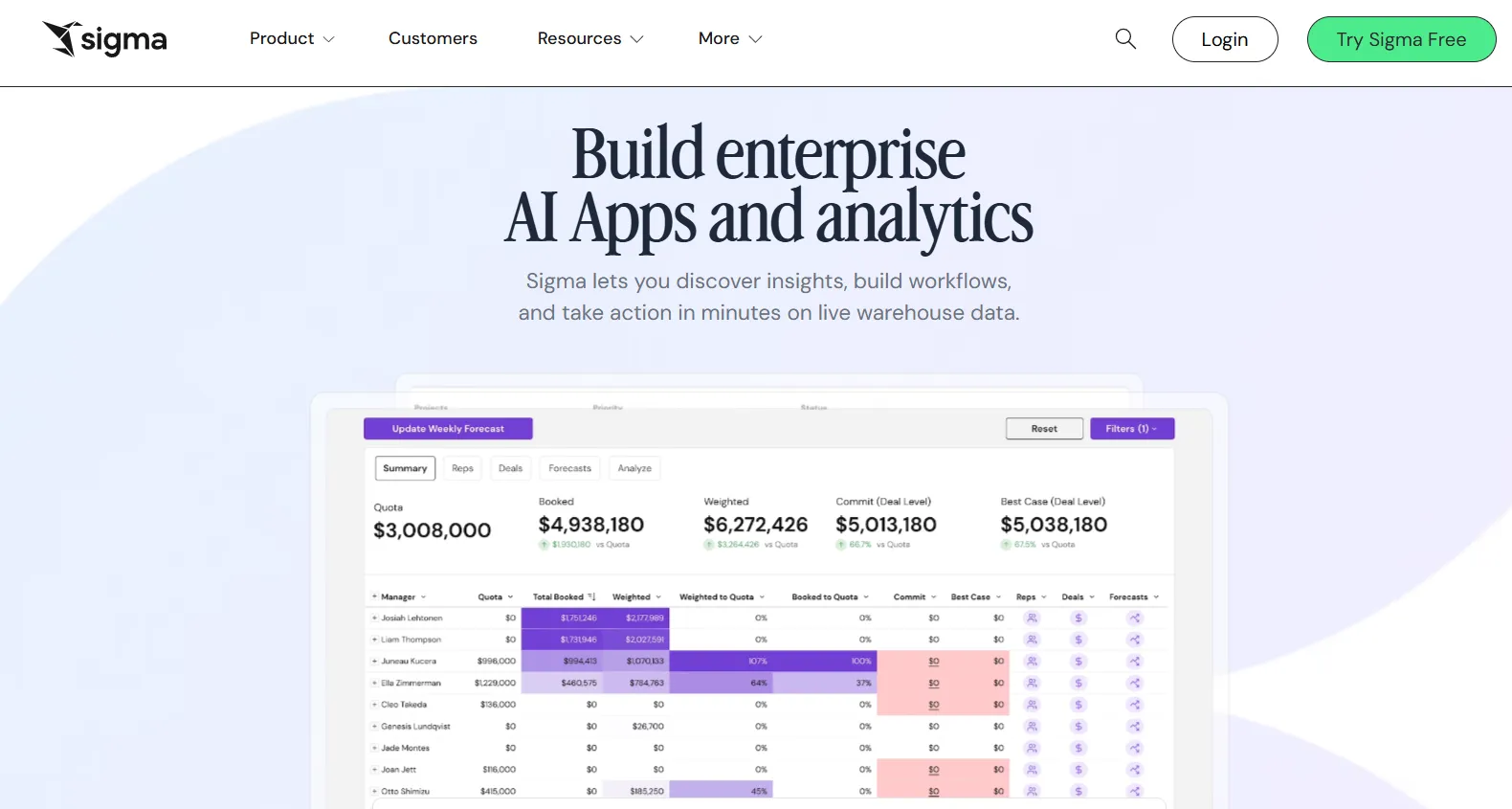
Sigma bridges the gap between the spreadsheet workflows teams already know and the warehouse-scale data they need to analyze.
Instead of asking users to learn SQL like Vanna AI does, or forcing them into rigid dashboard builders, Sigma puts a familiar Excel-style interface directly on top of live warehouse data so anyone comfortable with formulas and pivot tables can analyze billions of rows without leaving their comfort zone.
Sigma's Top Features
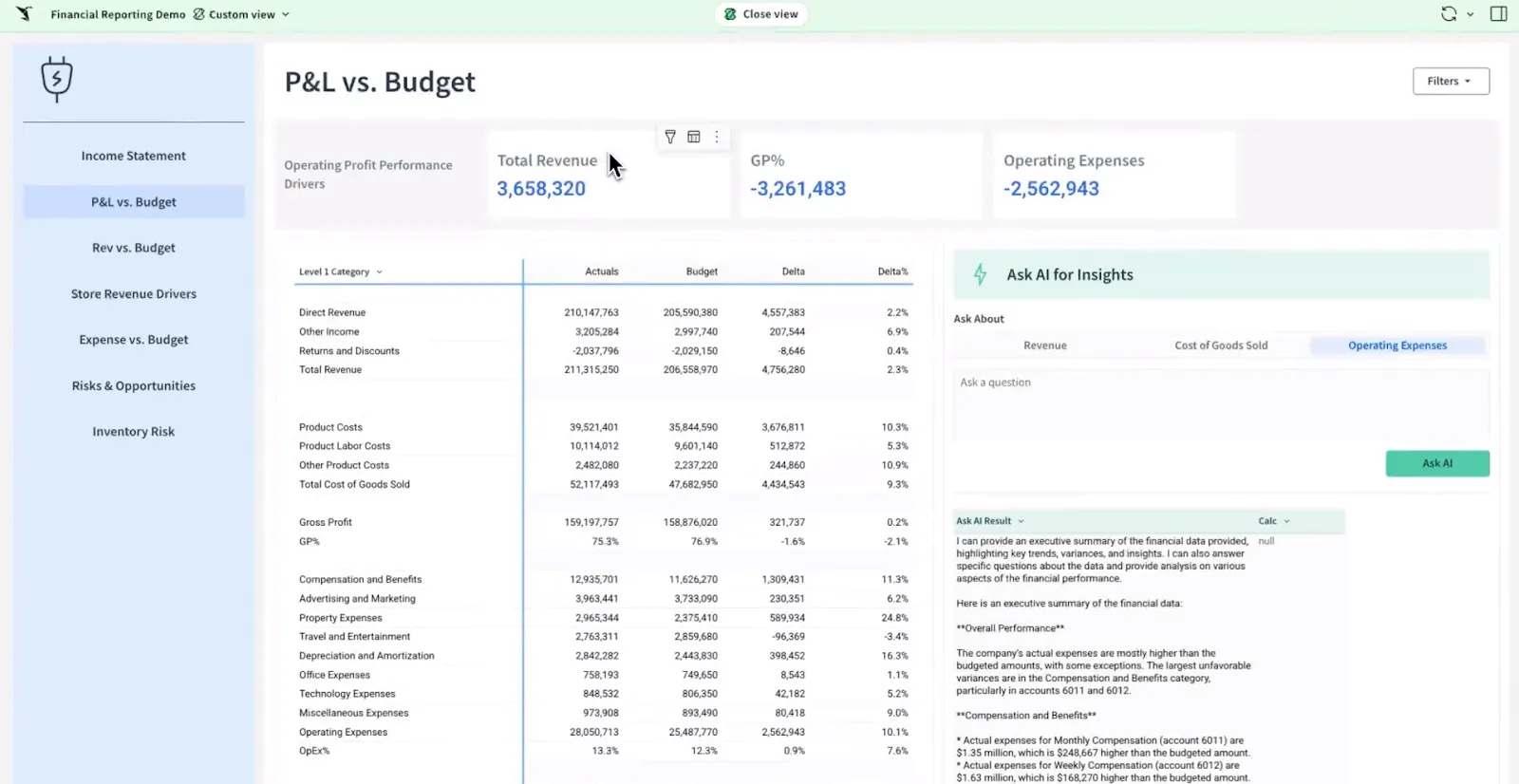
- Excel-style interface on warehouse data: Work with formulas, tables, and calculations in a layout that feels like a spreadsheet, but runs against live Snowflake, BigQuery, or Databricks data with no extracts or duplication.
- AI-powered app and dashboard creation: Use natural language to generate dashboards, reports, and full data applications that plug into real business workflows, not just static charts.
- Operational planning apps: Build interactive tools for budgeting, forecasting, capacity planning, and pipeline management without writing custom code or relying on engineering resources.
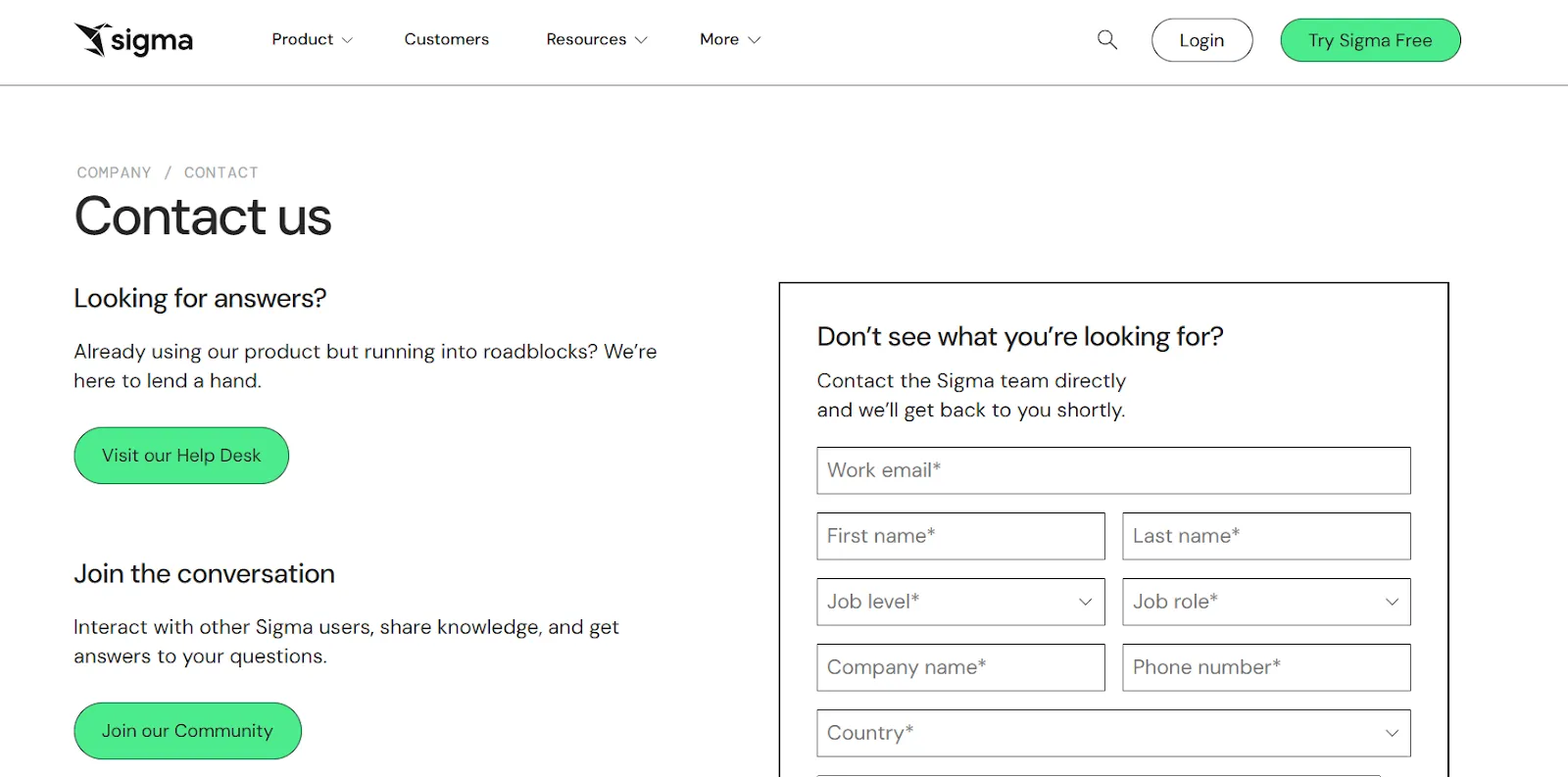
Sigma Pricing
Sigma keeps its pricing private.
You'd need to reach out to their sales team for a custom quote tailored to your usage and team size.
Sigma Pros and Cons
✅ The spreadsheet interface makes it immediately usable for anyone who already knows their way around Excel, which bypasses the SQL requirement that Vanna AI imposes on users.
✅ All analysis runs directly on live warehouse data, so results are always current without manual refreshes or data exports.
❌ Chart types and visual design options are more limited than what you'd find in dedicated visualization tools, which can be a constraint for teams with specific presentation needs.
❌ Complex data models and heavy transformations can strain performance if the backend isn't optimized carefully, especially on larger datasets.
#8: Holistics
Best for: Teams that need governed self-service analytics with a flexible semantic layer and strong collaboration between analysts and business users.
Similar to: Looker, Omni.
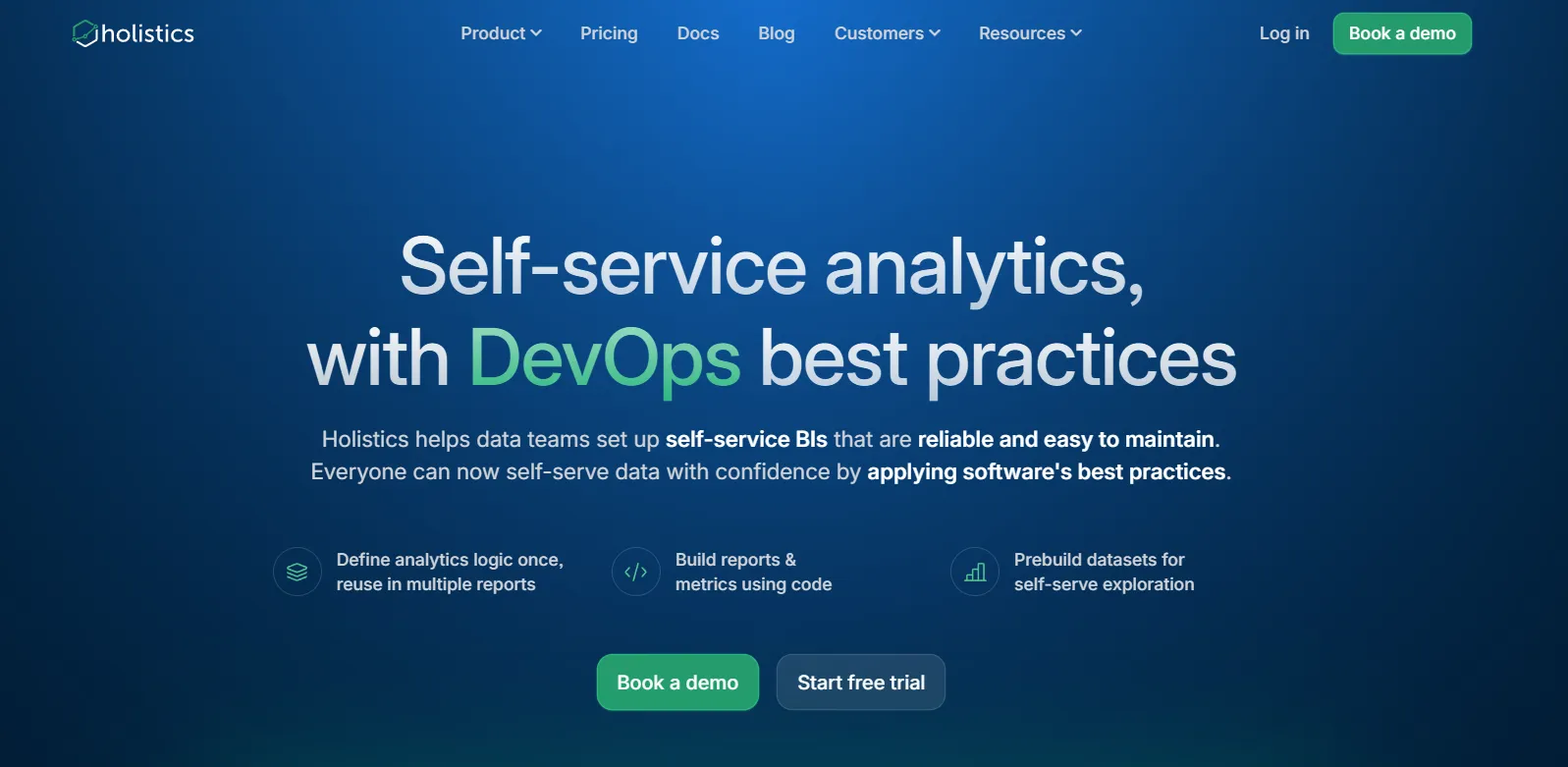
Holistics brings a software engineering mindset to business intelligence, with version-controlled data models, Git integration, and a declarative modeling layer that keeps metric definitions locked down across every dashboard and report.
For teams frustrated with Vanna AI's lack of governance and consistency, Holistics provides the structural foundation that ensures everyone across the organization works from the same numbers.
Holistics' Top Features
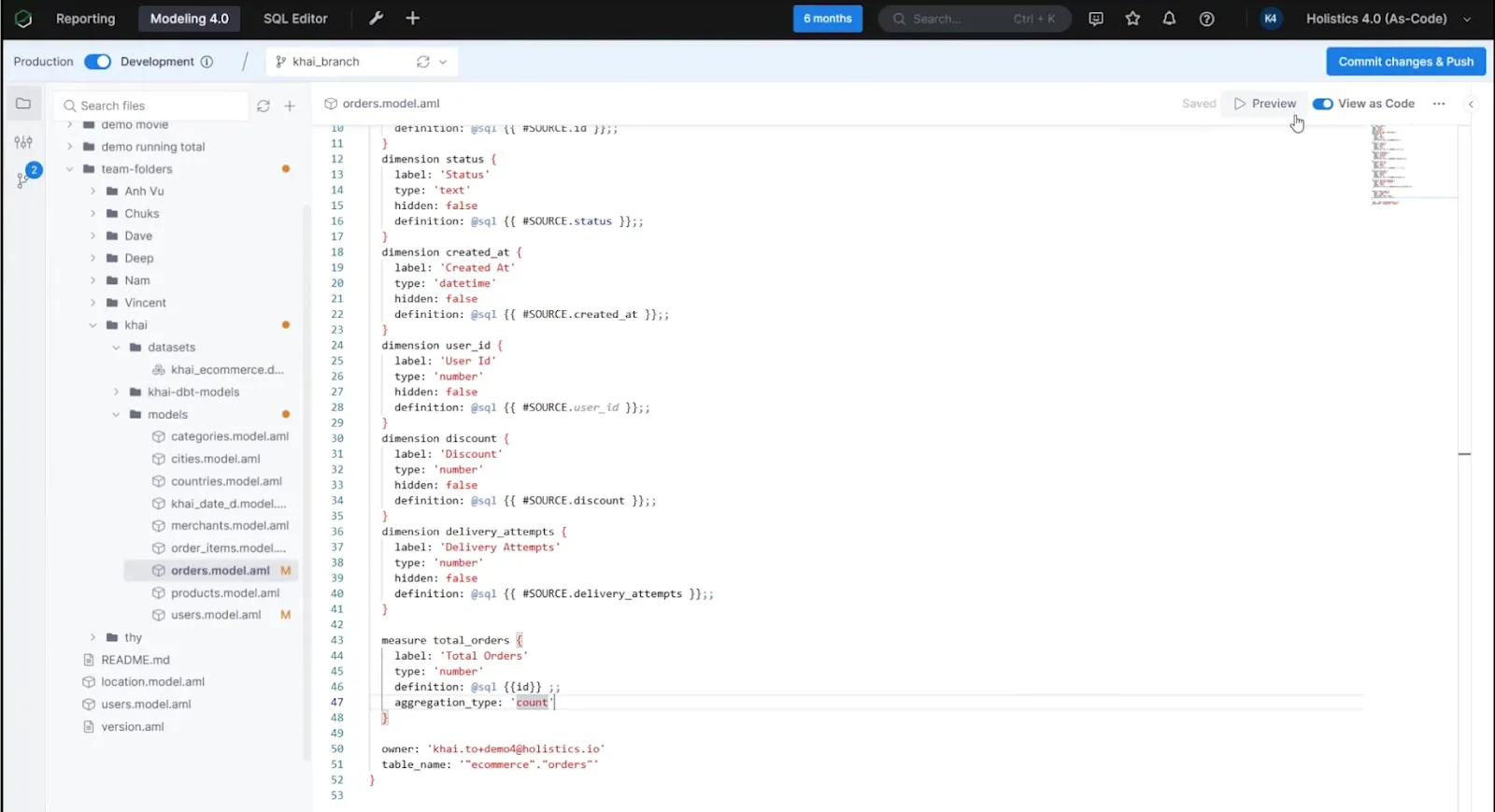
- Drag-and-drop exploration on governed models: Business users build their own reports and dashboards through a visual interface, but every metric, join, and calculation is pre-defined in the model layer so they can't accidentally break the logic.
- Version-controlled analytics (Analytics As-Code): Data teams define business logic using Holistics' DSL or SQL and push everything to Git, bringing branching, pull requests, and code reviews into the BI workflow.
- Single-source metric definitions: Metrics, joins, derived tables, and transformation rules are defined once in the modeling layer and enforced everywhere, eliminating the "whose number is right?" debates that plague tools without centralized governance.
Holistics Pricing
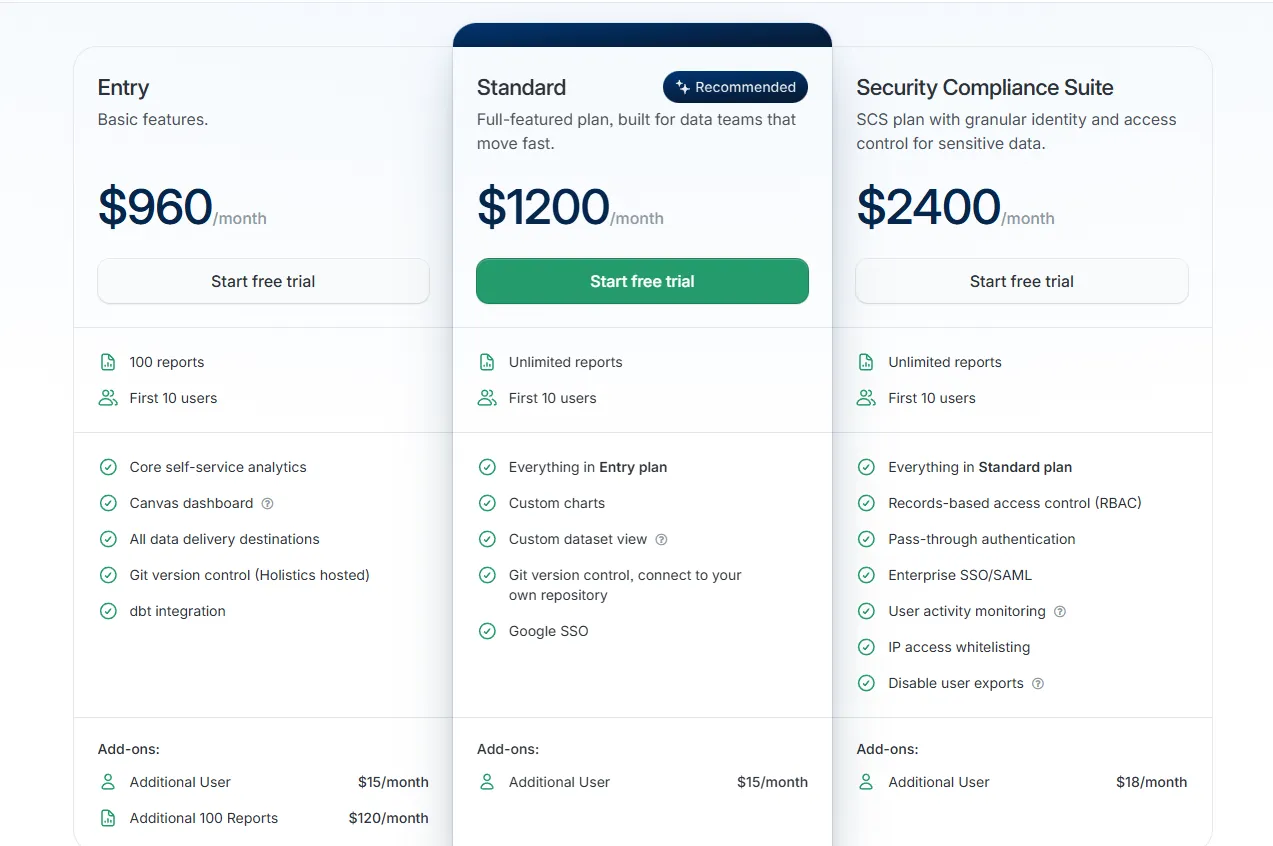
Holistics prices by reports and users, with add-ons for advanced security:
- Entry: $960/month for 100 reports and 10 users, covering core self-service analytics, Canvas dashboards, all delivery destinations, hosted Git version control, and dbt integration. Extra users run $15/month, and each additional 100-report block costs $120/month.
- Standard: $1,200/month for unlimited reports and 10 users, adding custom charts, custom dataset views, your own Git repository connection, and Google SSO. Extra users at $15/month.
- Security Compliance Suite: $2,400/month, layering on RBAC, pass-through authentication, enterprise SSO with SAML, activity monitoring, IP whitelisting, and export controls. Extra users at $18/month.
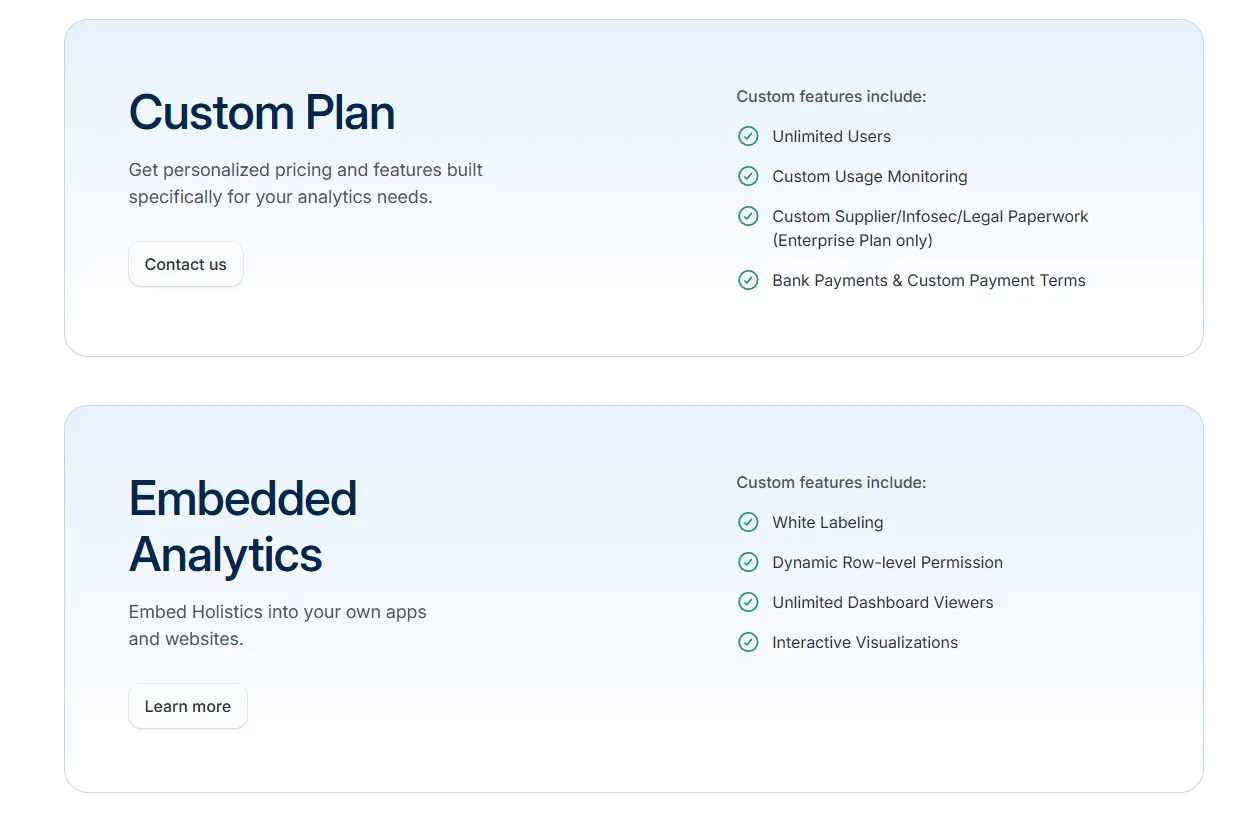
- Custom Plan: Tailored pricing for organizations that need unlimited users, custom monitoring, or advanced compliance configurations.
- Embedded Analytics: Custom pricing for white-labeled dashboards, dynamic row-level permissions, and unlimited viewer access.
Holistics Pros and Cons
✅ The "analytics as code" approach with Git version control gives data teams a level of governance and auditability that Vanna AI's training-based model simply can't match.
✅ Dashboards are powerful and deep, with Canvas layouts, AQL support, and an AI assistant that helps users explore data without leaving the platform.
❌ Query performance can lag on certain warehouse connections, particularly Snowflake, or when dealing with complex, multi-table datasets.
❌ Entry pricing starts close to $1,000 per month, which is a meaningful commitment for smaller teams still validating whether they need this level of governance.
#9: Metabase
Best for: Startups, product teams, and data teams that want fast, affordable, open-source analytics with light AI assistance.
Similar to: Redash, Apache Superset.
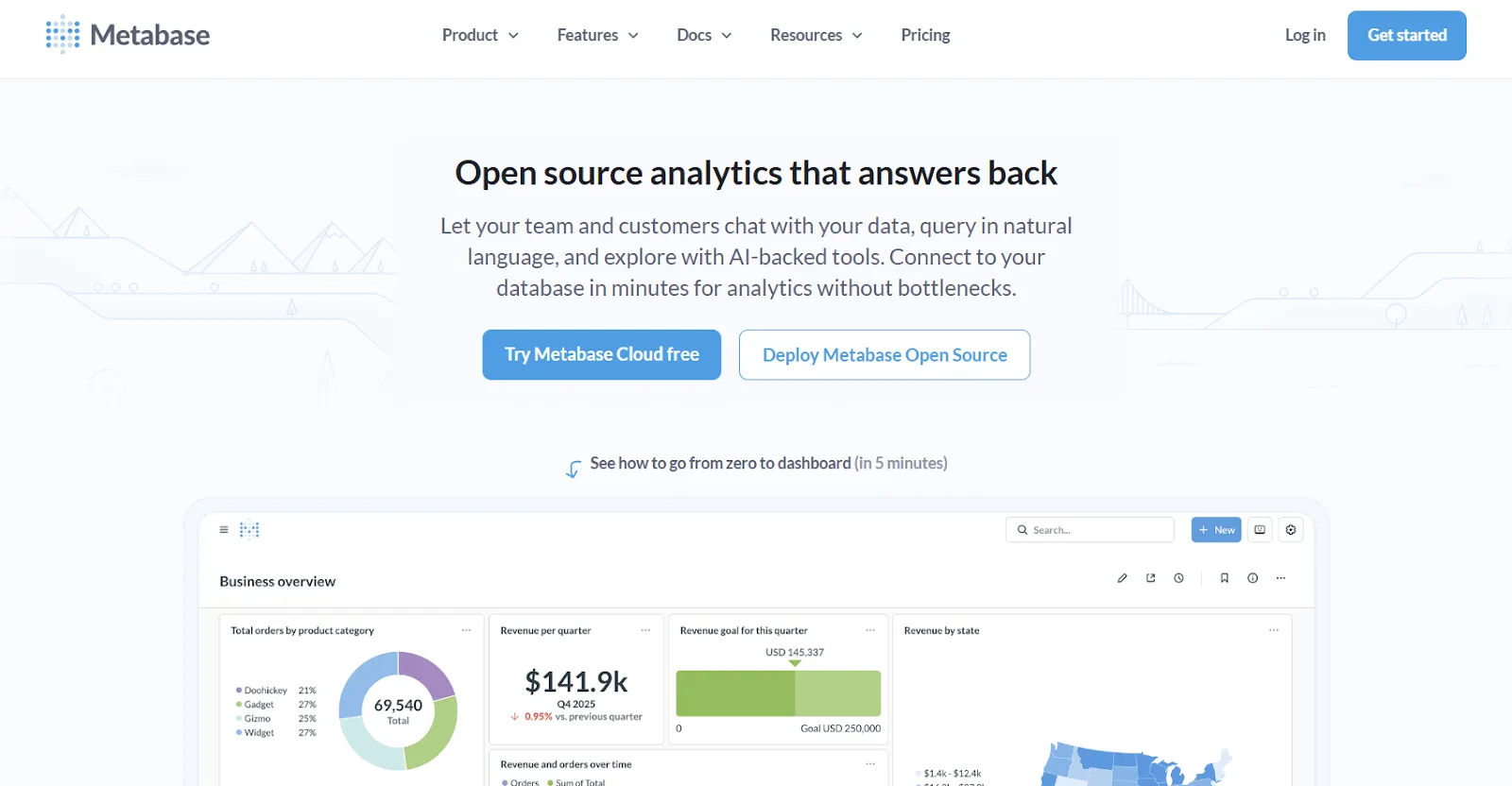
Metabase is the go-to option for teams that want to get analytics up and running quickly without a large budget or a dedicated BI team.
Its open-source core is genuinely production-ready, and the addition of Metabot AI gives non-technical users a way to ask questions in plain English, though the AI layer is still more of an add-on than a core capability compared to purpose-built AI analytics tools.
Metabase's Top Features
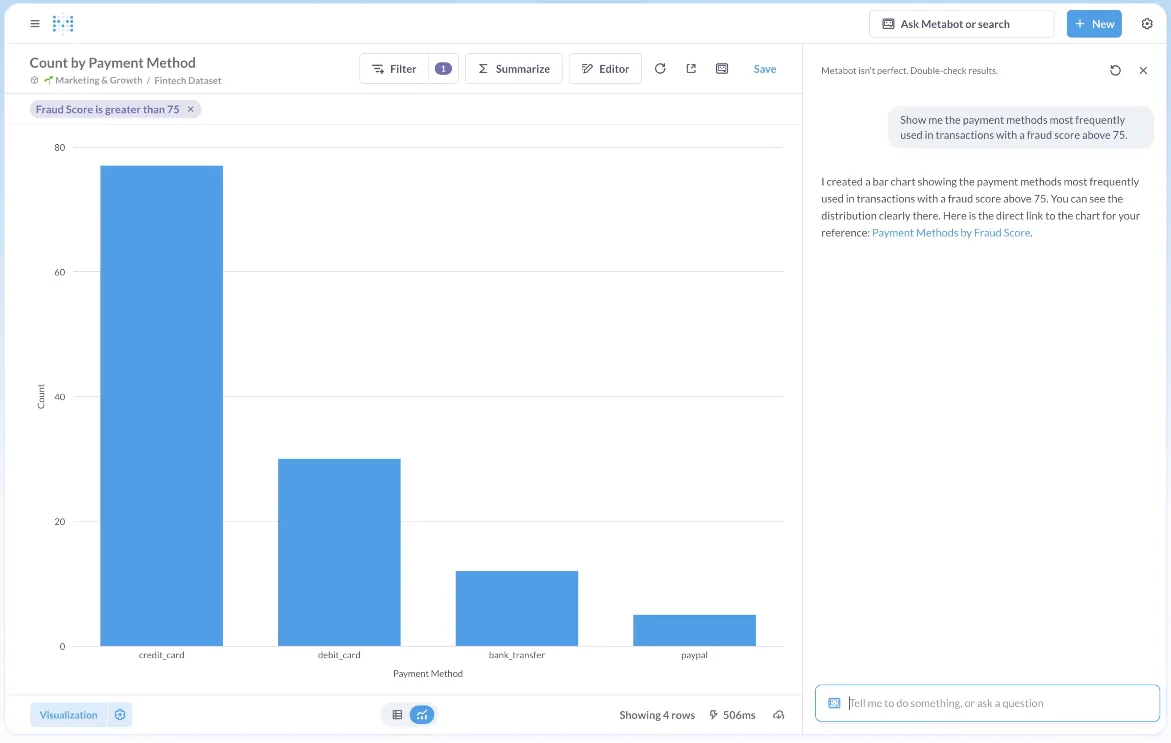
- AI-assisted querying with Metabot: Users type questions in natural language and Metabot generates the queries and visualizations behind the scenes, making basic data exploration possible without any SQL knowledge.
- No-code and SQL query building: A visual builder lets non-technical users filter, summarize, and chart data step by step, while analysts can switch to raw SQL whenever they need more control.
- Interactive dashboards with drill-through: Teams build shared dashboards and click directly into any data point to filter, break out, or zoom into the details behind a number, without needing to write a new query.
Metabase Pricing
Metabase offers two pricing options depending on how you use the product: internal business intelligence or customer-facing embedded analytics.
- Business Intelligence:
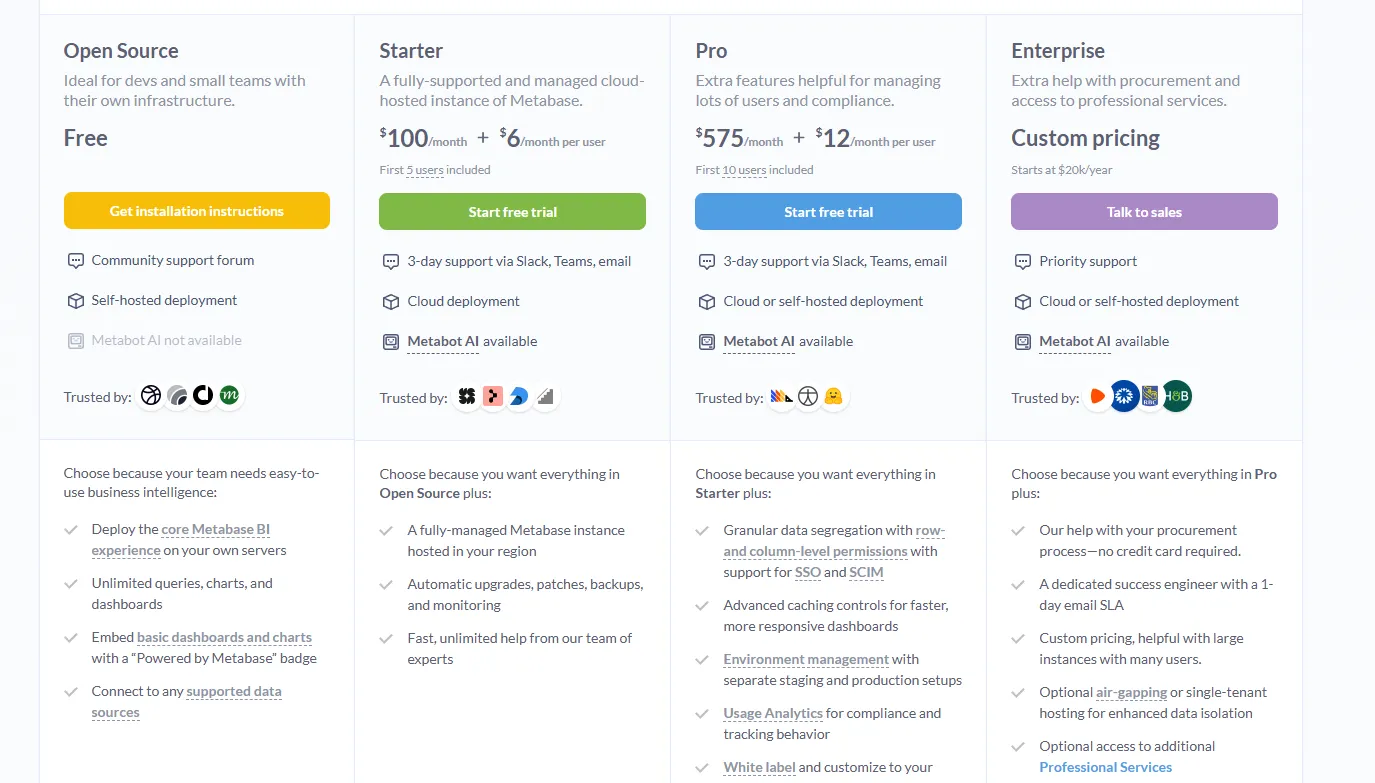
- Open Source (Self-hosted): Free, self-hosted deployment, includes unlimited queries, charts, and dashboards, connects to all supported data sources, basic embedding with “Powered by Metabase” branding, community support only.
- Starter (Cloud-hosted): $100/month + $6/user/month, first 5 users included, includes everything in Open Source, plus option to include Metabot AI (charged extra), automatic upgrades, backups, and monitoring, support via Slack, Teams, and email (3-day SLA).
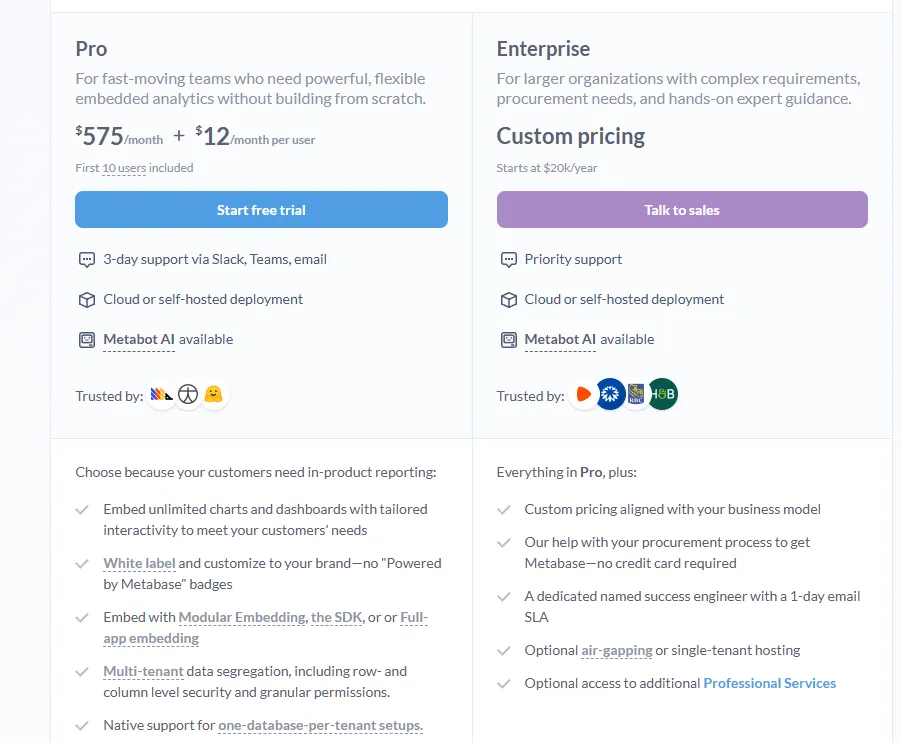
- Pro: $575/month + $12/user/month, first 10 users included, cloud or self-hosted deployment, includes everything in Starter, plus row- and column-level permissions, SSO and SCIM support, advanced caching and performance controls, staging + production environments, usage analytics and audit visibility, white-labeling, and embedded analytics capabilities.
- Enterprise: Custom pricing (starts at $20k/year), includes everything in Pro, plus priority support, dedicated success engineer (1-day email SLA), optional single-tenant or air-gapped deployment, and optional professional services.
- Embedded Analytics pricing:
- Pro: $575/month + $12/user/month, first 10 users included, includes unlimited embedded dashboards and charts, full white-labeling, modular embedding, SDK, or full-app embedding, multi-tenant security (row- and column-level), one-database-per-tenant support, staging + production environments, usage analytics, internal BI for your team, and option to include Metabot AI (charged extra).
- Enterprise: Custom pricing (starts at $20k/year), includes everything in Pro, plus a dedicated success engineer, priority support, optional single-tenant or air-gapped hosting, and optional professional services.
Metabase Pros and Cons
✅ Intuitive UI that lets non-technical users build dashboards without SQL.
✅ Cost-effective open-source option with solid scheduling and sharing features.
❌ Limited advanced visualizations (no native heatmaps, fewer complex chart options).
❌ Falls short for teams that need advanced calculations, deep data modeling, or enterprise-grade governance and security controls.
#10: Microsoft Power BI
Best for: Organizations already invested in the Microsoft ecosystem that want standardized dashboards, reporting, and self-service analytics at scale.
Similar to: Tableau, Qlik Sense.
Power BI is a traditional business intelligence platform built around interactive dashboards, predefined data models, and visual reporting across structured data sources.
It's a fundamentally different tool from Vanna AI in that it focuses on broad organizational reporting and governed dashboard delivery rather than developer-facing text-to-SQL, but teams often evaluate both when looking for a way to get business users closer to data.
Microsoft Power BI's Top Features
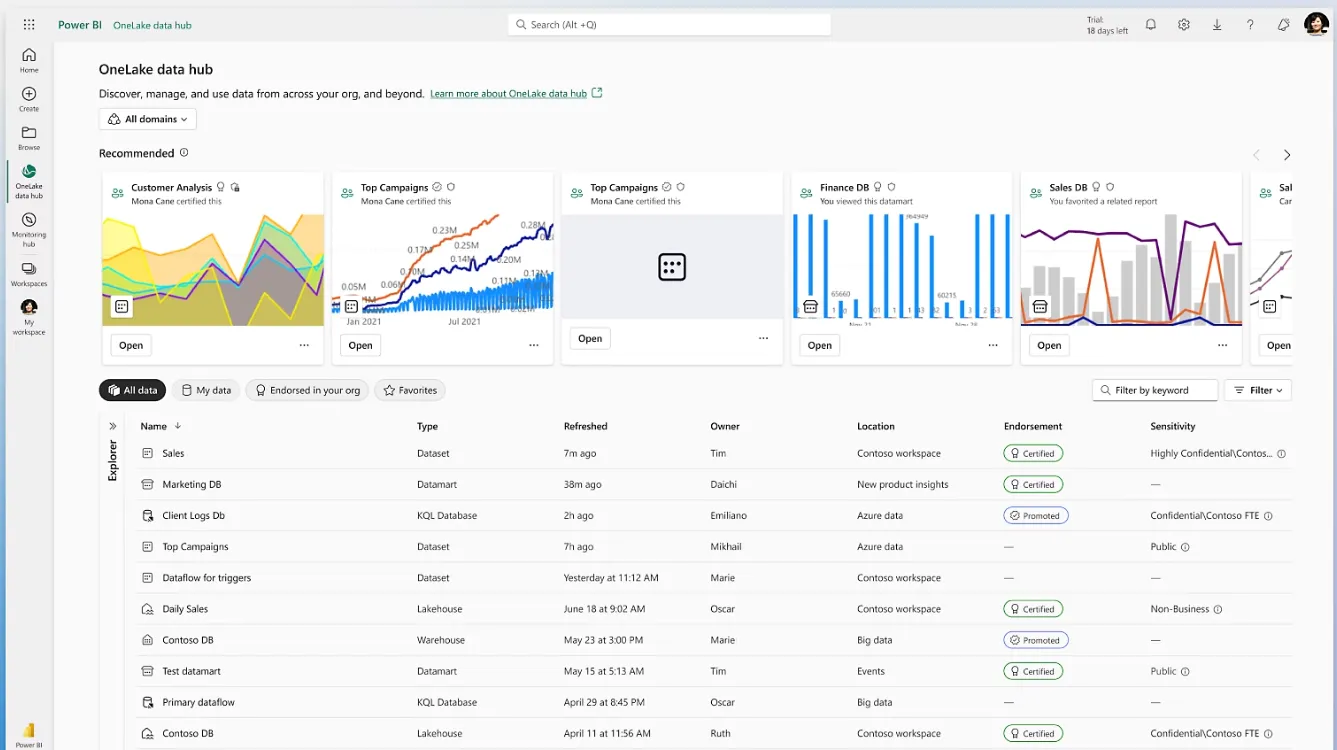
- Visual dashboards with deep drill-downs: Combine multiple chart types, filters, slicers, and cross-report drill-throughs in interactive dashboards that let teams explore data across departments and business units.
- Enterprise-grade access controls: Row-level security, data sensitivity labels, role-based access, and Microsoft Entra ID integration give organizations fine-grained control over who sees what, which matters in regulated industries.
- AI features including Copilot: Built-in tools for anomaly detection, forecasting, quick insights, and natural-language interaction through Copilot help surface trends without requiring users to build every analysis manually.
Microsoft Power BI Pricing
Power BI uses per-user pricing with a capacity-based option for larger deployments:
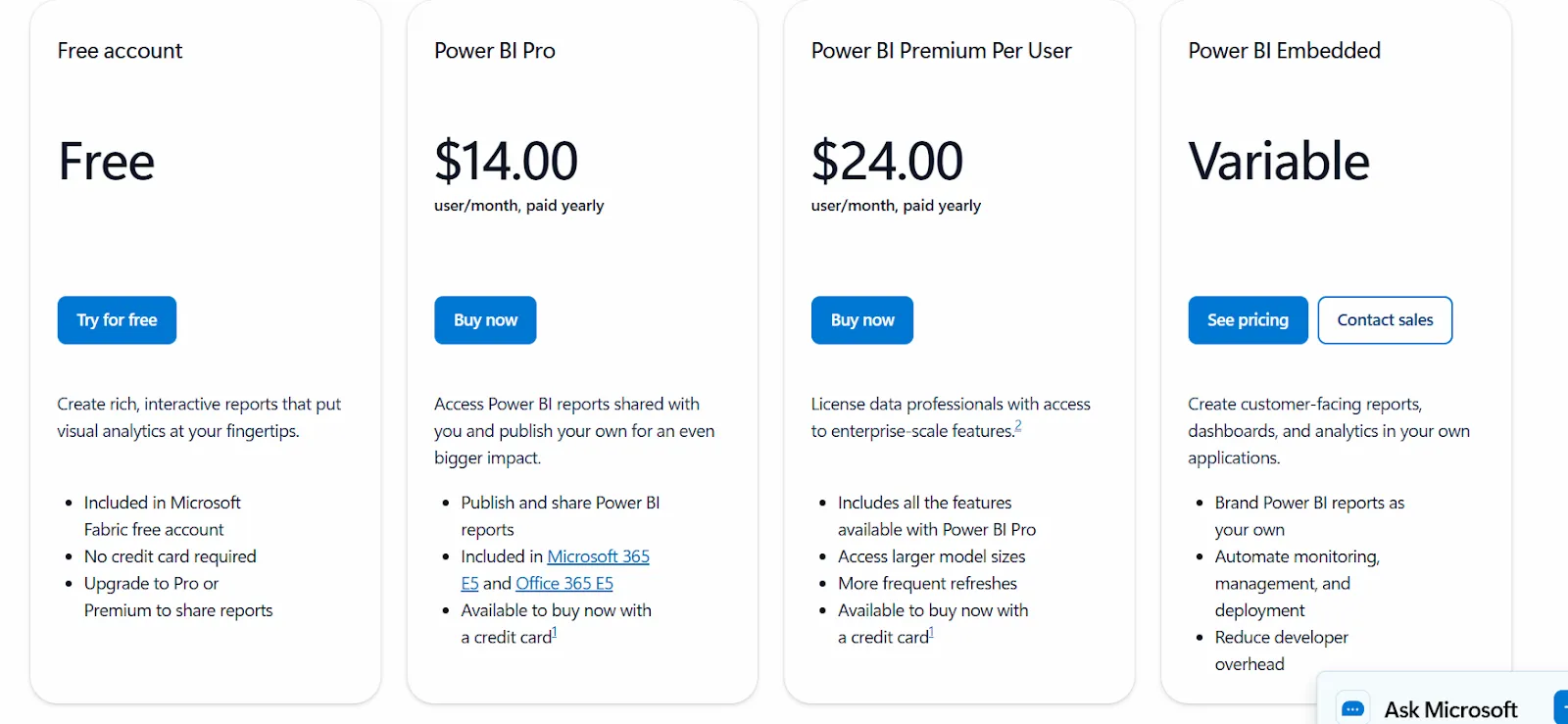
- Free: For individual users only, covering personal report building and dashboard creation with no sharing or collaboration.
- Pro: $14/user/month for report publishing, dashboard sharing, workspace collaboration, and embedding into Teams and SharePoint.
- Premium Per User: $24/user/month, adding larger data models, faster refresh cycles, paginated reports, and advanced AI features.
- Embedded: Custom pricing for organizations that want to build customer-facing analytics into their own applications.
Microsoft Power BI Pros & Cons
✅ The most affordable per-user pricing of any enterprise BI tool on this list.
✅ Deep integration with Excel, Teams, and the Microsoft ecosystem reduces adoption friction.
❌ Steep learning curve once you move into DAX formulas, data modeling, and advanced report optimization.
❌ Performance slows noticeably with large datasets and complex visuals.
Get Started With Dot For Free Today
Vanna AI does what it's designed to do: it turns natural language into SQL queries for developers who want an open-source framework to build on.
But most teams looking for alternatives aren't searching for another text-to-SQL tool.
They want faster answers, clearer reporting, and fewer bottlenecks between data and decisions.
The other alternatives on this list each handle a piece of that puzzle.
ThoughtSpot and Tellius cover AI-powered enterprise analytics with natural language search and explainable insights.
Supaboard and Zenlytic offer governed, conversational analytics that remove the need for SQL entirely.
And Metabase gives lean teams a free, open-source starting point for self-serve dashboards.
Dot takes a different approach entirely.
Instead of asking your team to build dashboards, train models, or interpret raw SQL, Dot does the analytical thinking for you.
You ask a question, and Dot investigates the data, explains what changed and why, delivers a narrative with recommendations, and shows its work with a full audit trail.
No training required. No SQL to read. No dashboards to maintain.
If your reporting still takes hours every week, or decisions stall because insights don't come fast enough, Dot is worth a look.
Here's what you get when you try Dot:
- Access to a free plan with 300 one-time credits and full access to Pro features, including chat-based analysis and the full model and evaluation workflow.
- Automated executive business review reports delivered on your schedule, directly from your warehouse.
- Ad-hoc analysis through Slack, Microsoft Teams, email, or the web app so insights show up where decisions happen.
- A Context Agent that maintains shared business definitions and prevents metric drift across teams.
- Full audit trail on every insight, with transparent links to underlying SQL, Python logic, and datasets.
Sign up for Dot's free plan to test the waters, or book a demo to see how teams replace manual reporting with automated, decision-ready insights.
Theo Tortorici
Theo writes about AI-powered analytics, data tools, and the future of business intelligence at Dot.