
What OpenAI's Data Agent Teaches Us (2026)
OpenAI says "less is more." Then they built a six-layer context system.
OpenAI published a deep dive into their internal data agent, shortly after Vercel revealed d0. Two very different approaches. And inside OpenAI's lessons hides a contradiction worth unpacking.
The Setup
OpenAI's data platform serves 3,500 internal users across 600 petabytes and 70,000 datasets. At that scale, finding the right table is the hard part. One internal user: "We have a lot of tables that are fairly similar, and I spend tons of time trying to figure out how they're different and which to use."
That is the universal data problem. Not too little data. Too much of it, with too little context.
Their solution: a GPT-5.2-powered agent available in Slack, web interfaces, IDEs, and inside ChatGPT via MCP connectors.
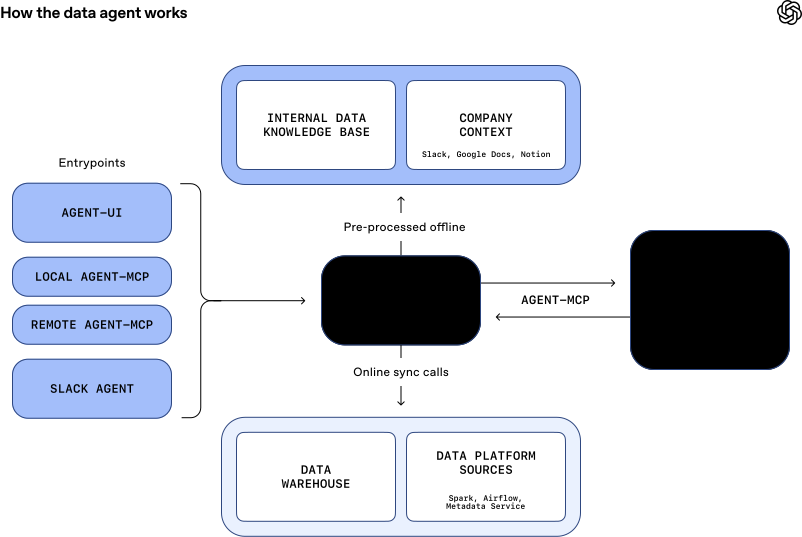
OpenAI's data agent architecture
Two Companies, Two Philosophies
Vercel deleted everything. They stripped d0 from 11 specialized tools down to two: file operations and bash. The model navigates their semantic layer with grep, cat, and ls. Success rate jumped from 80% to 100%, and answers got 3.5x faster. The full d0 case study has the details.
OpenAI built more infrastructure. Six layers of context:
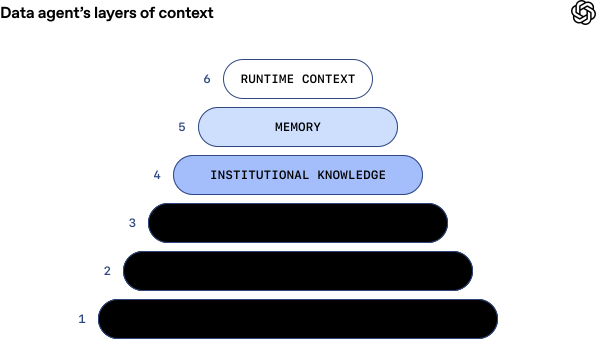
The six layers of context in OpenAI's data agent
Both claim success. Both state the same first lesson. So what is going on?
The Paradox Resolved
OpenAI's lesson #1 is literally titled "Less is More." They write: "Early on, we exposed our full tool set to the agent, and quickly ran into problems with overlapping functionality... To reduce ambiguity and improve reliability, we restricted and consolidated certain tool calls."
That sounds exactly like Vercel. But OpenAI still built six layers. The difference: the "less" is not about system complexity. It is about decision surface. Both companies reduced the number of choices their agent makes at runtime. They just did it differently:
- Vercel deleted nine of eleven tools and let the model reason over the semantic layer with file operations and bash
- OpenAI restricted and consolidated overlapping tool calls, pre-computing context across six layers so the agent chooses less at runtime
Same principle, different implementations. Do not make your agent think about things it should not have to think about.
Context and Architecture Are Connected
The amount of context you provide decides how complex your agent needs to be.
Vercel gets away with a minimal agent because their semantic layer is complete. Every entity has a YAML file with descriptions, sample values, join relationships, and example questions. When context is that rich, the agent figures out the rest with basic tools.
OpenAI has 70,000 datasets, so no single semantic layer can cover everything. They built systems that synthesize context on demand: crawling code with Codex, searching Slack and docs, remembering past corrections.
Their lesson #3: "Meaning Lives in Code." Schemas describe shape. Query history describes usage. The true semantics live in the pipelines that produce the data.
The takeaway: assess your context quality first. Sparse documentation needs smarter infrastructure. A complete semantic layer lets the agent stay simple.
What About Speed?
One OpenAI screenshot shows "Worked for 6m 7s." Vercel's d0 averages 77 seconds after optimization. These tools are built for depth, and for a multi-step analysis that would take a human hours, minutes are acceptable.
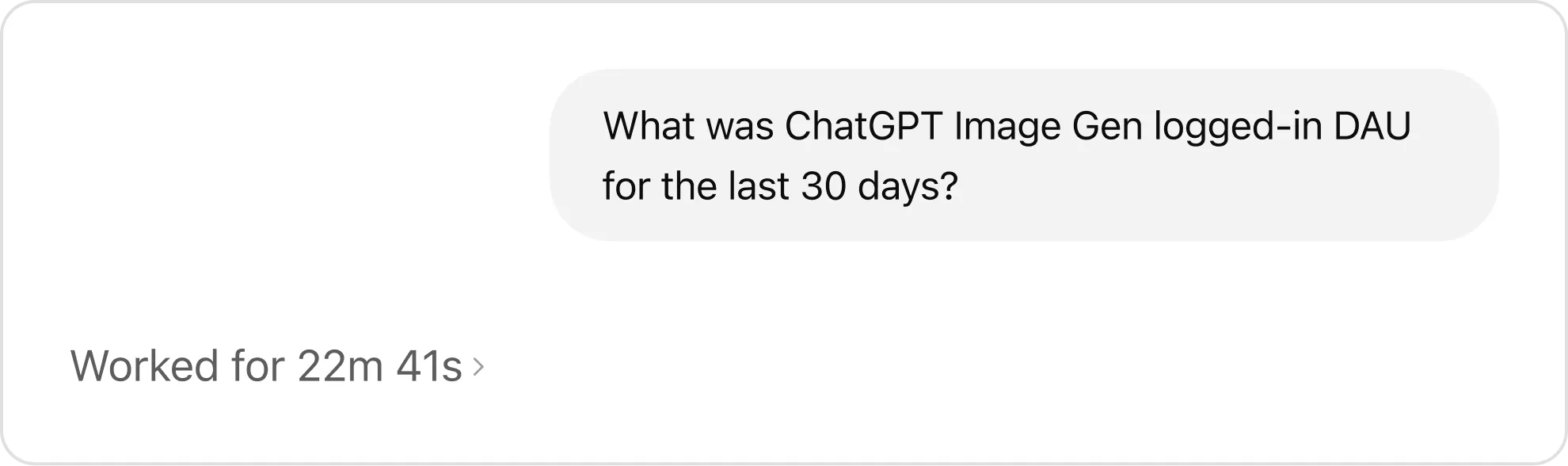
OpenAI's agent can take minutes to complete complex analyses
But most data questions are not that deep. When a sales leader asks for last quarter's revenue, six minutes is a non-starter. At Dot we see 80% of questions answered in under 20 seconds once the right context is in place. The deep 20% can take minutes. The default should be fast.
Evals: The Unsexy Foundation
OpenAI continuously tests the agent against curated question-answer pairs. Each question has a golden SQL query. The system runs both queries and compares the results, then grades with a score and an explanation. That is how you catch quality drift. A change that improves one query type can break three others. DoorDash runs similar LLM-as-judge evaluation.
We built the same into Dot. Customers create test questions with expected SQL, and the system grades answers with similarity matching and tracks pass rates. Not glamorous. It is the foundation everything else stands on.
The Real Lesson
1. Shrink the agent's decision surface. Minimal tools like Vercel, or pre-computed context like OpenAI. Either way, less to figure out at runtime.
2. Invest in context proportional to your scale. Small warehouse with great docs: keep it simple. Thousands of tables across many systems: build the infrastructure.
3. Measure relentlessly. LinkedIn's experience shows why the right metric matters: 53% technical accuracy, yet 95% of users rate the answers passing or better. If you are not measuring, you are guessing.
4. Match the tool to the task. Six-minute deep dives have their place. So do 20-second answers. Build for how your team actually works.
If this excites you, we'd love to hear from you. Get in touch.
Rick Radewagen
Rick is a co-founder of Dot, on a mission to make data accessible to everyone. When he's not building AI-powered analytics, you'll find him obsessing over well-arranged pixels and surprising himself by learning new languages.